
NEW YORK: The UN General Assembly on Wednesday held an emergency session to mark the Feb. 24 anniversary of the start of the war on Ukraine, with Kyiv and its supporters hoping to garner broad support for a resolution underscoring the need “to reach (a) comprehensible, just and lasting peace” in line with the UN Charter.
The draft resolution, sponsored by some 60 countries, calls for an immediate cessation of hostilities and for Russia to “immediately, completely and unconditionally” withdraw its military forces from Ukraine. The vote will likely take place on Thursday after speeches by representatives from more than 80 countries.
The text, which unlike a Security Council resolution does not have the binding force of international law but which could deepen Russia’s isolation on the world stage, reaffirms the UN’s “commitment to the sovereignty, independence, unity and territorial integrity of Ukraine” and calls for an immediate cessation of hostilities.
Kyiv hopes to garner the support of at least as many nations as it did in 2022, when nearly three quarters of the General Assembly voted for several resolutions condemning Russia.
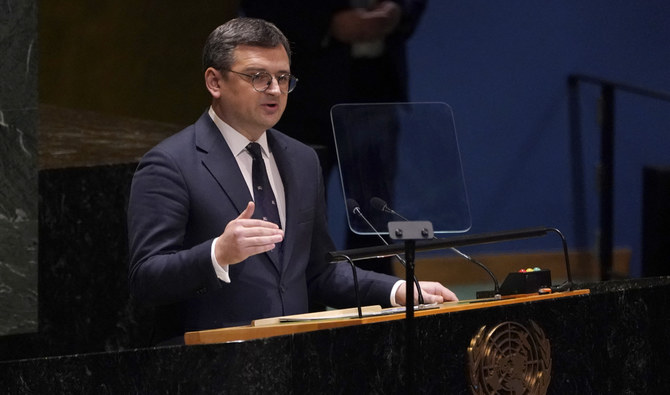
In his remarks to the 193-member Assembly, Ukraine’s Foreign Minister Dmytro Kuleba called on the UN to support the resolution, which “will contribute to our joint efforts to bring the war to an end as well as protect the fundamental principles of international law and the UN Charter.”
Kuleba said that the world, by committing to safeguard the territorial integrity of Ukraine, would send a “strong and clear” message to Russia and discourage it from attacking other territories.
He said that his country has no choice but to keep fighting for its survival “as any of you would do,” adding that the current situation on the frontlines proves Russians “want war, not peace. They are on the attack all along the front line, from the Dnipro River to the Russian border.”
For those countries who have not explicitly expressed support for Ukraine, the foreign minister called on them to stop hiding behind “the mask of neutrality” and choose the side of the UN Charter and international law.
“Never in recent history has the line between good and evil been so clear. One country merely wants to live. The other wants to kill and destroy.”
That is the reason why, Kuleba said, calls to cease arms delivery to Ukraine are “badly misplaced.”
“It’s perfectly legitimate to help a nation that has been attacked and is justifiably defending itself. It is an act of defense of the UN Charter act. It is an act in favor of ending the war sooner and achieving a lasting and just peace.
“On the contrary, it is illegal and against the Charter to give military help to the aggressor. It is an act of war escalation and prolongation of atrocities, destruction and sufferings.”
Vassily Nebenzia, Russia’s permanent representative to the UN, has called on the General Assembly to vote against the “anti-Russia” draft resolution. Doing otherwise would encourage the West to continue “their militaristic Russophobic lies using the support of UN member states as a cover.”
The Russian envoy said that one year on, member states are much better informed and it has become more difficult for the “Western camp to mobilize members states of the UN in support of their crusade against Russia.”
Throughout the past year, Nebenzia said, “it became obvious that the main element of anti-Russia propaganda campaign conducted by our former Western partners” consists of accusing Russia of waging an unprovoked aggression on Ukraine guided by imperial ambitions, while turning a blind eye to what he called “the resurging new Nazism” in Ukraine.
“It’s becoming very clear that the Ukrainian crisis has only become a catalyst for the visceral Russophobia to come to the surface. It has now contaminated the American and European elites. They’re competing against each other, in the number of sanctions that are imposed on my country.”
He said that sanctions imposed against Russia are hurting the developing world the most, and “what is at stake after all is the United States and its allies’ hegemony. They don’t want to have anyone come to the level of governing the planet. They think it’s their turf.”
Josep Borrell, EU high representative for foreign affairs, said that the world needs peace in Ukraine, “But not just any peace. We need a peace grounded in the principles of the UN Charter.”
He said the resolution, drafted by the EU, is there to “reiterate our support for Ukraine and to set out the principles for peace.
“I want to stress: this is not ‘a European issue’.” Nor is it about “the West versus Russia,” he said. “No, this illegal war concerns everyone: the North, the South, the East and the West.”
He told the assembly that failure to condemn Russia and stop its actions in Ukraine will lead to similar aggressions elsewhere in the world.
Borrell said that Ukraine has the right to defend itself, and until Russia ends hostilities and withdraw its forces from Ukraine “the EU will continue to give Ukraine the support it needs to defend its population.”
UN Secretary-General Antonio Guterres described the Russian war as “an affront to our collective conscience (and a) violation of the United Nations Charter and international law (that) is having dramatic humanitarian and human rights consequences.”
He said that the impact of the war is being felt “far beyond Ukraine.”
“As I said from day one, Russia’s attack on Ukraine challenges the cornerstone principles and values of our multilateral system.”
Quoting directly from the Charter, Guterres said: “All Members shall refrain in their international relations from the threat or use of force against the territorial integrity or political independence of any state, or in any other manner inconsistent with the Purposes of the United Nations.”
Guterres said that the war is “fanning regional instability and fueling global tensions and divisions, while diverting attention and resources from other crises and pressing global issues.”
Implicit threats to use nuclear weapons is “utterly unacceptable,” said the UN chief.
“It is high time to step back from the brink.”