Top Afghan, Pakistani officials meet in Kabul amid strained relations, security concerns

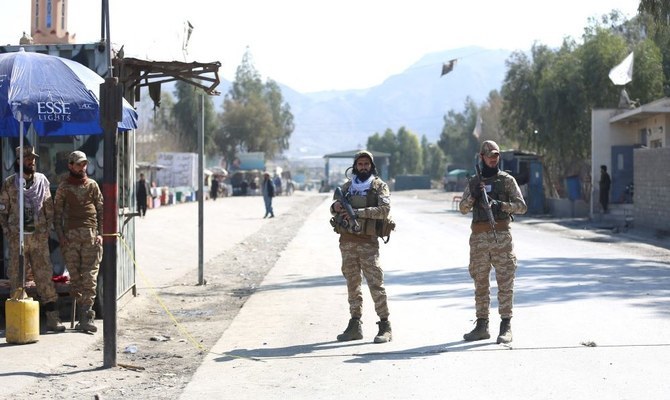
Reports of authorities exchanging gunfire surfaced on Feb. 20, 2023 after Afghan authorities closed the crossing at Torkham a day earlier over Pakistan’s alleged refusal to facilitate trade transport and Afghan patients going to the neighboring country for treatment. (AFP)
Short Url
Updated 23 February 2023
Follow

Top Afghan, Pakistani officials meet in Kabul amid strained relations, security concerns

  • Afghan authorities closed main border crossing point at Torkham on Sunday
  • Since November, Pakistan has witnessed a surge in militant attacks

KABUL: Top officials from Afghanistan’s Taliban government met with Pakistan’s defense minister and spy chief in Kabul on Wednesday, days after the main border crossing was closed and as Islamabad faces a growing security threat.
Reports of authorities exchanging gunfire surfaced on Monday after Afghan authorities closed the crossing at Torkham a day earlier over Pakistan’s alleged refusal to facilitate trade transport and Afghan patients going to the neighboring country for treatment.
Skirmishes have occurred along the Afghan-Pakistan border for years and in recent months have resulted in many civilian casualties with both Kabul and Islamabad blaming each other for the violence.
Afghanistan’s Defense Minister Mullah Mohammed Yaqoob and Deputy Prime Minister for Economic Affairs Mullah Abdul Ghani Baradar Akhund held talks with the high-ranking Pakistani delegation in the Afghan capital on Wednesday, said Taliban spokesman Zabihullah Mujahid.
“The two sides discussed issues on the ground, particularly the crossing points with Pakistan,” Mujahid told Arab News.
The Pakistani delegation was led by Defense Minister Khawaja Mohammed Asif and Nadeem Anjum, head of the Inter-Services Intelligence agency.
“God willing, a solution will be found for the difficulties,” he said.
“The Pakistani delegation was assured that no one will create a threat to Pakistan and the Pakistani side should too give attention to Afghan security until the economic and political relations of the two nations can be strengthened.”
In a statement issued by his office, Abdul Ghani Baradar said Pakistan and Afghanistan “are neighbors and should get along well.”
“Political and security concerns should not affect business or economic matters,” the statement read.
The Taliban official also called for the release of Afghans detained in Pakistan and urged for the facilitation of passengers and patients crossing at Torkham and Spin Boldak during Wednesday’s meeting, and assurances were given that the Pakistani side will work on the issues.
Pakistan’s foreign ministry said in a statement that discussions touched on “security-related matters including counter terrorism measures.”
Since November last year, Pakistan has witnessed a surge in militant attacks after the Pakistani Taliban — the outlawed Tehreek-e-Taliban Pakistan or TTP — ended a months-long cease-fire with the government. The TTP is a separate militant group that openly pledged allegiance to the Afghan Taliban after the fall of Kabul in 2021.
Security issues were a priority for the Pakistani delegation’s visit to Kabul.
“Very clearly, the Pakistani delegation is there in Kabul because of security concerns,” Kaswar Klasra, editor in chief of the Islamabad Telegraph, told Arab News.
“The TTP has become a very great threat to Pakistan’s existence,” he said. “Pakistan is seeking the Taliban’s government help to stop TTP from attacking targets in Pakistan, and this is the core agenda of the Pakistani delegation.”
Since the Taliban takeover, Pakistan has allowed critically ill or injured Afghans to enter the country for medical treatment, though, like many other countries, it still does not recognize Afghanistan’s Taliban government.


Blacklisted naphtha tanker from Russia enters Venezuelan waters while another diverts, ship data shows

Updated 4 sec ago
Follow

Blacklisted naphtha tanker from Russia enters Venezuelan waters while another diverts, ship data shows

  • Under U.S. sanctions related to Russia, the ship has a different sanctions profile than Skipper, the tanker that was seized by the U.S. on December 10

HOUSTON: A tanker subject to U.S. sanctions carrying some 300,000 barrels of naphtha from Russia entered Venezuelan waters late ​on Thursday, while another began redirecting course in the Atlantic Ocean, ship tracking data showed, a reflection of diverging last-minute decisions by ship owners after President Donald Trump ordered a "blockade" of oil tankers under sanctions bound for the OPEC country earlier this week.
The move ramped up pressure on Venezuelan president Nicolas Maduro by targeting the country's main source of income and followed the seizure by the U.S. of an oil tanker off the coast of Venezuela earlier in December.
Vessels that were not subject to sanctions began setting sail on Wednesday from Venezuelan waters after a week's pause, helping drain the country's mounting crude stocks.
Gambia-flagged medium tanker Hyperion docked on Friday at Amuay ‌Bay on Venezuela's ‌western coast, according to LSEG ship tracking data. It loaded near ‌Murmansk ⁠in ​Russia in ‌late November.
Under U.S. sanctions related to Russia, the ship has a different sanctions profile than Skipper, the tanker that was seized by the U.S. on December 10.
The U.S. can only seize vessels outside of its jurisdiction, or vessels that aren't heading to or from the country, if Washington has placed them under sanctions for links to groups it designates as terrorist, said David Tannenbaum, a director at consulting firm Blackstone Compliance Services that specializes in sanctions and anti-money laundering compliance.
Skipper, formerly called the Adisa, was under sanctions for what the U.S. says was involvement in Iranian oil trading that generated ⁠revenue for Iranian groups it has designated as foreign terrorist organizations.
With the Hyperion, though, sanctions were imposed to reduce Russian revenues from energy because of ‌its war with Ukraine.
"The Hyperion doesn't have known ties to ‍terrorism, and therefore unless they can prove it's subject ‍to the jurisdiction of the U.S., Washington can't grab it extraterritorially," said Tannenbaum, who previously worked with the ‍U.S. Treasury's Office of Foreign Assets Control that administers and enforces economic and trade sanctions.

REDIRECTS AND U-TURNS
The Angola-flagged Agate, another medium tanker under sanctions that loaded in Russia and had been sailing toward the Caribbean, was seen redirecting on Friday, according to LSEG ship tracking. The vessel was pointing towards Africa, but had not yet signaled a new destination.
Oman-flagged Garnet, also under sanctions ​and loaded in Russia, continued on its track, signaling the Caribbean as its destination on Friday.
Benin-flagged tanker Boltaris, under sanctions and carrying some 300,000 barrels of Russian naphtha bound for Venezuela, made ⁠a U-turn earlier this month and was heading for Europe without having discharged, according to LSEG vessel monitoring data.
Two very large crude carriers not subject to sanctions set sail for China on Thursday from Venezuela, according to sources familiar with Venezuela's oil export operations, marking only the second and third tankers unrelated to Chevron to depart the country since the U.S. seized Skipper.
The American oil major, which has continued to ship Venezuelan crude under a U.S. authorization, exported a crude cargo on Thursday bound for the U.S., LSEG data showed.
Secretary of State Marco Rubio on Friday said the U.S. was not concerned about the four vessels that sailed from Venezuela on Thursday, as those were not ships under sanctions.
"Sanctioned boats, we have the capabilities necessary to enforce our laws. We'll have a judicial order, we'll execute on those orders and there's nothing that will impede us from being able to do that," Rubio said.
Venezuela's government ‌called Trump's blockade a "grotesque threat" in a statement on Tuesday, saying it violates international law, free commerce and the right of free navigation.