

Saudi Arabia unveils 27 projects to boost water desalination in Asir region

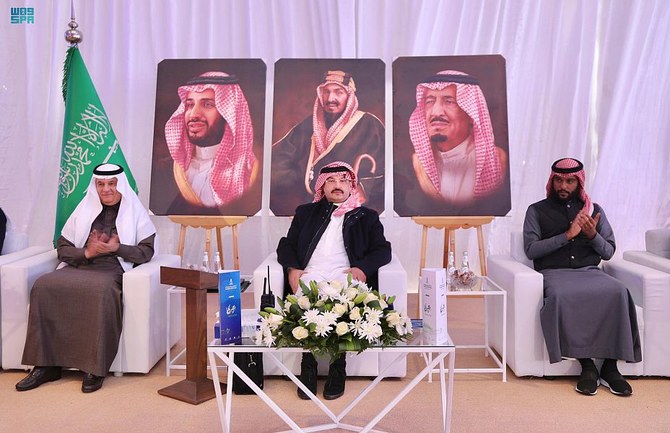
During the inauguration, the governor recognized the efforts of Abdul Rahman Al-Fadhli, the minister of environment, water, and agriculture, for ideating these projects (SPA)
Short Url
Updated 21 February 2023
Follow

Saudi Arabia unveils 27 projects to boost water desalination in Asir region

RIYADH: In a move to boost the water supply to wider parts of the country, Saudi Arabia has unveiled 27 development projects worth SR4 billion ($1.07 billion) in the Asir region that will serve about 160,000 new beneficiaries.  

Inaugurated by Asir Gov. Prince Turki bin Abdulaziz, the projects are aimed at developing the drinking water system, securing the supply, and expanding the availability of services in the region.  

The schemes will also enable water and environmental sustainability in the Asir region in accordance with the Kingdom's Vision 2030.  

During the inauguration, the governor recognized the efforts of Abdul Rahman Al-Fadhli, the minister of environment, water, and agriculture, for ideating these projects.  

The Asir governor was briefed about the ministry’s efforts to enhance the operational capacity of projects, prepare new environment systems, and sustain natural resources.  

In addition, it was highlighted that the ministry enhanced the protection of vegetation covers, as well as expanded the rehabilitation and development of national parks.  

Al-Fadhli said the Saline Water Conversion Corp. has built a water transmission system to support strategic projects and enhance the security of desalinated water supplies.

The minister noted that the SWCC developed the water transmission system of the Abha urban feeding line, with a total cost of more than SR1.35 billion.

This will transport water from the preserved reservoirs in the city of Abha to the east of Khamis Mushayt.  

With a length of 57 kilometers and a transport capacity of 375,000 cubic meters per day, it will be able to feed the two cities through seven branches.  

Al-Fadhli added that the SWCC also established the third phase of the Shuqaiq-Abha water transmission system, worth over SR2 billion.  

This scheme includes pipes stretching a length of 137 km and will enhance the water supply in the city of Abha, governorates, and centers associated with its water system.  

In addition, the National Water Co. has implemented 21 water and environmental projects at a cost of more than SR535 million.  

These projects are expected to strengthen the drinking water distribution system and manage the demand in the Asir region.  

To achieve full utilization of water and its reuse, the water company implemented a project to deliver recycled water to Yala National Park in the Bisha governorate.  

This was done through the implementation of irrigation networks with lengths of more than 1.33 million meters, and at a cost that exceeded SR12 million.  

The ministry also implemented a concrete dam in Wadi Yabah in Bariq governorate, at a cost of more than SR121 million, to maximize the benefit of rainwater harvesting and enhance surface water sources.  

Another project implemented by the National Center for Vegetation Development and Combating Desertification is to increase the vegetation cover in Bisha. The scheme was executed by planting more than 150,000 trees, at a cost of over SR6 million.  

Al-Fadhli said they ensured that these projects were implemented in accordance with best practices and technical expertise in Saudi Arabia.  


First EU–Saudi roundtable on critical raw materials reflects shared policy commitment

Updated 16 January 2026
Follow

First EU–Saudi roundtable on critical raw materials reflects shared policy commitment

RIYADH: The EU–Saudi Arabia Business and Investment Dialogue on Advancing Critical Raw Materials Value Chains, held in Riyadh as part of the Future Minerals Forum, brought together senior policymakers, industry leaders, and investors to advance strategic cooperation across critical raw materials value chains.

Organized under a Team Europe approach by the EU–GCC Cooperation on Green Transition Project, in coordination with the EU Delegation to Saudi Arabia, the European Chamber of Commerce in the Kingdom and in close cooperation with FMF, the dialogue provided a high-level platform to explore European actions under the EU Critical Raw Materials Act and ResourceEU alongside the Kingdom’s aspirations for minerals, industrial, and investment priorities.

This is in line with Saudi Vision 2030 and broader regional ambitions across the GCC, MENA, and Africa.

ResourceEU is the EU’s new strategic action plan, launched in late 2025, to secure a reliable supply of critical raw materials like lithium, rare earths, and cobalt, reducing dependency on single suppliers, such as China, by boosting domestic extraction, processing, recycling, stockpiling, and strategic partnerships with resource-rich nations.

The first ever EU–Saudi roundtable on critical raw materials was opened by the bloc’s Ambassador to the Kingdom, Christophe Farnaud, together with Saudi Deputy Minister for Mining Development Turki Al-Babtain, turning policy alignment into concrete cooperation.

Farnaud underlined the central role of international cooperation in the implementation of the EU’s critical raw materials policy framework.

“As the European Union advances the implementation of its Critical Raw Materials policy, international cooperation is indispensable to building secure, diversified, and sustainable value chains. Saudi Arabia is a key partner in this effort. This dialogue reflects our shared commitment to translate policy alignment into concrete business and investment cooperation that supports the green and digital transitions,” said the ambassador.

Discussions focused on strengthening resilient, diversified, and responsible CRM supply chains that are essential to the green and digital transitions.

Participants explored concrete opportunities for EU–Saudi cooperation across the full value chain, including exploration, mining, and processing and refining, as well as recycling, downstream manufacturing, and the mobilization of private investment and sustainable finance, underpinned by high environmental, social, and governance standards.

From the Saudi side, the dialogue was framed as a key contribution to the Kingdom’s industrial transformation and long-term economic diversification agenda under Vision 2030, with a strong focus on responsible resource development and global market integration.

“Developing globally competitive mineral hubs and sustainable value chains is a central pillar of Saudi Vision 2030 and the Kingdom’s industrial transformation. Our engagement with the European Union through this dialogue to strengthen upstream and downstream integration, attract high-quality investment, and advance responsible mining and processing. Enhanced cooperation with the EU, capitalizing on the demand dynamics of the EU Critical Raw Materials Act, will be key to delivering long-term value for both sides,” said Al-Babtain.

Valere Moutarlier, deputy director-general for European industry decarbonization, and directorate-general for the internal market, industry, entrepreneurship and SMEs at European Commission, said the EU Critical Raw Materials Act and ResourceEU provided a clear framework to strengthen Europe’s resilience while deepening its cooperation with international partners.

“Cooperation with Saudi Arabia is essential to advancing secure, sustainable, and diversified critical raw materials value chains. Dialogues such as this play a key role in translating policy ambitions into concrete industrial and investment cooperation,” she added.