


UNITED NATIONS: The United States and its allies urged the UN Security Council on Monday to condemn North Korea’s unlawful ballistic missile launches, but China and Russia blamed the US for escalating tensions with stepped-up military exercises targeting Pyongyang.
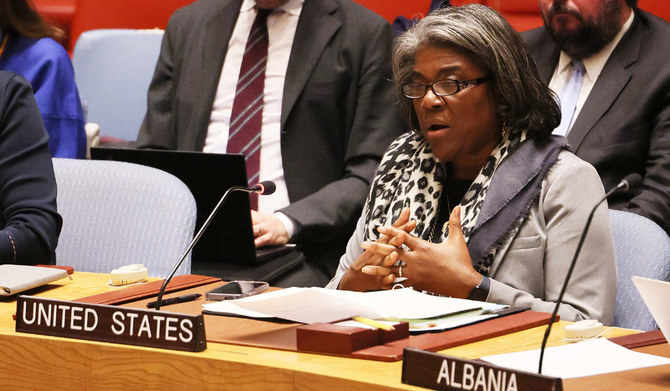
At the emergency meeting, US Ambassador Linda Thomas-Greenfield told the council that the United States will propose a presidential statement, saying at a minimum all 15 members should be agreeable to condemning the North’s unprecedented missile launches, to urging Pyongyang to comply with UN Security Council sanctions resolutions, and “to engage in meaningful dialogue.”
A presidential statement from the Security Council requires the support of all its members, including North Korea’s closest allies, China and Russia.
Thomas-Greenfield said the United States condemns North Korea’s firing of two short-range ballistic missiles Monday following the launch of an intercontinental ballistic missile Saturday “in the strongest terms” as “flagrant violations” of the council’s ban on the country’s ballistic missile launches.
The launches and North Korea’s threatening rhetoric are undermining international peace and security, Thomas-Greenfield said.
And she warned the council that its silence and failure to condemn the North’s missile activities “leads to irrelevance.”
But Pyongyang’s allies China and Russia countered that what’s needed now is dialogue between North Korea and the Biden administration, a de-escalation of military exercises, an easing of sanctions on North Korea, and approval of a resolution they circulated in November 2021 aimed at resolving the situation on the Korean Peninsula.
That resolution urges the Security Council to end a host of sanctions against North Korea and calls on the US and North Korea to resume dialogue and consider taking steps to reduce tensions and the risk of military confrontation including by adopting a declaration or peace treaty formally ending the 1950-53 Korean War. The war ended with an armistice, leaving the peninsula technically in a state of war.
China’s Deputy UN Ambassador Dai Bing said joint US-South Korean military exercises “on a higher level and a bigger scale,” the deployment of US strategic assets, and NATO Secretary General Jens Stoltenberg’s high-profile visit to Seoul and Tokyo two weeks ago, are “”highly provocative” to the Democratic People’s Republic of Korea, “and aggravate a sense of insecurity.”
“Since the US has repeatedly expressed its willingness to unconditionally engage in dialogue with the DPRK, it should take tangible steps to start and maintain a dialogue,” he said. “Exclusively pursuing and piling on sanctions will only lead to a dead end.”
Russia’s deputy ambassador Dmitry Polyansky told the council North Korea is responding with missile tests to “the unprecedented military maneuvers in the region under the United States umbrella which are clearly anti-Pyongyang in nature.”
Japan’s UN Ambassador Kimihiro Ishikane, whose country called the emergency meeting, told the council that Saturday’s ICBM fell in the Japan’s exclusive economic zone just 200 kilometers (124 miles) from Hokkaido, where people could see it falling from the sky.
“I assume we can all imagine how terrifying it must have been to see a missile flying to you,” he said, stressing that it endangered vessels and aircraft and was “an act of intimidation and threatening by force.”
To those who contend that Security Council meetings provoke North Korea “and hence we should remain silent,” Ishikane retorted that remaining silent “will only encourage rule-breakers to write the playbook as they like.”
After the council meeting, Thomas-Greenfield, read a statement on behalf of 10 council nations and South Korea, surrounded by their ambassadors, strongly condemning the latest missile launches and urging the other five council nations to join in condemning “the DPRK’s irresponsible behavior.”
The 11 countries — Albania, Ecuador, France, Japan, Malta, Mozambique, Switzerland, United Arab Emirates, United Kingdom, US and South Korea — “remain fully committed to diplomacy and continue to call on the DPRK to return to dialogue,” the statement said.
“But we will not stay silent as the DPRK advances its unlawful nuclear and missile capabilities, threatening international peace and security,” their statement said.


