

UN chief ‘strongly condemns’ North Korea missile launches as Pyongyang threatens to turn Pacific Ocean into ‘firing range’

1 / 3
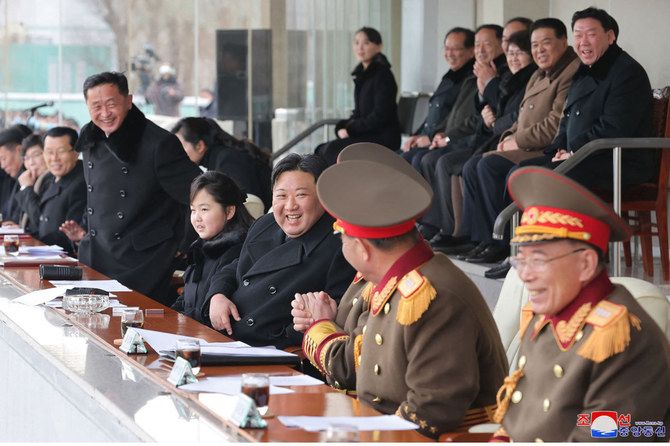
North Korea fired a pair of short-range ballistic missiles off its east coast on Monday, a day after US and South Korean military drills began. (AP )
2 / 3
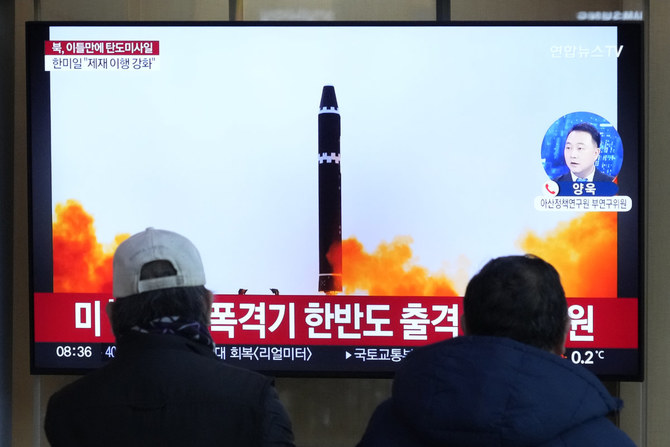
A TV screen shows a file image of North Korea's missile launch during a news program at the Seoul Railway Station in Seoul, South Korea, on Feb. 20, 2023. (AP)
3 / 3
US and South Korean fighters jets and bomber aircraft fly over South Korea Peninsula during a joint air drill on Feb. 19, 2023. (AFP/South Korean Defense Ministry)
Short Url
Updated 20 February 2023
Follow

UN chief ‘strongly condemns’ North Korea missile launches as Pyongyang threatens to turn Pacific Ocean into ‘firing range’

  • South Korea sanctions 4 individuals, 5 entities linked to North’s weapons program
  • The launches come just two days after North Korea fired an intercontinental ballistic missile  into the sea off Japan

SEOUL: North Korea fired two more ballistic missiles off its east coast on Monday, ignoring a call by UN Secretary-General Antonio Guterres on Pyongyang to cease “provocative actions.”

The powerful sister of leader Kim Jong Un also warned US forces to halt military drills, saying the reclusive nuclear state could turn the Pacific into a “firing range.”

In a statement spokesman issued Sunday, UN Spokesman Stephane Dujarric said Guterres reiterated a call for Pyongyang “to immediately desist from taking any further provocative actions.”

“The Secretary-General strongly condemns the launch of yet another ballistic missile of intercontinental range by the Democratic People’s Republic of Korea,” referring to North Korea’s official name.

In a counter-move against its rogue neighbor, South Korea imposed new sanctions on four individuals and five entities linked to Pyongyang’s weapons programs.

The launches come just two days after North Korea fired an ICBM into the sea off Japan’s west coast, prompting the United States to hold joint air exercises with South Korea and separately with Japan on Sunday.
North Korea’s state media confirmed it fired two projectiles from a multiple rocket launcher, aiming at targets 395 km (245 miles) and 337 km (209 miles) away, respectively.
“The 600mm multiple rocket launcher mobilized in the firing... is a means of tactical nuclear weapon,” capable of “paralyzing” an enemy airfield, state news agency KCNA said.
Japan’s Defense Ministry said the two ballistic missiles, fired around 2200 GMT, reached a maximum altitude of about 100 km and 50 km, traveling a distance of about 350-400 km before falling outside Japan’s EEZ.
There were no reports of damage to aircraft or vessels.
In a statement, the ministry said it would continue to gather and analyze information in close cooperation with the United States.
“North Korea’s series of actions, including its repeated ballistic missile launches, threaten the peace and security of Japan, the region, and the international community,” the ministry said. “Japan lodged a strong protest and forcefully condemned North Korea.”
Tensions rising
North Korean leader Kim’s sister, Kim Yo Jong, warned against increased presence of US strategic assets on the Korean peninsula after the United States held the joint air drills with its Asian allies over the weekend.
“We are carefully examining the influence it would exert on the security of our state,” she said in a statement. “The frequency of using the Pacific as our firing range depends upon the US forces’ action character.”
Kim Yo Jong also challenged experts’ assessment of its missile capabilities after some pointed out that it took over nine hours for the “sudden” missile launch to take place following an order from leader Kim, and said South Korea didn’t even fly reconnaissance planes at the time of its launch.
“We have possessed satisfactory technology and capability and, now will focus on increasing the quantity of their force,” she said. “We affirm once again that there is no change in our will to make the worst maniacs escalating the tensions pay the price for their action.”
Analysts say tensions in the region are expected to further heighten as South Korea and the United States plan a range of expanded field exercises, including live fire drills, in the coming weeks and months.
The two countries are also set to hold simulated nuclear drills, called the Deterence Strategy Committee Tabletop Exercise, at the Pentagon on Wednesday.
Park Won-gon, a professor at Ewha Womans University in Seoul, said Monday’s missile launch and statement are in line with the North Korean foreign ministry’s recent threat to take “unprecedentedly persistent, strong” responses to the allies’ joint military drills.
“North Korea seems to be trying to stoke tension in the region and reinforce its nuclear capability by raising issue over the drills, and the statement by Kim Yo Jong signals there would be additional provocations,” Park said.
Monday’s missile launch is the North’s third major weapons test this year after it fired an unprecedented number of missiles last year, including ICBMs capable of striking anywhere in the United States. 


UK veterans are ‘ticking time bomb’ after Iraq war chemical exposure

Updated 59 min 52 sec ago
Follow

UK veterans are ‘ticking time bomb’ after Iraq war chemical exposure

  • Fifteen former RAF personnel were deployed to the Qarmat Ali water plant in 2003, which was contaminated with sodium dichromate
  • Veterans say they were not screened or protected, and are now living with serious health conditions

LONDON: Fifteen British servicemen who worked on a carcinogen-contaminated water treatment site during the Iraq war say they were not offered biological screening despite official guidance saying they should have been.

The former Royal Air Force members, who have suffered from ailments including cancer, tumors and nosebleeds, told Sky News they were offered no medical assistance or subsequent treatment after having been exposed to toxic sodium dichromate at the Qarmat Ali water treatment plant in 2003.

The channel said it had seen a letter from the RAF’s medical authority stating that senior officers knew of the dangers posed by the substance.

Peter Lewis, 53, was one of 88 personnel deployed to guard the site, which was deemed vital for getting Iraq’s oil industry up and running. He told Sky: “I’ve had eight or nine operations to remove cancer.

“I’ve had so many lumps taken out of my neck, one on my face. This is something I’m literally fighting every year now. It’s constant.”

Qarmat Ali, the former troops say, was covered in ripped bags of bright orange sodium dichromate.

“We were never warned what the bags of chemicals were,” Jon Caunt, another former serviceman, said. “We were breathing this stuff in.”

His former comrade Tony Watters added: “I never thought about what it was. We were told the site is safe.”

Several months after deployment to the site, however, the servicemen were joined by two workers wearing protective gear who placed signs around it reading: “Warning. Chemical hazard. Full protective equipment and chemical respirator required. Sodium dichromate exposure.”

Watters said: “When you left the site, your uniform was contaminated, your webbing was contaminated.

“You went in your sleeping bag, and that was contaminated. And you were contaminating other people with it back at camp.”

Andy Tosh, who has led the group of veterans as they sought answers from the Ministry of Defence, said: “Even with the warning signs going up … they kept us there. They knowingly kept us exposed.”

The RAF gave some of the men a leaflet on their return to the UK, warning of the dangers of the substance, but not all were told.

The letter seen by Sky acknowledging the dangers posed to the veterans made a “strong” link to “increased risk of lung and nose cancer” as well as numerous other issues. It suggested personnel sent to Qarmat Ali should have their medical records altered to mention their exposure to sodium dichromate.

“Offer biological screening. This cannot be detailed until the numbers exposed are confirmed,” the letter also said.

An inquiry into US personnel deployed to Qarmat Ali found that 830 people were “unintentionally exposed” to sodium dichromate, giving them access to support from the US Department of Veterans Affairs. This came after the death of Lt. Col. James Gentry from cancer in 2009, which the US Army determined came “in line of duty for exposure to sodium dichromate.”

There has been no such inquiry by UK authorities despite British personnel being deployed at the site for longer than their American counterparts.

Thirteen of them have suffered from cancer and similar symptoms, including one who developed a brain tumor.

Jim Garth told Sky: “My skin cancer will never go away … It’s treatable, but when the treatment is finished, it comes back, so I’ve got that for life really.”

Lewis added: “I’m actually getting to the point now where I don’t care anymore … sooner or later, it’s going to do me.”

Caunt described his former colleagues’ conditions as a “ticking time bomb.”

He added: “We do not know what’s going to happen in the future."

The MoD insists medical screening was offered to personnel at the time, despite the men stating that it was not. In 2024, several met with Labour MPs about the issue. One, John Healey, who is now the UK defence secretary, said at the time the veterans should have “answers to their important questions.”

In a statement, the MoD said: “We take very seriously the concerns raised by veterans who were deployed to guard the Qarmat Ali Water Treatment Plant in 2003.

“As soon as we were alerted to the possible exposure of Sodium Dichromate, an environmental survey was conducted to evaluate typical exposure at Qarmat Ali. Results showed that the levels at the time were significantly below UK government guidance levels.”

A 2004 letter seen by Sky News suggested, however, that the MoD knew the levels of sodium dichromate were higher.

“Anyone who requires medical treatment can receive it through the Defence Medical Services and other appropriate services,” the MoD said.

“Veterans who believe they have suffered ill health due to service can apply for no-fault compensation under the War Pensions Scheme.”

Watters called on the government to hold an investigation into what happened at Qarmat Ali.

“We are the working class, we are ex-soldiers who have put our lives on the line and you’re turning a blind eye to us,” he said.

Garth added: “We felt let down at Qarmat Ali all those years ago, and we still feel let down now.”