

Mounting death toll as new quake hits battered Turkiye, Syria

1 / 2
2 / 2
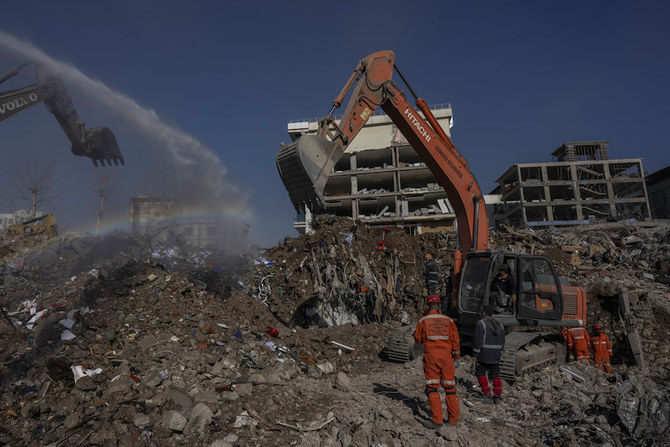
Excavators work at the site of buildings that collapsed during the earthquake in Kahramanmaras, Turkiye. (AP)
Short Url
Updated 21 February 2023
Follow

Mounting death toll as new quake hits battered Turkiye, Syria

  • Monday’s earthquake centered in Defne of Turkey’s Hatay province, one worst-hit regions from earlier quake
  • Quake felt in Syria, Jordan, Cyprus, Israel and as far away as Egypt

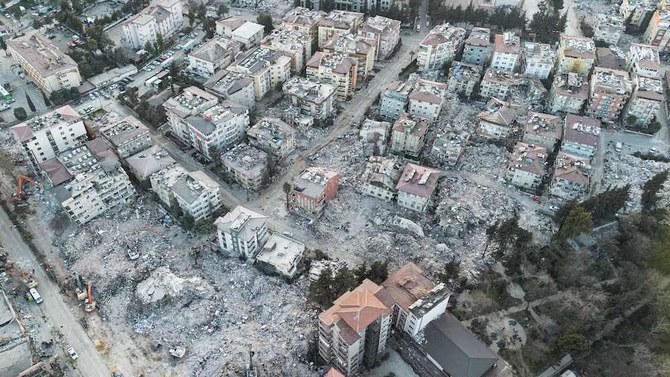
ANKARA, Turkiye: A new 6.4 magnitude earthquake on Monday killed three people and injured more than 200 in parts of Turkiye laid waste two weeks ago by a massive quake that killed tens of thousands, authorities said. More buildings collapsed, trapping some people, while scores of injuries were recorded in neighboring Syria too.

Monday’s earthquake was centered in the town of Defne, in Turkiye’s Hatay province, one the worst-hit regions in the magnitude 7.8 quake that struck on Feb. 6. It was felt in Syria, Jordan, Cyprus, Israel and as far away as Egypt, and followed by a second, magnitude 5.8 temblor.

Turkish Interior Minister Suleyman Soylu said 6 people were killed and 213 injured. Search and rescue efforts were underway in three collapsed buildings where six people were believed trapped.

In Hatay, police rescued one person trapped inside a three-story building and were trying to reach three others inside, HaberTurk television reported. It said those trapped included movers helping people shift furniture and other belongings from the building that was damaged in the massive quake.

Syria’s state news agency, SANA, reported that six people were injured in Aleppo by falling debris. The White Helmets, northwest Syria’s civil defense organization, reported more than 130 injuries, most of them non-life threatening, including fractures and cases of people fainting from fear, while a number of buildings in areas already damaged by the quake collapsed.

The Feb. 6 quake killed nearly 45,000 people in both countries — the vast majority of them in Turkiye, where more than a million and a half people are in temporary shelters. Turkish authorities have recorded more than 6,000 aftershocks since.

HaberTurk journalists reporting from Hatay said they were jolted violently by Monday’s quake and held onto to each other to avoid falling.

In the Turkish city of Adana, eyewitness Alejandro Malaver said people left homes for the streets, carrying blankets into their cars. Malaver said everyone is really scared and “no one wants to get back into their houses.”

Mehmet Salhaoglullari, from a village near Samandag, said he was eating at a restaurant when the building began to shake.

“We all threw ourselves outside and we continued to shake outside,” he said.

In the Syrian city of Idlib, frightened residents were preparing to sleep in parks and other public places, while fuel lines formed at gas stations as people attempted to get as far as possible from any buildings that might collapse.

The Syrian American Medical Society, which runs hospitals in northern Syria, said it had treated a number of patients — including a 7-year-old boy — who suffered heart attacks brought on by fear following the new quake.

President Recep Tayyip Erdogan visited Hatay earlier on Monday, and said his government would begin constructing close to 200,000 new homes in the quake-devastated region as early as next month.

Erdogan said the new buildings will be no taller than three or four stories, built on firmer ground and to higher standards and in consultation with “geophysics, geotechnical, geology and seismology professors” and other experts.

The Turkish leader said destroyed cultural monuments would be rebuilt in accordance with their “historic and cultural texture.”

Erdogan said around 1.6 million people are currently being housed in temporary shelters.

The Turkish disaster management agency AFAD on Monday raised the number of confirmed fatalities from the Feb. 6 earthquake in Turkiye to 41,156. That increased the overall death toll in both Turkiye and Syria to 44,844.

Search and rescue operations for survivors have been called off in most of the quake zone, but AFAD chief Yunus Sezer said earlier that search teams were continuing their efforts in more than a dozen collapsed buildings — mostly in Hatay province.

There were no signs of anyone being alive under the rubble since three members of one family — a mother, father and 12-year-old boy — were extracted from a collapsed building in Hatay on Saturday. The boy later died.

Authorities said more than 110,000 buildings across 11 quake-hit Turkish provinces were either destroyed or so severely damaged by the Feb. 6 quake that they need to be torn down.

The European Union’s health agency warned Monday of the risk of disease outbreaks in the coming weeks. The Centre for Disease Prevention and Controls said that “food and water-borne diseases, respiratory infections and vaccine-preventable infections are a risk in the upcoming period, with the potential to cause outbreaks, particularly as survivors are moving to temporary shelters.”

“A surge of cholera cases in the affected areas is a significant possibility in the coming weeks,” it said, noting that authorities in northwestern Syria have reported thousands of cases of the disease since last September and a planned vaccination campaign was delayed due to the quake.


Two dead in UAE, 8 injured in Qatar from waves of Iranian strikes on Gulf neighbors

Updated 8 sec ago
Follow

Two dead in UAE, 8 injured in Qatar from waves of Iranian strikes on Gulf neighbors

  • UAE defense ministry said Iran fired 137 missiles and 209 drones at the territory
  • Qatar intercepted most of the 65 missiles and 12 drones launched by Iran, said officials

ABU DHABI: Explosions rocked cities across the Gulf on Saturday, killing two people in Abu Dhabi, while smoke and flames rose from Dubai landmark The Palm as Iran launched waves of attacks in retaliation for US and Israeli strikes.

The attacks hit airports in Abu Dhabi, Dubai and Kuwait, as well as Gulf military bases and residential areas, raising fears of a wider conflict and rattling a region long seen as a haven of peace and security.

Across the UAE, Iran fired 137 missiles and 209 drones at the territory, the country’s defense ministry said, as projectiles streaked across the skies of every Gulf state but Oman, a mediator in the recent US-Iran talks.

The UAE defense ministry said most of the missiles and drones were intercepted but at Abu Dhabi’s Zayed International Airport officials said at least one person was killed and seven wounded in an “incident.”

Earlier, falling debris killed a Pakistani civilian in Abu Dhabi, the United Arab Emirates’ capital, officials said.

At Dubai International Airport four people were injured according to airport authorities and four others were also hurt at the luxury Palm development.

In Qatar, officials said Iran launched 65 missiles and 12 drones toward the Gulf state, most of which were intercepted, but eight people were injured in the salvos, with one of them in critical condition.

“We are scared of what the future is for us now, and we can’t say how the next few days are going to be,” Maha Manbaz, a nursing student in Doha told AFP.

‘Terrified’

Smoke poured from US bases in Abu Dhabi and Bahrain’s capital Manama, home of the American navy’s Fifth Fleet, witnesses saw.

A drone struck Kuwait’s international airport and a base housing US personnel was targeted. Three Kuwaiti soldiers and 12 other people were wounded, authorities said.

After Iran’s Revolutionary Guards reported missile strikes, US Central Command (CENTCOM) said on X that no American naval vessels were hit, damage to US facilities was minimal, and no US casualties had been reported.

Residential buildings were also targeted in Manama, with officials saying firefighters and civil defense teams had been dispatched to the scene.

“The sound of the first explosion terrified me,” said a 50-year-old retiree living near the US base in Manama’s Juffair area, where residents were quickly evacuated.

The UAE, Saudi Arabia and Qatar warned they reserved the right to respond to the attacks.

The oil-and-gas-rich Arab monarchies, lying just across the Gulf from Iran, are long-term American allies and host a clutch of US military bases.

“The Gulf states are sandwiched between Iran and Israel, and have to bear the worst inclinations of both,” said Bader Al-Saif, an assistant professor at Kuwait University.

“Iran’s attacks on the Gulf are misplaced. They’ll only alienate its neighbors and invite further distancing from Iran,” he added.

Conflict is unusual in the Gulf, which has traded on its reputation for stability to become the Middle East’s commercial and diplomatic hub.

‘Significant damage’

The unprecedented barrage targeted Qatar’s Al Udeid base, the region’s biggest US military base, as well as Riyadh and eastern Saudi Arabia.

The UAE, Qatar and Kuwait all announced that their airspace was closed.

An AFP journalist in Qatar saw one missile destroyed in a puff of white smoke, while another in Dubai saw a volley of Patriot interceptors taking off.

Iran fired missiles at Al Udeid last June after US strikes targeted Iranian nuclear facilities during a brief war with Israel.

The escalation also saw Saudi Crown Prince Mohammed bin Salman and UAE President Mohamed bin Zayed speak for the first time since a public row in late December.

The Saudi de facto ruler called the Emirati president and the pair discussed Iran’s retaliatory strikes on the Gulf and expressed solidarity and sympathy.

In Kuwait, an Iranian missile attack caused “significant damage” to the runway at an air base hosting Italian air force personnel, Italian Foreign Minister Antonio Tajani was quoted by the ANSA news agency as saying.

Late on Saturday, Kuwaiti officials said a drone targeted a naval base there with air defense forces intercepting the projectile, according to a post by the defense ministry on X.

For many residents in the Gulf, which has drawn a cosmopolitan, largely expat population, the reaction was one of shock.

“I heard the explosions, I don’t know what I felt,” a Lebanese woman living in Riyadh told AFP.

“We came to the Gulf because it’s known to be safer than Lebanon. Now I don’t know what to do or how to think really.”