

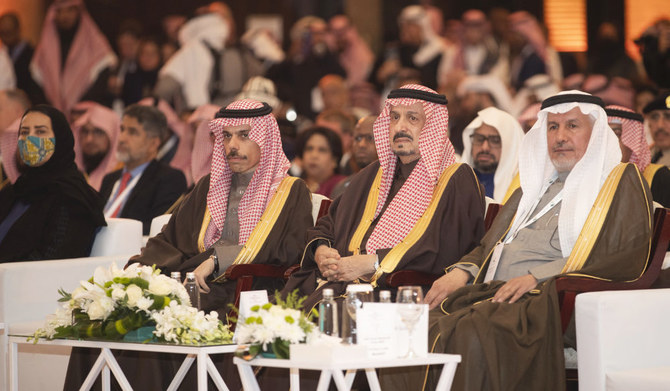


RIYADH: The third Riyadh International Humanitarian Forum opened on Monday with a focus on enhancing global aid efforts, increasing donor funding, and raising the levels of coordination for humanitarian assistance.
Being held under the patronage of King Salman, the opening ceremony was attended by Saudi Foreign Minister Prince Faisal bin Farhan, Riyadh Gov. Prince Faisal bin Bandar, and Martin Griffiths, UN undersecretary-general for humanitarian affairs and emergency relief coordinator.
The forum, hosted by the King Salman Humanitarian Aid and Relief Center in partnership with the UN and its humanitarian organizations, includes the participation of humanitarian leaders, donors, practitioners, researchers, government officials, and key decision-makers from the humanitarian sector.
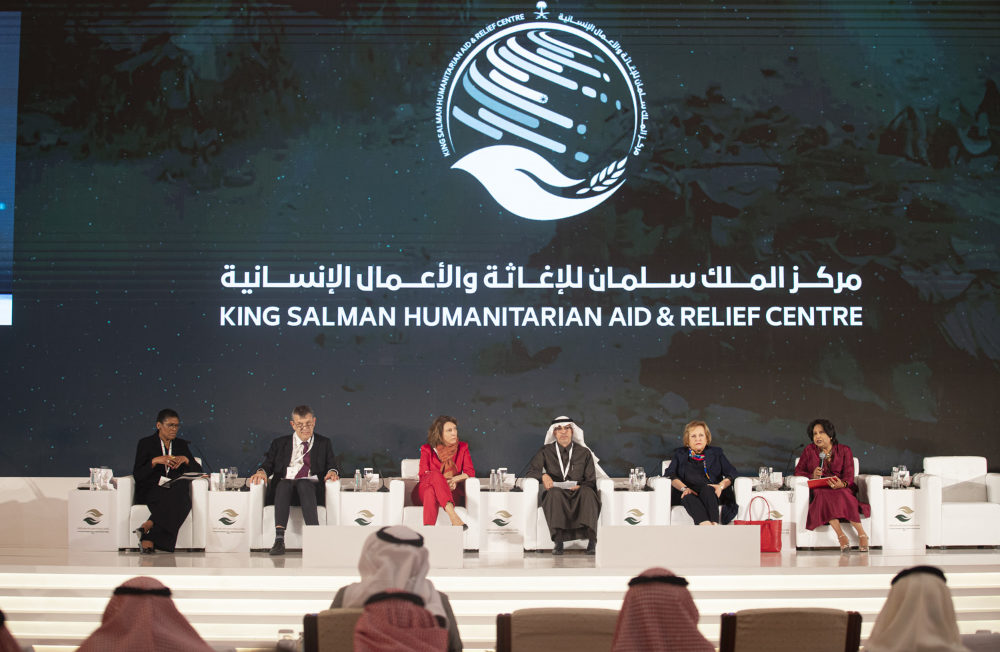
A session in progress at Riyadh International Humanitarian Forum. (AN photo by Yazeed Alsamrani)
KSrelief Supervisor General Dr. Abdullah Al-Rabeeah said: “As we meet today, the world is experiencing many disasters, crises, conflicts, and other developments which have exacerbated the global humanitarian situation and multiplied its challenges. The latest are the catastrophic earthquakes that struck recently in Syria and Turkiye, killing tens of thousands and rendering millions homeless.
“This forum will focus on enhancing global aid efforts, increasing donor funding from countries, organizations and individuals, and raising the levels of coordination and impact of humanitarian assistance to make our work more effective and responsive,” he added.
Human rights, especially women rights, are under vicious attack in many places, punishing entire societies.
Martin Griffiths
“The forum is receiving great interest, and includes the active participation of the UN and other international, regional and local organizations. Nearly 60 organizations and humanitarian leaders from 50 countries are participating in the forum, and the world looks forward to the solutions and recommendations that will come out of this high-level gathering.
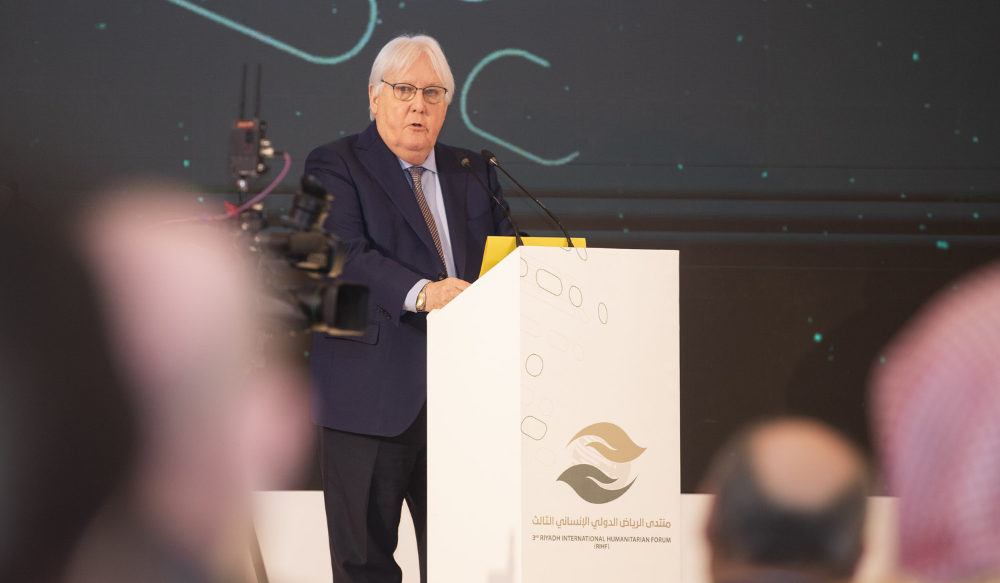
Martin Griffiths, Under-Secretary-General for Humanitarian Affairs and Emergency Relief Coordinator speaking at RIHF3. (AN photo by Yazeed Alsamrani)
“We will discuss a number of urgent issues, including the growing number and urgency of humanitarian needs, the widening funding gap, the unification of aid efforts, mechanism for developing humanitarian work, finding sustainable and practical solutions, adapting technology, digital transformation, and artificial intelligence in collecting and analyzing data, distributing aid and monitoring its impact on the ground, and enhancing control, transparency, and impartiality of aid provision,” he added.
Al-Rabeeah said that the forum will also focus on the role of women and youth in humanitarian response, and ways to raise the level of protection for the world's most vulnerable groups.
Prince Faisal said: “Over seven decades, the amount of aid provided by Saudi Arabia has reached $95 billion, which provided support to 160 beneficiary countries. The Kingdom continues its humanitarian and development efforts, making it one of the world’s leading donor countries.”
The Saudi minister said that humanitarian assistance is not only about providing material aid, but also requires more coordination between international, regional and societal organizations.
It requires the exchange of experiences to help provide urgent humanitarian response and overcoming the challenges to reach those in need, he added.
“We must take proactive measures to prevent crises, and develop appropriate plans for early response and effective action,” he said.
Griffiths, speaking on behalf of UN Secretary-General Antonio Guterres said: “More than 350 million people around the world currently need humanitarian assistance.
“Human rights, especially women rights, are under vicious attack in many places, punishing entire societies,” he added.
“We also need to address climate change head on, because every flood, heatwave, drought or superstorm leaves a humanitarian crisis in its wake,” said Griffiths.
“Globally, more than 222 million people don't know when or even if they will eat another meal, 45 million people are already on the brink of starvation, most of them are women and children,” he added.
The two-day forum will also address humanitarian challenges and seek innovative practical solutions in accordance with international humanitarian principles and standards and in line with the achievement of Sustainable Development Goals.


