IEA's Birol warns of tighter energy supply next winter 

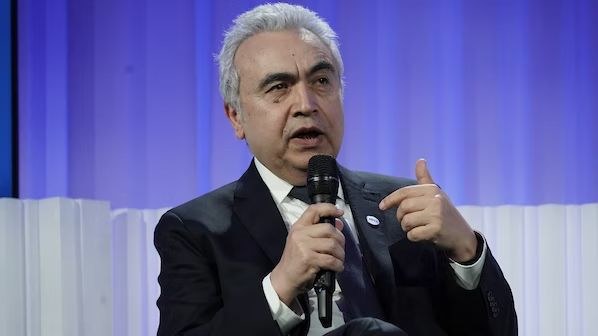
International Energy Agency head Fatih Birol. (Supplied)
Short Url
Updated 19 February 2023
Follow

IEA's Birol warns of tighter energy supply next winter 

BERLIN: International Energy Agency head Fatih Birol has warned of possible energy shortages next winter as relatively little new liquefied natural gas is coming to the market while China's consumption is set to rise this year. 

European governments made many correct decisions over the last year to ensure energy supply, such as building more LNG terminals to replace pipeline deliveries of Russian gas, Birol told Reuters on the sidelines of the annual Munich Security Conference on Saturday. 

But they also got lucky, he said, with a mild winter dampening demand while economic weakness in China led to the first drop in consumption there for 40 years. 

"For this winter it is right to say that we are off the hook. If there are no last-minute surprises, we should get through...maybe with some bruises here and there," said Birol. "But the question is...what happens next winter?" 

An additional 23 billion cubic meters of LNG is expected this year, Birol said, adding that even with only a small increase in economic output as pandemic restrictions ease, China would likely swallow 80 percent of the extra gas. 

"Even though we have enough LNG import terminals, there may not be enough gas to import and therefore it will not be easy this coming winter for Europe," he said, noting this would likely push prices up again. 

"It is not right to be relaxed, it is not right now to celebrate". 

Even with a renewed push to develop new gas fields, it would be years before they came online, he said. 

Households and firms, therefore, need to continue efforts to reduce gas usage while renewable energy output needs to expand faster, he said. 

Klaus Mueller, head of the German network agency which regulates gas and electricity markets, in an interview with Deutschlandfunk on Sunday also said he could not exclude possible gas shortages next winter, especially as Germany would now have to fill storage facilities without Russian pipeline gas. 

"We can manage it but will have to really make a big effort," he said, adding that it would be good not to let storage levels drop too far below the current 71.52 percent. 

In the interview, Birol also warned countries that had decided to phase out nuclear energy to reconsider if this was the best time to do so, saying the temporary extension of Germany's last nuclear plants until April for example was a step in the right direction. 

"We need all energy sources to help us for the next winter," he said. 


Saudi Arabia leads outcome-based education to prepare future-ready generations: Harvard Business Review

A Harvard sign is seen at the Harvard University campus in Boston, Massachusetts, on May 27, 2025. (AFP)
Updated 10 February 2026
Follow

Saudi Arabia leads outcome-based education to prepare future-ready generations: Harvard Business Review

  • The Riyadh-based school group developed a strategy that links every classroom activity to measurable student competencies, aiming to graduate learners equipped for the digital economy and real-world contexts

RIYADH: Saudi Arabia’s education system is undergoing a sweeping transformation aligned with Vision 2030, shifting from traditional, input-focused methods to outcome-based education designed to equip students with future-ready skills, Harvard Business Review Arabic reported.

The transformation is being adopted and spearheaded by institutions such as Al-Nobala Private Schools, which introduced the Kingdom’s first national “learning outcomes framework,” aimed at preparing a generation of leaders and innovators for an AI-driven future, the report said.

Al-Nobala has leveraged international expertise to localize advanced learning methodologies.

The Riyadh-based school group developed a strategy that links every classroom activity to measurable student competencies, aiming to graduate learners equipped for the digital economy and real-world contexts. The school’s group approach combines traditional values with 21st-century skills such as critical thinking, communication, innovation and digital fluency.

According to the report, the shift addresses the growing gap between outdated models built for low-tech, resource-constrained environments and today’s dynamic world, where learners must navigate real-time information, virtual platforms, and smart technologies.

“This is not just about teaching content, it’s about creating impact,” the report noted, citing how Al-Nobala’s model prepares students to thrive in an AI-driven world while aligning with national priorities.

The report noted that Saudi Arabia’s Ministry of Education has paved the way for this shift by transitioning from a centralized controller to a strategic enabler, allowing schools such as Al-Nobala to tailor their curriculum to meet evolving market and societal needs. This is part of the long-term goal to place the Kingdom among the top 20 global education systems.

Al-Nobala’s work, the report stated, has succeeded in serving the broader national effort to link education outcomes directly to labor market demands, helping to fulfill the Vision 2030 pillar of building a vibrant society with a thriving economy driven by knowledge and innovation.

Last February, Yousef bin Abdullah Al-Benyan, Saudi Arabia’s minister of education, said that the Kingdom was making “an unprecedented investment in education,” with spending aligned to the needs of growth and development. He said that in 2025, education received the second-largest share of the state budget, totaling $53.5 billion.