

UAE-based financial technology firm evaluates Pakistan for business expansion

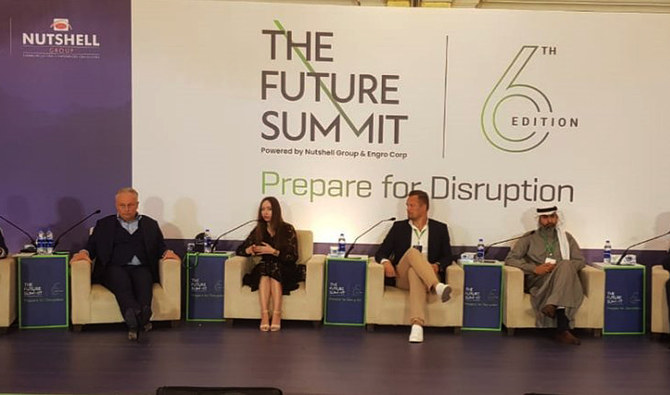
UAE-based Fintech Galaxy representative, Michael Hartmann (2nd right), gestures during a dialogue on The Digital Future at day 2 of the Future Summit in Karachi on February 17, 2023. (Photo courtesy: Twitter/ Nutshell Group)
Short Url
Updated 18 February 2023
Follow

UAE-based financial technology firm evaluates Pakistan for business expansion

  • A top official of Fintech Galaxy says Pakistan has the right ecosystem for innovative financial inclusion
  • Middle Eastern experts say Pakistani programmers can benefit from digital transformation in Gulf states

KARACHI: Fintech Galaxy, a firm based in the United Arab Emirates (UAE), is evaluating the option of expanding its outreach to Pakistan due to the size of the market, confirmed one of its top officials during an interview with Arab News earlier this week.

The company is the first central bank-regulated open finance platform offering cloud-based innovation, crowdsourcing, an open application programming interface sandbox, and an artificial intelligence-powered global fintech marketplace.

“We’re looking at both the GCC [Gulf Cooperation Council] and MENA [Middle East and North Africa] area and then also evaluating Pakistan as well as a market, given its size and population,” Michael Hartmann, chief business officer of Fintech Galaxy, told Arab News on Thursday.


“We’re on the mission of trying to kind of move the needle on financial inclusion and we do that by initially engaging with the financial institutions around innovation, but we do want to make sure that innovation in those financial services is coming from Fintechs,” he said on the sidelines of “The Future Summit” in Karachi.

Hartmann maintained the foundation for fintech ecosystem had already been laid in Pakistan, though the political climate of the country was a big hurdle.

While Fintech Galaxy plans to make business inroads in Pakistan, Saudi entrepreneurs and financial technology service providers said the information technology players in the South Asian country should explore and benefit from technological transformation taking place in the Middle East.

“There are a lot of fintechs and startups being done by local Saudis,” Dr. Rehan Al Taji, project head at Gabriel Jobs in Saudi Arabia, told Arab News, adding: “There we have a gap [due to a lack of] technical [experts].”

He maintained that Saudi tech startups were trying to cut down their cost and build better optimized products by approaching Pakistan, India and Bangladesh.

“Pakistani IT experts should approach these [Saudi] entrepreneurs because they are in need of developers and freelancers,” he added.

Al Taji agreed there was a huge IT potential in Pakistan which could be exported to the kingdom and other Gulf countries.

Under Vision 2030, extensive digital transformation has been taking place in Saudi Arabia. In 2022, fintech emerged as the most funded industry in the kingdom where the overall startup ecosystem witnessed record funding of nearly $1 billion.

Fintech experts said there was a great demand for Pakistani software developers and IT consultants in Saudi Arabia and other Middle Eastern countries undergoing digital transformation.


Pakistan president meets UAE counterpart, explores trade, investment opportunities

Updated 27 January 2026
Follow

Pakistan president meets UAE counterpart, explores trade, investment opportunities

  • Asif Ali Zardari is in UAE on four-day visit to strengthen bilateral ties, review bilateral cooperation
  • Both sides discuss regional, international developments, reaffirm commitment to promote peace

ISLAMABAD: President Asif Ali Zardari met his UAE counterpart Sheikh Mohammed bin Zayed Al-Nahyan in Abu Dhabi on Tuesday during which both sides explored new opportunities in trade, investment, energy and other sectors, Zardari's office said. 

Zardari arrived in Abu Dhabi on Monday evening with a high-level delegation on a four-day official visit to the UAE to review trade, economic and security cooperation. 

"The leaders discussed ways to further deepen the longstanding and brotherly relations between Pakistan and the UAE," a statement from Zardari's office said about his meeting with the UAE president. 

"They reviewed the full spectrum of bilateral cooperation and explored new opportunities in trade, investment, energy, infrastructure, technology, and people-to-people exchanges, highlighting the significant potential for expanding economic and strategic partnership.

Zardari highlighted the significance of Al-Nayhan's visit to Pakistan last month, the statement said, expressing appreciation for the UAE's continued support for strengthening bilateral ties.

It said both sides also exchanged views on a range of regional and international developments, reaffirming their commitment to promoting peace, stability and sustainable development.

The meeting was also attended by Pakistan's First Lady Aseefa Bhutto-Zardari, the Pakistani president's son Bilawal Bhutto-Zardari, who is also the chairman of the Pakistan Peoples Party, Interior Minister Mohsin Naqvi and Pakistan's ambassador to the UAE. 

ZARDARI MEETS AD PORTS CEO

Zardari earlier met AD Ports Group CEO Captain Mohamed Juma Al-Shamisi to discuss the group's investment initiatives in Karachi. 

"Both sides agreed that the expansion and modernization of port infrastructure would strengthen trade flows and support Pakistan’s broader economic development and country’s seaborne trade," the President's Secretariat said in a statement.

It added that Zardari described the AD Ports Group's long-term investment and expanding role in Pakistan's maritime and logistics sector as a key pillar of Pakistan–UAE economic cooperation.

Pakistan and the UAE maintain close political and economic relations, with Abu Dhabi playing a pivotal role in supporting Islamabad during periods of financial stress through deposits, oil facilities and investment commitments. 

The UAE is Pakistan's third-largest trading partner, after China and the United States, and a key destination for Pakistani exports, particularly food, textiles and construction services.

The Gulf state is also home to more than 1.5 million Pakistani expatriates, one of the largest overseas Pakistani communities in the world, who contribute billions of dollars annually in remittances, a crucial source of foreign exchange for Pakistan’s economy.

Beyond trade and labor ties, Pakistan and the UAE have steadily expanded defense and security cooperation over the years, including military training, joint exercises and collaboration in counter-terrorism and regional security matters.