Four killed in Karachi police attack claimed by Pakistan Taliban

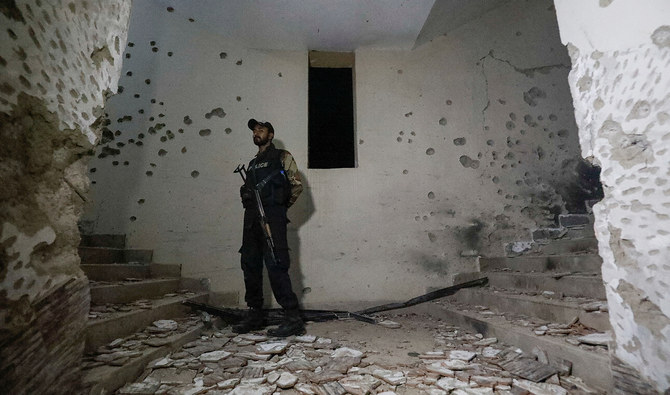
A police officer secures a site as he stands amid the damages in the aftermath of an attack on a police station in Karachi, Pakistan February 17, 2023. (Photo courtesy: REUTERS)
Short Url
Updated 18 February 2023
Follow

Four killed in Karachi police attack claimed by Pakistan Taliban

  • The Pakistan Taliban said their fighters stormed the tightly guarded Karachi Police Office compound
  • The attack comes just weeks after a bombing in the country’s northwest killed more than 80 people

KARACHI: At least four people were killed when a Pakistan Taliban suicide squad stormed a police compound Friday in the port city of Karachi, with a gunbattle raging for hours as security forces went floor-to-floor through an office building in pursuit of the assailants.

The attack comes just weeks after a bomb blast at a police mosque in the country’s northwest killed more than 80 officers, and officials said late Friday that security would be stepped up in the capital Islamabad.

The Pakistan Taliban said its fighters had stormed the tightly guarded Karachi Police Office compound, home to dozens of administrative and residential buildings as well as hundreds of officers and their families.

“Four people were killed in the attack, including two policemen, one ranger and one sanitary worker,” Sindh government spokesman Murtaza Wahab Siddiqui told AFP, adding 14 others were wounded.

“The operation has concluded with the killing of all three terrorists,” he said.

A spokesman for Tehreek-e-Taliban Pakistan claimed responsibility in a WhatsApp message to AFP.

“Our Mujahideen martyrs have attacked Karachi Police Office. More details to follow,” he said.

Speaking on Samaa TV, Interior Minister Rana Sanaullah called the attackers “terrorists... armed with grenades and other weapons” and said they fired at a gate with a rocket.

Prime Minister Shehbaz Sharif vowed Friday to stamp out the violence.

“Pakistan will not only uproot terrorism, but will kill the terrorists by bringing them to justice,” he tweeted.

“This great nation is determined to end this evil forever.”

Condemning the attack, State Department spokesman Ned Price said the United States stands “firmly with the Pakistani people in the face of this terrorist attack. Violence is not the answer, and it must stop.”

Earlier, Syed Murad Ali Shah, chief minister of Sindh province, told ARY news that security forces had focused on one main building seized by the attackers.

“It is a five-floor building. Our police and rangers have cleared the first three floors and are approaching the fourth. The terrorists are still inside the building.”

An AFP reporter near the scene saw dozens of ambulances and security vehicles arrive outside the compound.

Karachi is Pakistan’s largest city, a sprawling metropolis of more than 20 million people and the main trade gateway at its Arabian Sea port.

Low-level militancy, often targeting security checkpoints in the north and west, has been steadily rising since the Taliban seized control in neighboring Afghanistan in August 2021.

The assaults are claimed mostly by the Pakistan Taliban, as well as the local chapter of the Islamic State, but separatists from Balochistan have struck over the years in Karachi, capital of the southern Sindh province.

Investigators blamed an affiliate of the Pakistan Taliban for the January blast at a mosque inside a police compound in Peshawar that killed more than 80 officers.

Tehreek-e-Taliban Pakistan share a common lineage and ideals with the Afghan Taliban.

Provinces around the country announced they were on high alert after the mosque attack, with checkpoints ramped up and extra security forces deployed.

“There’s a general threat across the country but there was no specific threat to this place,” Interior Minister Sanaullah said of Friday’s Karachi attack.


Tirah Valley residents flee homes ahead of Pakistan’s planned anti-militant army offensive

Updated 58 min 2 sec ago
Follow

Tirah Valley residents flee homes ahead of Pakistan’s planned anti-militant army offensive

  • Families flee militant-hit region on days-long journeys amid bitter winter cold
  • Cash aid announced but displaced residents cite lack of evacuation planning

PAINDA CHEENA, Pakistan: In the rugged mountains of Pakistan’s Tirah Valley, long lines of tractor-trolleys and mini-pickups inched toward a registration camp earlier this month. 

The vehicles were stacked with bedding, food supplies and families escaping their homes as a military operation against militants looms in the conflict-striken northwestern region. 

At the Painda Cheena registration point, 60-year-old Hajji Muhammad Yousuf sat wrapped in a shawl, waiting with dozens of others after traveling nearly 40 kilometers from his village in Maidan Tirah, a journey that took four days instead of the usual few hours. He still faces another 66-kilometer trip to Bara, near the northwestern city of Peshawar, the provincial capital of Khyber Pakhtunkhwa. 

Like thousands of others, Yousuf is leaving behind a fully furnished home ahead of an expected security offensive in the volatile border region near Afghanistan.

“Today is our fourth night here,” Yousuf said. “We have left fully furnished houses behind ... There are no facilities, no amenities for us. We are facing great hardships.”

Families load their belongings onto vehicles in Pakistan’s Tirah Valley on January 15, 2026. (AN photo)

Officials say the evacuation could affect up to 20,000 families, marking a significant escalation in Pakistan’s campaign against the proscribed militant group Tehreek-e-Taliban Pakistan (TTP). Despite major military operations in the mid-2010s, Tirah Valley has remained a stronghold for insurgents, prompting authorities to plan what they describe as a targeted clearance.

The scale of displacement has placed acute pressure on limited local infrastructure. While the journey from Maidan Tirah to the registration point at Mandi Kas normally takes around two hours by vehicle, congestion and verification procedures have stretched the trip into days for many families.

“Last night, a woman died of hunger in Sandana,” Yousuf said. “There is no arrangement for medicine, no doctor, no food, no washroom. Women and children are facing problems.”

Displaced residents say they feel trapped between militant threats and state action.

“We ourselves are opposing terrorism, yet we do not understand why, if a Taliban comes in the evening and we give bread, the government comes in the morning asking why the bread was given,” Yousuf said. “In the end, we were forced to do this [to leave].”

RELIEF MEASURES

The Khyber Pakhtunkhwa (KP) provincial government has announced a compensation package for displaced families. Talha Rafi, assistant commissioner for Bara, said authorities had set up 15 biometric counters at the registration site.

“One person receives a one-time compensation of Rs255,000 ($911), and a monthly Rs50,000 ($179) is provided,” he said, adding that SIM cards were being issued to ensure digital disbursement of funds.

Families load their belongings onto vehicles in Pakistan’s Tirah Valley on January 15, 2026. (AN photo)

Provincial officials say the payments are intended to cover basic needs during displacement, though residents and tribal elders argue that cash alone cannot offset the absence of shelter, health care and transport arrangements during evacuation.

The evacuation has also exposed tensions between the provincial government and Pakistan’s military establishment over the use of force in the region.

“We have neither allowed the operation nor will we ever allow the operation,” KP Law Minister Aftab Alam Afridi said, arguing that past military campaigns had failed to deliver lasting stability.

“These people are our own people. They are also the people of this state, the people of this province. We will definitely take care of them,” he said, adding that the KP cabinet had approved what he described as “a large package” for the displaced families.

Federal authorities and the military have signaled a firmer stance. While Federal Information Minister Ataullah Tarar and the military’s public relations wing did not respond to requests for comment, military spokesperson Lt. Gen. Ahmed Shareef Chaudhry has previously defended security operations as necessary.

Families sittinng in vehicles with their belongings in Pakistan’s Tirah Valley on January 15, 2026. (AN photo)

In a recent briefing, Chaudhry said security forces carried out 75,175 intelligence-based operations nationwide last year, including more than 14,000 in Khyber Pakhtunkhwa, attributing the surge in violence to what he described as a “politically conducive environment” for militants.

Analysts say political divisions have allowed the TTP to regain ground. 

Peshawar-based journalist Mehmood Jan Babar said many militants now operating in Tirah are local residents who returned after refusing settlement offers in remote parts of Afghanistan.

“Whenever we have seen division at the national level, the Taliban have taken advantage of it,” he said.

But for families waiting in freezing conditions at Painda Cheena, such strategic calculations offer little comfort. Tribal elders accuse civil authorities of ordering displacement without adequate logistical planning.

“The government has, without any administrative arrangements, ordered these people to migrate,” said Muhammad Khan Afridi, an elderly local resident. “You yourselves are seeing what suffering these people are facing, what humiliation they are experiencing.”

As a January 25 evacuation deadline approaches, uncertainty dominates daily life for those uprooted.

“Bringing peace is in the government’s hands,” Yousuf said. “It is up to them whether they normalize the situation or drive us out again tomorrow.”