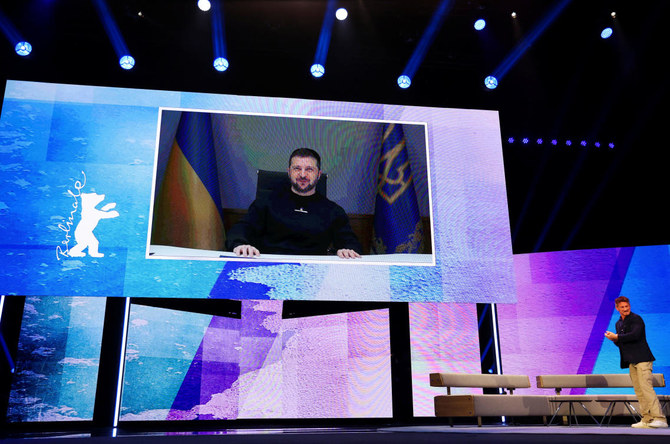
Ukrainian President Volodymyr Zelensky on Thursday asked artists and filmmakers to unequivocally declare their support for his country during a live video address at the opening of the 73rd Berlin International Film Festival.
Referring to the Berlin Wall which divided the German capital from 1961 to 1989 into the capitalist west and communist east, Zelensky said that now Russia, which attacked Ukraine almost one year ago, is building a new — figurative — wall in his country.
“This is a wall between freedom and slavery,” Zelensky said adding that the art world cannot remain indifferent because amid silence the “voice of evil only becomes louder and more convincing.”
Zelensky, a former comedian and actor, features prominently in Sean Penn’s film about the war in Ukraine, “Superpower,” which will have its world premiere at the Berlinale.
Before the opening ceremony, US actress Anne Hathaway lauded the Ukrainian president as a “hero of our time” and thanked the festival for inviting him via video link, German news agency dpa reported.
Germany’s minister of culture also stressed the importance of culture in times of war and crisis. “Whoever makes films and whoever shows films in dark times resists bondage,” Claudia Roth said.
This year’s film festival, which runs until Feb. 26, will see 18 films compete for the Golden and the Silver Bear awards. The winners will be chosen by a jury headed by American actor, screenwriter and director Kristen Stewart.
The festival was set to open with the premiere of Rebecca Miller’s “She Came to Me,” starring Hathaway, Marisa Tomei and Peter Dinklage.

Zelensky asks for support for Ukraine at Berlin film fest
https://arab.news/9krak
Zelensky asks for support for Ukraine at Berlin film fest
- Zelensky, a former comedian and actor, features prominently in Sean Penn’s film about the war in Ukraine, ‘Superpower,’ which will have its world premiere at the Berlinale
- Before the opening ceremony, US actress Anne Hathaway lauded the Ukrainian president as a ‘hero of our time’ and thanked the festival for inviting him via video link
Tug of war: how US presidents battle Congress for military powers
- The last official declaration of war by Congress was as far back as World War II
WASHINGTON, United States: Donald Trump’s unleashing of operation “Epic Fury” against Iran has once more underscored the long and bitter struggle between US presidents and Congress over who has the power to decide on foreign military action.
In his video address announcing “major combat” with the Islamic republic, Trump didn’t once mention any authorization or consultation with the US House of Representatives or Senate.
In doing so he sidelined not only Democrats, who called for an urgent war powers vote, but also his own Republican party as he asserts his dominance over a largely cowed legislature.
A US official said Secretary of State Marco Rubio had called top congressional leaders known as the “Gang of Eight” to give them a heads up on the Iran attack — adding that one was unreachable.
Rubio also “laid out the situation” and consulted with the same leaders on Tuesday in an hour-long briefing, the US official said.
According to the US Constitution, only Congress can declare war.
But at the same time the founding document of the United States first signed in 1787 says that the president is the “commander in chief” of the military, a definition that US leaders have in recent years taken very broadly.
The last official declaration of war by Congress was as far back as World War II.
There was no such proclamation during the unpopular Vietnam War, and it was then that Congress sought to reassert its powers.
In 1973 it adopted the War Powers Resolution, passed over Richard Nixon’s veto, to become the only lasting limit on unilateral presidential military action abroad.
The act allows the president to carry out a limited military intervention to respond to an urgent situation created by an attack against the United States.
In his video address on Saturday, Trump evoked an “imminent” threat to justify strikes against Iran.
- Sixty days -
Yet under this law, the president must still inform Congress within 48 hours.
It also says that if the president deploys US troops for a military action for more than 60 days, the head of state must then obtain the authorization of Congress for continued action.
That falls short of an official declaration of war.
The US Congress notably authorized the use of force in such a way after the September 11, 2011 attacks on the United States by Al-Qaeda. Presidents have used it over the past two decades for not only the 2001 invasion of Afghanistan but a series of operations in several countries linked to the “War on Terror.”
Trump is far from the first US president to launch military operations without going through Congress.
Democrat Bill Clinton launched US air strikes against Kosovo in 1999 as part of a NATO campaign, despite the lack of a green light from skeptical lawmakers.
Barack Obama did the same for airstrikes in Libya in 2011.
Trump followed their example in his first term in 2018 when he launched airstrikes in Syria along with Britain and France.
But since his return to power the 79-year-old has sought to push presidential power to its limits, and that includes in the military sphere.
Trump has ordered strikes on alleged drug trafficking boats in Latin America without consulting Congress, and in June 2025 struck Iran’s nuclear facilities.
Perhaps the most controversial act was when he ordered the capture of Venezuelan president Nicolas Maduro in a lightning military raid on January 3.
Republicans however managed to knock down moves by Democrats for a rare war powers resolution that would have curbed his authority over Venezuela operations.
Trump has meanwhile sought to extend his powers over the home front. Democrats have slammed the Republican for deploying the National Guard in several US cities in what he calls a crackdown on crime and immigration.