Explosion on Peshawar-bound train kills two passengers from Balochistan

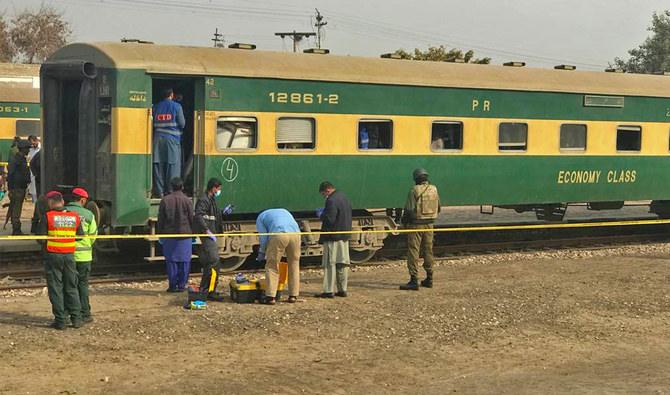
Investigators examine the train at the Chichawatni Railway Station in Pakistan on February 16, 2022, after an explosion on a Peshawar-bound train that killed two passengers. (AN Photo)
Short Url
Updated 16 February 2023
Follow

Explosion on Peshawar-bound train kills two passengers from Balochistan

  • The blast took place shortly after the train departed the Mian Channu Railway Station in Punjab province
  • No group has claimed responsibility for the attack, though Baloch separatists have targeted trains in the past

QUETTA: Balochistan Chief Minister Mir Abdul Quddus Bizenjo on Thursday demanded investigation into a train blast that killed at least two people and injured eight others while passengers from his province were traveling to the northwestern Peshawar city earlier in the day.

A senior police official confirmed the explosion took place in one of the washrooms shortly after the train departed the station in Mian Channu, a small town in Pakistan’s most populous Punjab province.

“Deeply saddened by the death of two passengers and injuries of several others in the explosion on the passenger train,” the chief minister was quoted in a statement issued by his office. “It is hoped the investigation will be completed soon and the causes of the explosion will be found.”
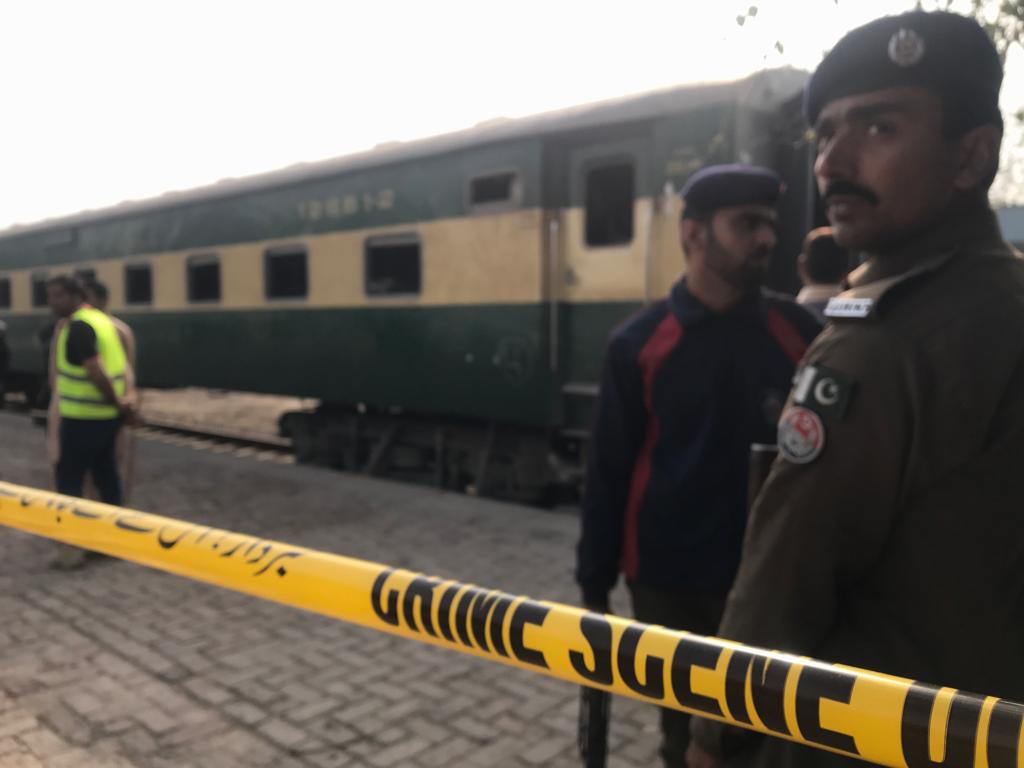


Security personnel cordon off an area of the Chichawatni Railway Station in Pakistan on February 16, 2022, after an explosion on a Peshawar-bound train that killed two passengers. (AN Photo)

Regional Police Officer Mehboob Rashid told reporters at the Chichawatni Railway Station, the next train stop, that the nature of the blast was not yet known.

“One female passenger was killed in the blast while eight others were injured and shifted to the District Headquarter Hospital,” he said soon after the incident.

Rashid said the Bomb Disposal Squad and police officials had started investigating the incident, saying they would share their findings with the media later.

“We heard a powerful explosion at 7:45am when the train departed the Mian Channu Railway Station,” said one of the passengers while speaking to Arab News. “There was a plume of black smoke inside the compartment and people started pulling the emergency chain to stop the train.”
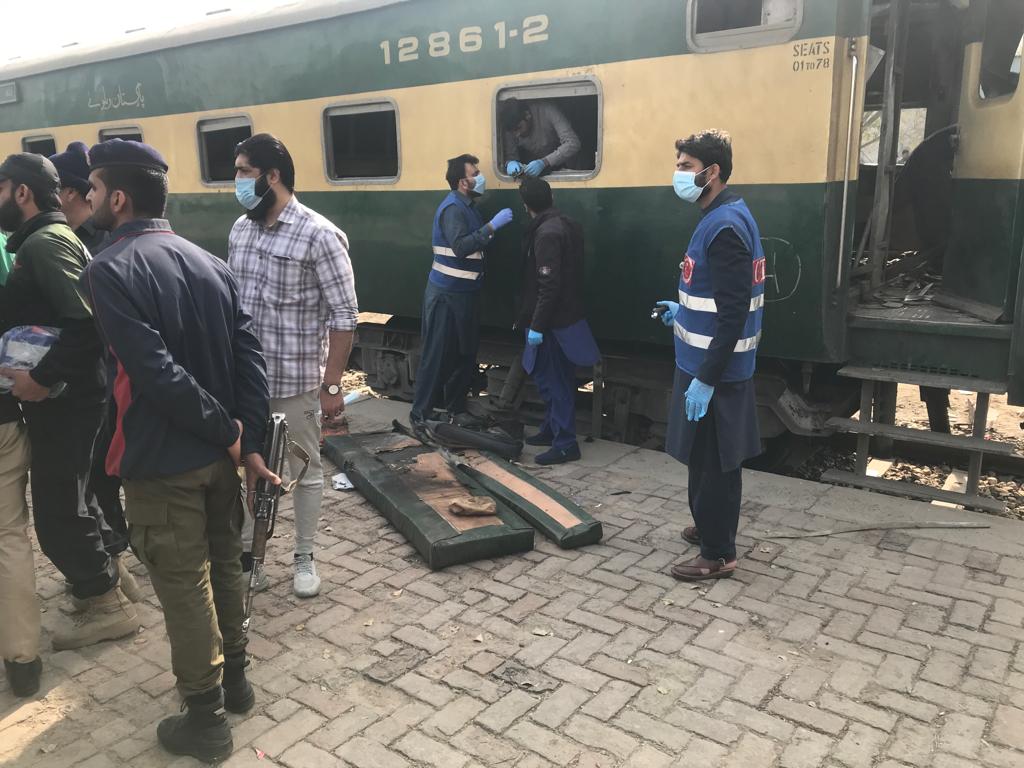


Investigators examine the train at the Chichawatni Railway Station in Pakistan on February 16, 2022, after an explosion on a Peshawar-bound train that killed two passengers. (AN Photo)

While no group has so far taken responsibility for the attack, Baloch separatist outfits have targeted the same train in the past.

Last month, at least 15 passengers were injured after the Balochistan Liberation Army bombed Jaffar Express near Sibi.


Pakistan highlights economic reforms at Davos, eyes cooperation in AI, IT and minerals

Updated 30 min 5 sec ago
Follow

Pakistan highlights economic reforms at Davos, eyes cooperation in AI, IT and minerals

  • Prime Minister Shehbaz Sharif speaks at breakfast event in Davos at sidelines of World Economic Forum summit
  • Pakistan, rich in gold, copper reserves, has sought cooperation with China, US, Gulf countries in its mineral sector

ISLAMABAD: Prime Minister Shehbaz Sharif highlighted Pakistan’s recent economic reforms during the sidelines of the ongoing World Economic Forum (WEF) summit in Davos on Wednesday, saying that his country was eyeing greater cooperation in mines and minerals, information technology, cryptocurrency and artificial intelligence with other states. 

The Pakistani prime minister was speaking at the Pakistan Pavilion in Davos on the sidelines of the WEF summit at a breakfast event. Sharif arrived in Switzerland on Tuesday to attend the 56th annual meeting of the WEF, which brings together global business leaders, policymakers and politicians to speak on social, economic and political challenges. 

Pakistan has recently undertaken several economic reforms, which include removing subsidies on energy and food, privatization of loss-making state-owned enterprises and expanding its tax base. Islamabad took the measures as part of reforms it agreed with the International Monetary Fund (IMF) in exchange for a financial bailout package. 

“We are now into mines and minerals business in a big way,” Sharif said at the event. “We have signed agreements with American companies and Chinese companies.”

Islamabad has sought to attract foreign investment in its critical minerals sector in recent months. In April 2025, Pakistan hosted an international minerals summit where top companies and government officials from the US, Saudi Arabia, China, Türkiye, the UK, Azerbaijan, and other nations attended.

Pakistan is rich in gold, copper and lithium reserves as well as other minerals, yet its mineral sector contributes only 3.2 percent to the countrys GDP and 0.1 percent to global exports, according to official figures.

Sharif said Pakistan has been blessed with infinite natural resources which are buried in its mountains in the northern Gilgit-Baltistan, Khyber Pakhtunkhwa, Azad Kashmir and southwestern Balochistan regions. 

“But we have now decided to go forward at lightning speed,” he said. “And we are also moving speedily in the field of crypto, AI, IT.”

He said the government’s fiscal and economic measures have reduced inflation from nearly 30 percent a few years ago to single-digit figures, adding that its tax-to-GDP ratio had also increased from 9 to 10.5 percent. 

The prime minister admitted Pakistan’s exports face different kinds of challenges collectively, saying the country’s social indicators needed to improve. 

“But the way forward is very clear: that Pakistan has to have an export-led growth,” he said. 

SHARIF MEETS IMF MANAGING DIRECTOR

Separately, Sharif met IMF Managing Director Kristalina Georgieva on improvements in Pakistan’s macroeconomic indicators, efforts toward stability and progress on institutional reforms, a statement from Sharif’s office said.

He emphasized Pakistan’s commitment to fiscal discipline, revenue mobilization and sustainable development, it added. 

The IMF managing director acknowledged and appreciated Pakistan’s reform efforts, the Prime Minister’s Office (PMO) said.

“Both sides exchanged views on the global economic outlook, challenges facing emerging economies, and the importance of multilateral cooperation in safeguarding economic stability,” the PMO said.