

Economic crisis dims joy of Ramadan lanterns in Egypt

1 / 3
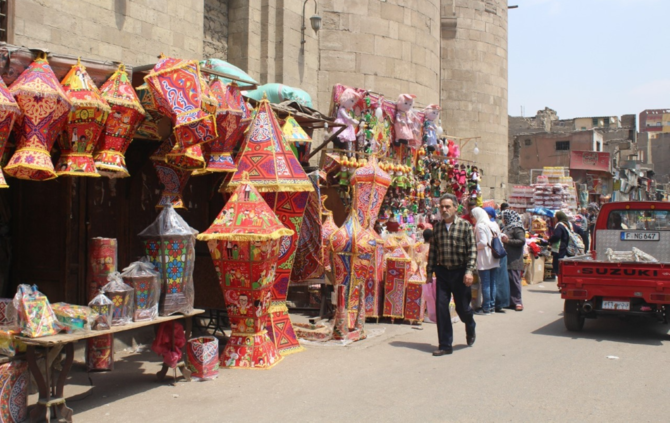
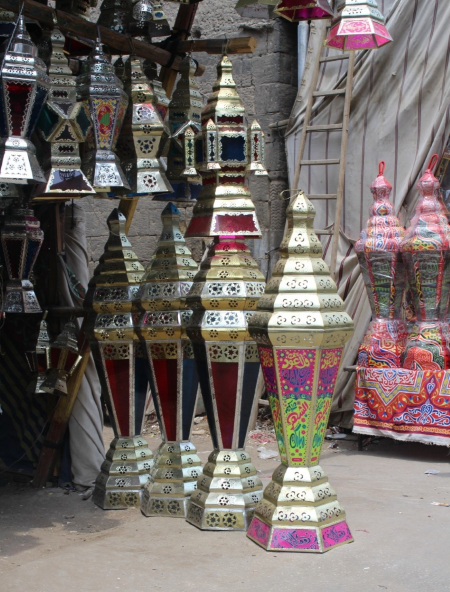
Lanterns on sale in a Cairo market. (AN Photo)
2 / 3
Lanterns on sale in a Cairo market. (AN Photo)
3 / 3
Lanterns on sale in a Cairo market. (AN Photo)
Short Url
Updated 14 February 2023
Follow

Economic crisis dims joy of Ramadan lanterns in Egypt

  • Egyptian lantern-making business in full swing at workshops in Taht Al-Rabaa, near Cairo’s Al-Azhar district
  • Cheaper Chinese-made lantern pressurizing Egyptian equivalent in the marketplace

CAIRO: With about a month left until the start of the holy month of Ramadan, the Egyptian lantern-making business is in full swing at workshops in the Taht Al-Rabaa area near Cairo’s Al-Azhar district.

The most popular national item in the festive season is the metallic lantern that features different shapes printed on glass. Other lanterns are made using fabric and wood.

Their production begins at least two months before Ramadan, with each workshop known for making lanterns in a specific shape.

Ahmed Abdel Nasser, the owner of a workshop in the Al-Hussein area, said: “The most expensive lanterns are about two meters high and are produced according to demand. However, the rising cost of raw materials has caused a price increase for lanterns in the market this year.”

Fadi Sayed, a lantern maker in the area, complained about the lack of sales, saying that customers come to see lanterns but often do not buy an item “because of the economic crisis and the high prices.”

Customers prefer lower-priced Chinese lanterns instead, he added, noting the higher cost of materials and labor in the production of Egyptian-made items.

Hana Tawhid, a housewife and mother of two, used to buy Ramadan supplies such as lanterns and mattresses from the Taht Al-Rabaa area. This year, however, she opted for plastic lanterns, which cost no more than 50 Egyptian pounds ($1.7) each.

To provide an affordable alternative to pricey imported gifts and lanterns, the Egyptian government, through the National Council for Women, conducted a workshop to train women in the manufacturing of Ramadan lanterns using beads.

Malls, hotels and offices are decorated at night with the colorful lanterns, known as fanous in Arabic.

The fanous has become a worldwide symbol that represents the holy month.


NGOs condemn settler attack on activists in West Bank

Updated 5 sec ago
Follow

NGOs condemn settler attack on activists in West Bank

  • Herzog said on X he strongly condemned the violence that “stands in complete opposition to the values of the State of Israel“
  • The attack occurred in the Palestinian village of Qusra in the northern West Bank

JERUSALEM: Two Israeli NGOs denounced an attack Friday in which settlers used sticks to beat two activists in the occupied West Bank, calling the incident “state violence” and “Jewish terrorism.”
Israeli President Isaac Herzog said on X he strongly condemned the violence that “stands in complete opposition to the values of the State of Israel.”
“This serious incident adds to a series of recent... unacceptable events that harm, above all, the (West Bank colonization) enterprise and the reputation of the State of Israel,” he added.
The attack occurred in the Palestinian village of Qusra in the northern West Bank.
Israeli human rights group B’Tselem released a video filmed by one of the activists, which showed at least four masked men armed with sticks jumping out of a four-wheel drive vehicle that arrived at high speed.
Someone was then heard yelling “No, please, no” in Hebrew, followed by thuds and cries of pain, before the attackers departed.
Two people were left on the ground, one of them motionless and stretched out face down with a bleeding head.
Israeli emergency service Magen David Adom said the two wounded individuals, who are in their fifties, were taken by helicopter to a hospital in Israel.
The Israeli military said it was searching for suspects.
Excluding Israeli-annexed east Jerusalem, more than 500,000 Israelis live in West Bank settlements and outposts, which are illegal under international law.
Around three million Palestinians live in the territory, which Israel has occupied since 1967.
In recent months, attacks attributed to Israeli settlers have multiplied in the West Bank, targeting Palestinians, Israeli and foreign anti-settlement activists and sometimes Israeli soldiers.
The Israeli government, considered one of the most right-wing in the country’s history, has fast-tracked settlement expansion.
B’Tselem said “the unrestrained attacks carried out by settlers throughout the West Bank constitute state violence.”
“They are carried out with full backing, participation, and assistance from state authorities, as part of a strategy of Israel’s apartheid regime seeking to advance and complete the takeover of Palestinian land,” it added.
Avi Dabush, executive director of Rabbis for Human Rights, said “the blood of our friends is on the hands of those who support and finance Jewish terrorism, either directly, through the government or by turning a blind eye.”
He also condemned “the army’s impotence” in a statement that called on “Israeli society to pull itself together ... in order to put an end to this endemic terrorism.”
