Lanterns bring touch of Cairo to Jeddah

1 / 6
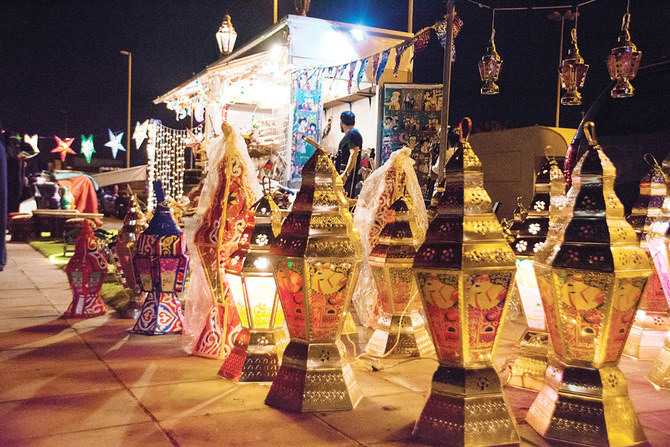
A stall in Jeddah’s Al-Shati’i district sells lanterns that are a hit with Saudi customers. (AN photo by Huda Bashatah)
2 / 6
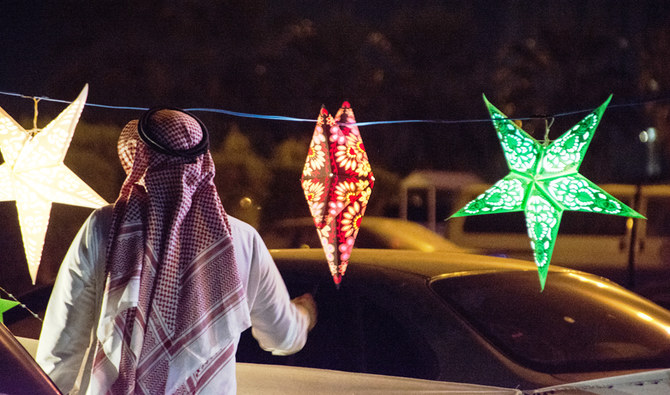
A stall in Jeddah’s Al-Shati’i district sells lanterns that are a hit with Saudi customers. (AN photo by Huda Bashatah)
3 / 6
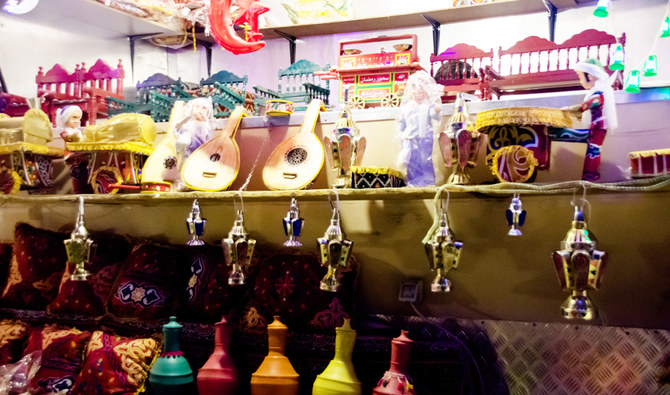
A stall in Jeddah’s Al-Shati’i district sells lanterns that are a hit with Saudi customers. (AN photo by Huda Bashatah)
4 / 6
A stall in Jeddah’s Al-Shati’i district sells lanterns that are a hit with Saudi customers. (AN photo by Huda Bashatah)
5 / 6
6 / 6
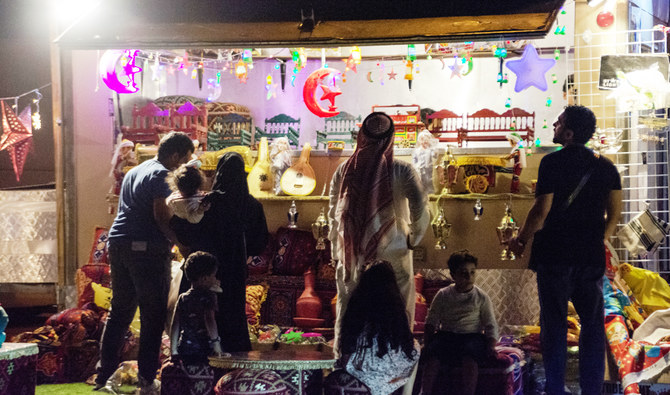
A stall in Jeddah’s Al-Shati’i district sells lanterns that are a hit with Saudi customers. (AN photo by Huda Bashatah)
Updated 11 May 2019
Follow

Lanterns bring touch of Cairo to Jeddah

  • Kiosk selling Ramadan lanterns is a huge hit with shoppers
  • Entrepreneur took a leap of faith in what he thought Saudi customers would like

JEDDAH: Outside a makeshift store in Jeddah’s lively Al-Shati’i district, shoppers crowd around brightly colored lanterns that are shaped like crescent moons and stars. Other lanterns are on the ground, adding a jewel-like glow to the evening.   

The stall was set up by Zuhair Omar Shami and his business partner Ra’ed after they came across traditional Egyptian lanterns during a trip to Cairo.

“We started our business about eight or nine years ago, when this culture was foreign to us and nobody knew what Ramadan lanterns were,” said Shami. “I acquired these lanterns from Egypt and, through my visits, decided to go ahead and introduce them to the Saudi market.” 

Shami took a leap of faith in what he thought Saudi customers would like and it was a hit, with customers flocking to buy the festive and pretty lanterns.

The initial success encouraged him to develop the business by bringing in other items he thought people would be interested in, such as furniture and soft furnishings. 

“We get a lot of people who are seeing this for the first time,” said Shami. “They stop in their cars to peruse and ask us about our products, while others are in disbelief about finding them in the city.” 

Their shop opens five days into Sha’aban, the Hijri month preceding Ramadan, outside Al-Sawary Mall in Al-Zahra. 

From then until the beginning of Ramadan the entrepreneurs are busy at their kiosk helping customers to pick out the right lantern. 

Shami said they have never considered changing their location as it is where they started and where they became a hit. It is also where loyal customers come every year to find them. 

“We settled here because it is a lively part of the city that combines all segments of society, and that is our target audience because our prices also cater to everyone,” he said. “At the start of Sha’aban we handle backorders and deliver our items and decorate homes, gardens, and even cafes and events.”


Healthcare must be ‘proactive’ says Hevolution exec

Updated 20 December 2025
Follow

Healthcare must be ‘proactive’ says Hevolution exec

  • Princess Dr. Haya bint Khaled bin Bandar Al-Saud spoke to Arab News at a presentation of its second Global Healthspan Report

RIYADH: Healthcare needs to shift to a global model that targets preventing disease rather than treating it, a senior executive from the Saudi-funded Hevolution Foundation told Arab News.

The senior vice president of research of Hevolution, Princess Dr. Haya bint Khaled bin Bandar Al-Saud, spoke to Arab News at a presentation of its second Global Healthspan Report at the nonprofit’s headquarters in Riyadh’s KAFD on Wednesday.

“People have to be aware, healthcare has to change its way of thinking, because it’s a must,” she said. “We cannot be reactive anymore, we have to be proactive.

“And this has to start earlier in the education of health professionals, and third, someone needs to take this to the global agenda. The general public needs to know that this is a reality.” 

Launching its report, Hevolution called for urgent global action to treat healthy aging as an economic imperative, where prevention, not disease, drives prosperity.

The organization focuses on healthspan research, or extending the healthy human lifespan.

The findings of the report centered around five main areas; rising awareness and public demand, breakthrough science and new therapies, AI and data revolution, investment momentum and gaps and economic and policy imperatives.

The report detailed the momentum of a new healthspan era where science, technology and public awareness are converging, but momentum alone is not enough.

Al-Saud explained that achieving equitable and evidence-based progress would require coordinated leadership from scientists, policymakers and investors alike.

“Today, science and societal cause has to be integrated, meaning the public needs to know that everything that we are investing in is for the general population, not just on a local level but on a global level,” she said.

The report surveyed 23 countries on the awareness of healthspan, which found that two-thirds of healthcare professionals now receive patient inquiries about healthspan interventions at least once a month, with one-third reporting them weekly.

Al-Saud highlighted that the report also found that 80 per cent of citizens believed governments should fund preventive care programs, while 39 per cent expressed concern about inequality in access.

“Awareness is the most important thing. This subject touches every single one of us, every single one of us has a story that this relates to, whether a grandparent, sick parent, or us,” she said.

Under artificial intelligence the report found that 74 per cent of experts believe AI will transform healthspan R&D and healthcare delivery, yet 26–30 per cent remain opposed to AI in diagnostics, reflecting an ongoing trust and ethics gap.

The report detailed that 59 per cent of investors cite lack of awareness as the top barrier while 46 per cent point to limited experts, unclear evidence and weak regulatory frameworks.

“Between 2022 and 2024 the investments in healthspan has doubled, it’s estimated to be $7 billion invested in finding interventions in healthspan globally,” Al-Saud said.

Investment in healthspan reached $7.33 billion in 2024, up from $3.48 billion the previous year. The average deal size has grown 77 per cent since 2020, signaling maturing confidence in the sector.

“Hevolution Foundation remains the world’s largest philanthropic backer of aging biology and healthspan science, with $400 million allocated in over 230 grants, 25 partnerships, and four biotech ventures,” Al-Saud said.

According to a report from Hevolution, expanding could deliver up to $220 billion annually in productivity gains, and every $1 invested in prevention could yield $16 in returns.

“We always want to support scientists but the end-consumer is the general public,” Al-Saud said.

Hevolution has remained true to its mission since its foundation; to extend healthy human lifespan for all, mobilizing the science, innovation and investment needed to make healthier longer lives a shared global reality.

Established by royal decree in 2018 and launched in 2021, Hevolution Foundation is a non-profit organization that focuses on accelerating independent research and entrepreneurship in the emerging field of healthspan science.

Headquartered in Riyadh, Saudi Arabia, with a North American hub in Boston, the foundation says it has plans for further international expansion, and has set key goals and targets to advance its vision and mission.