Afghan journalists win case against UK government over relocation

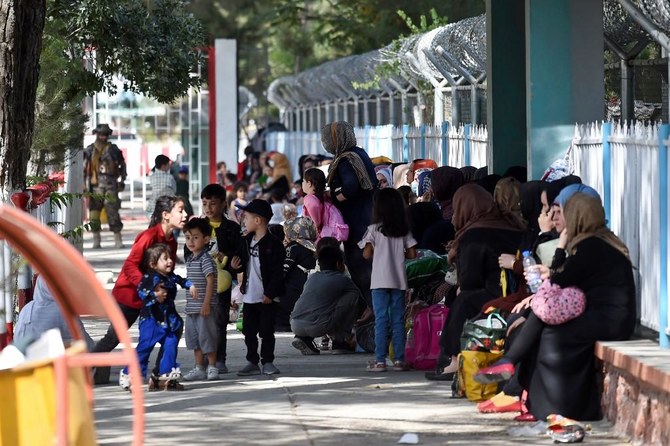
Eight Afghan journalists who worked for the BBC won a legal challenge on Monday against Britain’s refusal to relocate them from Afghanistan. (File/AFP)
Short Url
Updated 13 February 2023
Follow

Afghan journalists win case against UK government over relocation

  • Government representatives had argued that none of the eight were eligible for relocation under Afghan Relocation and Assistance Policy program

LONDON: Eight Afghan journalists who worked for the BBC broadcaster won a legal challenge on Monday against Britain’s refusal to relocate them from Afghanistan, which they said put them at high risk of being killed by the Taliban rulers.
The journalists’ lawyers told London’s High Court in December that the government had “betrayed the debt of gratitude” owed to them by refusing to relocate them after the Taliban’s takeover of Afghanistan in August 2021.
Representatives for the government had argued that none of the eight were eligible for relocation under its Afghan Relocation and Assistance Policy (ARAP) program.
David Blundell, a lawyer for the Ministry of Defense, said the Taliban’s perception that the BBC is a part of the British government was irrelevant.
But Judge Peter Lane said in a written ruling that the perception was “clearly relevant” to the risks the journalists faced.
The decision on whether to relocate the eight will now have to be taken again, which their lawyers said would have be done within three weeks.
The journalists were embedded with military personnel and worked on British government-funded projects, the lawyers said.
As part of their work, they spoke out against the Taliban and exposed corruption and abuse, resulting in numerous threats and attacks by Taliban fighters, the lawyers added.
Erin Alcock, who represented the journalists, said her clients have been “living in fear for over 18 months.”
A spokesperson for the Ministry of Defense said the department does not comment in detail on specific legal cases, but was considering potential next steps.


OpenAI’s Altman says world ‘urgently’ needs AI regulation

Updated 57 min 31 sec ago
Follow

OpenAI’s Altman says world ‘urgently’ needs AI regulation

  • Sam Altman, head of ChatGPT maker OpenAI, told a global artificial intelligence conference on Thursday that the world “urgently” needs to regulate the fast-evolving technology

NEW DELHI: Sam Altman, head of ChatGPT maker OpenAI, told a global artificial intelligence conference on Thursday that the world “urgently” needs to regulate the fast-evolving technology.
An organization could be set up to coordinate these efforts, similar to the International Atomic Energy Agency (IAEA), he said.
Altman is one of a host of top tech CEOs in New Delhi for the AI Impact Summit, the fourth annual global meeting on how to handle advanced computing power.
“Democratization of AI is the best way to ensure humanity flourishes,” he said on stage, adding that “centralization of this technology in one company or country could lead to ruin.”
“This is not to suggest that we won’t need any regulation or safeguards,” Altman said.
“We obviously do, urgently, like we have for other powerful technologies.”
Many researchers and campaigners believe stronger action is needed to combat emerging issues, ranging from job disruption to sexualized deepfakes and AI-enabled online scams.
“We expect the world may need something like the IAEA for international coordination of AI,” with the ability to “rapidly respond to changing circumstances,” Altman said.
“The next few years will test global society as this technology continues to improve at a rapid pace. We can choose to either empower people or concentrate power,” he added.
“Technology always disrupts jobs; we always find new and better things to do.”
Generative AI chatbot ChatGPT has 100 million weekly users in India, more than a third of whom are students, he said.
Earlier on Thursday, OpenAI announced with Indian IT giant Tata Consultancy Services (TCS) a plan to build data center infrastructure in the South Asian country.