
KABUL: When many major international organizations stopped operations in Afghanistan two years ago, millions of Afghans were left without lifesaving assistance and forced to fend for themselves, as the country plunged into humanitarian and economic crisis.
Development projects worth billions of dollars came to a halt in Afghanistan in late 2021, after donor countries froze aid and cut the country off from the global financial system as the Taliban took control.
The measures triggered the collapse of war-ravaged Afghanistan’s already fragile economy. The UN estimates that more than 28 million Afghans, or 70 percent of the population, are now in need of humanitarian assistance, with some 6 million at risk of famine.
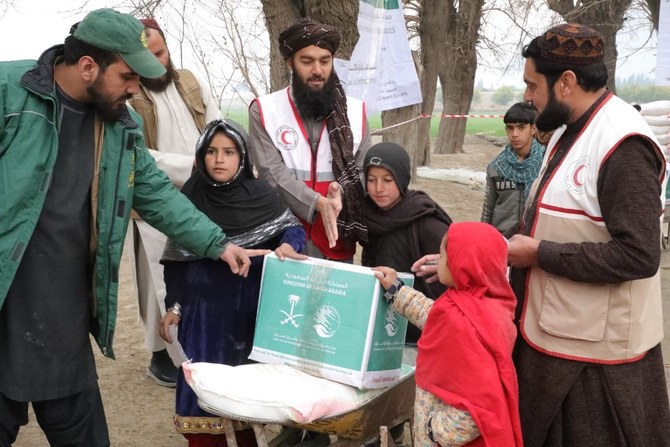
It is in these circumstances that the King Salman Humanitarian Aid and Relief Center remains on the ground as one of the few organizations continuing to distribute aid to the most vulnerable communities, where people are turning to desperate measures to feed their families.
KSrelief’s projects during the winter are focused on providing food where no other sources of it are available, and where some people cannot even afford to buy flour.
In February, aid reached eastern parts of Afghanistan, including Nuristan, Laghman and Nangarhar — the country’s second most-populous province, where the help was particularly needed after last year’s harvests were destroyed by natural disasters.
“A few months ago, people of Nangarhar suffered from floods and heavy rains and an earthquake,” Mia Najmuddin Helal, the Afghan Red Crescent Society director for the province, told Arab News.
“The disasters took the lives of some residents of Nangarhar and destroyed their homes and farmlands.”
The ARCS and the Organization of Islamic Cooperation are involved in the distribution of aid, as KSrelief aims to reach tens of thousands of families.
“It will provide food packages to 47,400 families in 25 provinces of Afghanistan in the ongoing year,” said Ahmad Nasari, deputy humanitarian aid director at the OIC Mission in Kabul.
“Each family will be given 62 kg of food items ... each package contains flour, ghee, sugar, beans and dates.”
Those who have received the aid, like 27-year-old Maiwand Omaid, say it is crucial in the face of a 25 percent unemployment rate and during the freezing winter months.
“People have been not able to pay for food and non-food items in the ongoing winter season throughout Afghanistan. A big number of our countrymen have lost their jobs after the Taliban took control of Afghanistan,” Omaid told Arab News.
Mohammad Numan, 34, who received food assistance in Kabul last week, breathed a sigh of relief as it will help his family stay afloat for some time.
“I want to thank the KSrelief for providing food packages to the needy and poor families across Afghanistan,” he said.
“In this hard time, what I have received will definitely help meet my family’s needs for a while.”