

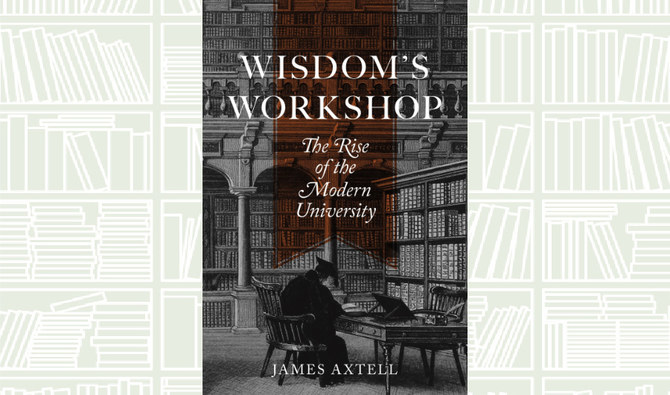
What We Are Reading Today: Wisdom’s Workshop: The Rise of the Modern University

Short Url
Updated 13 February 2023
Follow

What We Are Reading Today: Wisdom’s Workshop: The Rise of the Modern University

Author: Jamex Axtell

When universities began in the Middle Ages, Pope Gregory IX described them as “wisdom’s special workshop.” He could not have foreseen how far these institutions would travel and develop.

Tracing the eight-hundred-year evolution of the elite research university from its roots in medieval Europe to its remarkable incarnation today, “Wisdom’s Workshop” places this durable institution in sweeping historical perspective.

In particular, James Axtell focuses on the ways that the best American universities took on Continental influences, developing into the finest expressions of the modern university and enviable models for kindred institutions worldwide.


What We Are Reading Today: A Capital’s Capital

Updated 16 February 2026
Follow

What We Are Reading Today: A Capital’s Capital

Authors: Gilles  Postel-Vinay and Jean-Laurent Rosenthal

Successful economies sustain capital accumulation across generations, and capital accumulation leads to large increases in private wealth. In this book, Gilles Postel-Vinay and Jean-Laurent Rosenthal map the fluctuations in wealth and its distribution in Paris between 1807 and 1977. 

Drawing on a unique dataset of the bequests of almost 800,000 Parisians, they show that real wealth per decedent varied immensely during this period while inequality began high and declined only slowly. 

Parisians’ portfolios document startling changes in the geography and types of wealth over time.

Postel-Vinay and Rosenthal’s account reveals the impact of economic factors (large shocks, technological changes, differential returns to wealth), political factors (changes in taxation), and demographic and social factors (age and gender) on wealth and inequality.

Before World War I, private wealth was highly predictive of other indicators of welfare, including different forms of human capital, age at death, and access to local public goods.
