

US business delegation to visit Kingdom to explore opportunities in different sectors

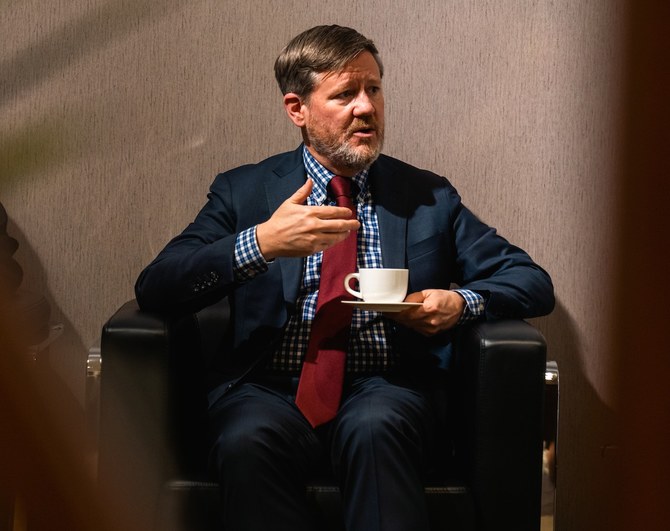
Steve Lutes, vice president for Middle East affairs at the US Chamber of Commerce, during an interview with Arab News in Riyadh. AN photo by Abdulrahman Shalhoub
Short Url
Updated 12 February 2023
Follow

US business delegation to visit Kingdom to explore opportunities in different sectors

RIYADH: Representatives from the US Chamber of Commerce are in Saudi Arabia to lay down the groundwork for the arrival of a large business delegation later this year to explore mutual investment opportunities.

In an exclusive interview with Arab News, Steve Lutes, vice president for Middle East affairs at the US Chamber of Commerce, said the delegation will focus on innovation and knowledge-based economic growth.

“It very much fits into what we think is our strength, which is exactly that: It’s to, on the American side, expose more companies to what are (the) vast opportunities here (in Saudi Arabia) across the whole economy, and fit into the goal of Vision 2030, which is to diversify the (Saudi) economy,” the top official said.

The delegation will target several sectors including healthcare, life sciences, genomics, sustainable living, green energy and tech, climate solutions, and the digital space.

During his previous visit to the Kingdom, Lutes lauded the fast-growing infrastructure in the Kingdom and the positive approach toward emerging economic sectors.

“Be it food security, or energy transition, harnessing the future of the digital space, whether it be AI or fintech, there is just so much to do in that space. Bringing US companies, which in our mind are first in class, to come and partner with Saudi companies or to pursue relationships with the Saudi government, and some of those bigger tender opportunities — there’s just a lot to do here,” he told Arab News.

During his current visit, the US Chamber official will hold meetings with the officials of the economy, commerce, investment, and communications and IT ministries and other entities to discuss the fundamental framework of the delegation’s agenda.

The two countries collaborate through several platforms, one of which is the US-Saudi Business Leaders Forum. It is held on rotation and this year’s forum, according to Lutes, will be held in Riyadh. He hopes to integrate the business delegation into the forum.

The US Chamber is also looking to launch a US-Saudi Sustainability Working Group and meet Saudi Minister of State for Foreign Affairs Adel Al-Jubeir to publish a report profiling what US companies are doing to advance partnerships within the Kingdom’s circular economy and Saudi Green Initiative goals.

“We want to highlight what the US companies are doing because too often, people don’t understand how advanced Saudi Arabia is on that, but they don’t understand that often that US companies are aggressively involved in supporting that,” Lutes said.

The official commended the open-door policy of Saudi ministries, as they always welcome the feedback from their US counterparts on policy drafts. He said that their collaboration has been a very “fruitful process.”

“We’ve been very focused on the PDPL, the personal data protection law. To (MCIT’s) credit, there have been great advances from prior drafts,” he said.

The US Chamber of Commerce’s visit will also be an inquiry into the UN Climate Change Conference (COP28), which will be held in the UAE this year, and how they can support and be involved in the conference while also bolstering Saudi Arabia’s role in it.


Saudi exchange leads GCC in foreign net buying in 2025, hits $5.5bn: Kamco Invest

Updated 10 sec ago
Follow

Saudi exchange leads GCC in foreign net buying in 2025, hits $5.5bn: Kamco Invest

RIYADH: Foreign investors poured $5.5 billion into the Saudi exchange in 2025, the highest net buying in the Gulf Cooperation Council, an analysis showed. 

In its latest report, Kamco Invest said the Kingdom was followed by the Abu Dhabi and Kuwait exchanges, which saw net foreign inflows of $3.4 billion and $1.5 billion, respectively, over the 12 months.

Dubai and Qatar also registered net buying in 2025, amounting to $1.3 billion and $171 million, respectively. 

The steady performance in the majority of exchanges in the region comes as GCC equity markets continue to attract global capital, buoyed by strong corporate earnings and ongoing economic reforms.

“The yearly trend indicated continued positive activity by foreign investors on GCC exchanges in 2025, although total buying declined over the course of the year,” said Kamco Invest in the report. 

According to the analysis, the Oman Exchange recorded the largest net sales by foreign investors in 2025 at $440 million, followed by Bahrain, which posted net sales of $10.3 million. 

In the fourth quarter of 2025, net buying by foreign investors in the Kingdom stood at $1 billion, followed by Oman at $86.6 million. 

All other exchanges, excluding the Kingdom and Oman, witnessed a net selling trend in the fourth quarter. 

“Quarterly trading data showed that foreign investors were net sellers in Q4-2025 on all exchanges barring Saudi Arabia and Oman. Saudi Arabia recorded net foreign buying of $1 billion, while Oman saw net inflows of $86.6 million during the (fourth) quarter, partially offsetting the overall net sales across the region,” added Kamco Invest. 

Foreign investors were the biggest sellers of Abu Dhabi stocks with net sales of $1 billion during the quarter, followed by Kuwait at $187.9 million, Bahrain at $45.6 million, and Qatar at $8.8 million. 

Saudi Arabia and Oman also recorded consecutive net buying by foreign investors across all three months of the fourth quarter, signaling rising investor interest in these countries. 

Dubai exhibited a net selling trend during the first two months of the fourth quarter, which subsequently reversed to net buying in the final month of the year. 

Qatar registered net buying in the first month of the quarter before shifting to net selling in the second month, and returned to net buying in the final month.

The UAE and Kuwait exchanges experienced consistent net selling by foreign investors across all three months of the fourth quarter.

Kamco Invest said that the key factors which affected the flow of foreign money in the region included regional market trends, economic health of individual countries and crude oil prices.