RIYADH: A senior US official remains optimistic that Saudi-American trade relations will flourish — in contrast to the dire predictions of many Western pundits that recent political disagreements might hinder the ongoing strategic and mutually beneficial 80-year relationship between the two nations.
US-Saudi economic relations can be taken to a “new level,” according to Arun Venkataraman, assistant secretary of commerce for global markets and director general of the US and Foreign Commercial Service.
“What we see here in Saudi Arabia under the leadership of King Salman and Crown Prince Mohammed bin Salman is a spectacular transformation that began as a result of Vision 2030.”

Saudi Arabia’s King Salman meets with US President Joe Biden. (File/AFP)
Venkataraman expressed his pleasure at being able to witness the changes in person. “And what is most impressive is that we see Vision 2030 already being implemented. So, it is not just a vision; it is becoming a reality and I am so pleased to be here and see it in person.”
The reason behind his visit and meetings in Saudi Arabia was explained in this way. “We hope through our meetings to build on the existing commercial work plan designed to strengthen our commercial partnership, which is so critical, and which underpins the strong strategic relationship between our two nations.”
Furthering commercial relations is at the top of his agenda in addition to deepening the already existing partnership. “We know there are many areas for collaboration in the business between our governments. The opportunities we have, and the way they complement our economies and our private sectors, are so vast that we want to make sure we take full advantage of them. Only by doing so can we be sure that the actions will benefit both our peoples.”

Assistant secretary of commerce for global markets and director general of the US and Foreign Commercial Service, Arun Venkataraman. (Supplied)
Since the launch of Vision 2030 in 2016, the Kingdom has gone through significant transformations on several fronts, including the empowering of women and diversifying the economy. Venkataraman called the transformations “game changers.”
“We see women taking their rightful place in professional society and in driving the work of both the private sector and the government. In meeting both American and Saudi companies today, I was really taken with the fact that both groups of companies emphasized how much they depend on women to fill the talent gaps. In addition, they are looking to women to be the future leaders in their companies in Saudi Arabia.
 During his trip to Riyadh, Venkataraman held many meetings but what stood out the most for him was the Apple Academy at Princess Nourah University. “The first visible sign is noting how women have taken on a new role. In my visit to the Apple Academy, it was so inspiring to see the university supporting the young women’s skills development in a space that women have really not until now been present in, either in Saudi Arabia or the United States.”
He was impressed with the level of skill the young women have acquired. “To see those young women develop the skills and start creating completely new apps out of the blue, and to see the passion and the pride that they exhibited in doing so was striking. That’s the kind of spirit and passion that is at the core of Vision 2030.”

US President Joe Biden can be seen during a trip to the Kingdom. (File/AFP)
Venkataraman noted that there had been diversification of the economy in many sectors. “We see that in the digital sector. We see that in the move to the development of clean energy, moving away from dependence on fossil fuels. We also see tremendous advances in healthcare, not only in terms of pharmaceuticals, but really looking at smaller, more cutting-edge areas of healthcare, like research, development and clinical trials.”
“I think we also see something of particular interest in the entertainment space. We know that Saudi Arabia has a long history of being a cultural leader in the region in terms of disseminating culture. To see it now, however, as it expands that role and gives our partnership special opportunities for American cultural industries, is really exciting.”

US President Joe Biden is received by Saudi Crown Prince Mohammed bin Salman during a visit to the Kingdom. (File/AFP)
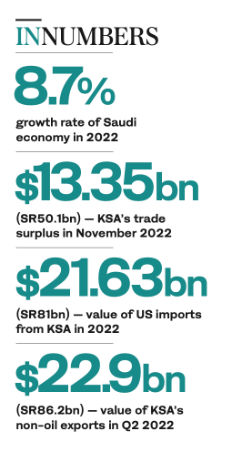
Commenting on the recent Bloomberg report that the Saudi economy had grown 8.7 percent in 2022, he said: “Saudi Arabia had a fantastic year last year with a growth rate that we could only wish the rest of the world had enjoyed, particularly as we emerged from COVID-19 in 2022. Saudi Arabia’s growth was historic.”

Arun Venkataraman was talking to Arab News assistant editor in chief Noor Nugali. (AN Photo)
According to Venkataraman, what that really shows is that “Vision 2030 is working. The intention to diversify the economy which the government is supporting is evident. It translates on the ground to what we are excited about from our perspective as the government pushes to diversify the economy.”
“We are proud that American companies have a role to play and can really greatly contribute to that diversification across a wide range of sectors. Such partnerships will further strengthen and underpin the strength of our bilateral relationship.”

US President Joe Biden is received by Saudi Crown Prince Mohammed bin Salman during a visit to the Kingdom. (File/AFP)
Venkataraman reiterated that relations between the two countries can only go one way — and that is up.
“I think we are fortunate to have such a strong broad-based foundation to our relationship. And what that means is that the commercial opportunities that exist are so vast that really, I see the opportunities as limitless. This is true whether we want to talk in terms of supporting Saudi Arabia through weapons sales, or whether we talk about supporting the movement away from fossil fuels by supporting clean energy development, or supporting the expanded role of tourism in the Saudi economy.”
“I think there are so many areas, both old and new, that will form the basis for the next stage of impactful, high-level economic activity between our two countries. I would say the future looks bright for our bilateral relations and I look forward to being a part of that relationship and facilitating it in the future.”


keywords