Saudi Arabia’s tourism appeal grows in India after roadshow

1 / 3
Indian visitors interact with representatives of Saudi Arabia's tourism industry at the South Asian Travel and Tourism Exchange in Noida, in the Indian capital region, on Feb. 11, 2023. (AN Photo)
2 / 3
A poster advertises Saudi Arabia's pavilion at the South Asian Travel and Tourism Exchange in Noida, in the Indian capital region, on Feb. 11, 2023. (AN Photo)
3 / 3
Saudi Arabia's pavilion at the South Asian Travel and Tourism Exchange in Noida, in the Indian capital region, is seen on Feb. 11, 2023. (AN Photo)
Short Url
Updated 12 February 2023
Follow

Saudi Arabia’s tourism appeal grows in India after roadshow

  • Saudi Tourism Authority organizes series of promotions in India to draw more visitors
  • Indians say Kingdom is becoming increasingly attractive to all kinds of tourists

NEW DELHI: A successful India roadshow organized by the Saudi Tourism Authority has boosted the Kingdom’s appeal in the country, with travel industry leaders forecasting it could soon compete with Dubai as a preferred destination for visitors.

Since the beginning of February, the STA has been taking part in a series of travel and trade events across India, including the One World Travel Market in Mumbai and the South Asian Travel and Tourism Exchange, which ran from Thursday to Saturday in Noida, in the Indian capital region.
At the SATTE, Asia’s leading platform for the tourism and hospitality industry, the STA established a huge pavilion promoting not only the traditional religious tourism destinations such as Makkah and Madinah, but also the Kingdom’s ancient sites and futuristic projects.
The promotion strategy immediately appealed to Indian visitors.
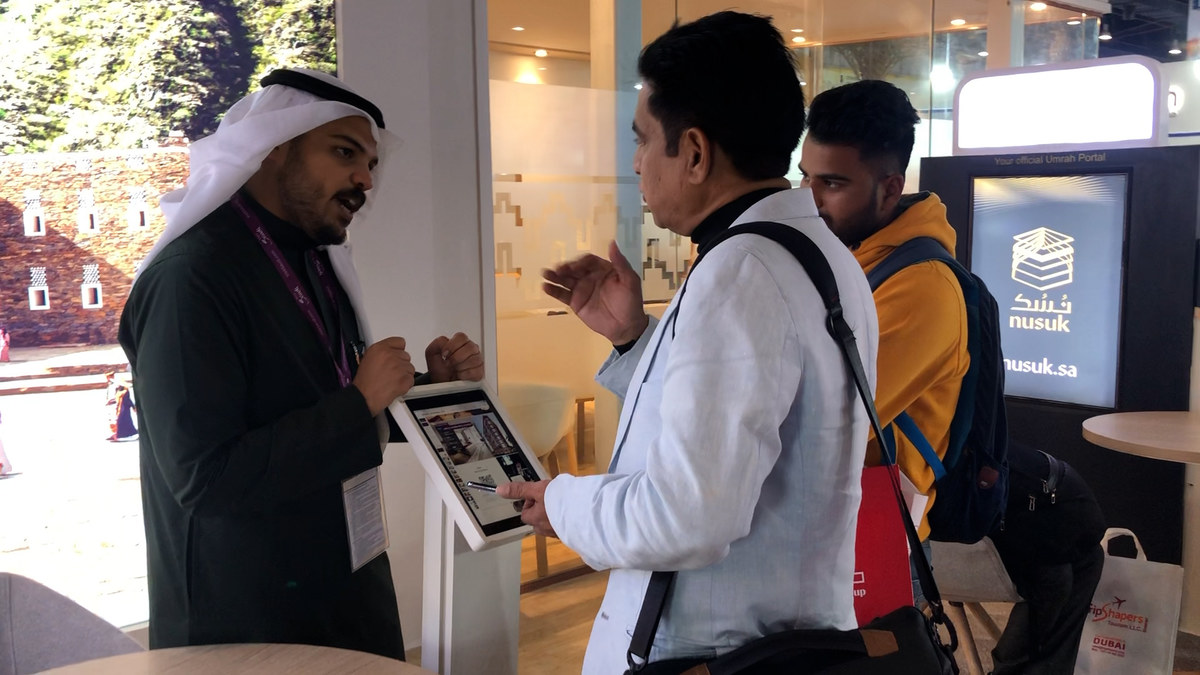


Indian visitors interact with representatives of Saudi Arabia's tourism industry at the South Asian Travel and Tourism Exchange in Noida, in the Indian capital region, on Feb. 11, 2023. (AN Photo)

“The marketing was so very well done — the posters, the flyers and signboards. Everywhere I could see ‘Visit Saudi Arabia.’ They are really doing good,” Sathiswaran Palanivel, a tourism professional from Chennai, told Arab News as he visited the Saudi pavilion.
The message he got from the exhibition was one of expansion, not only of the tourism industry in the Kingdom, but also of the visitor target — from religious tourists visiting the holy Muslim sites of Makkah and Madinah to a general audience seeking to explore historical places and nature.
“They are raising the client audience perfectly. The natural sites and places like AlUla can bring in more customers, all kinds of visitors,” Palanivel said.
“It’s a country for everyone, that’s what I felt, that’s what I’ve seen.”
Diksha Singh, a public relations professional from New Delhi, also observed the change in Saudi Arabia’s tourism strategy and the increasing appeal it has to all Indians, not only Muslims.
“The spiritual image was one large part of Indians traveling to Saudi, but now the preference has also changed. Many corporates or executives like to make their meetings in Saudi and they also like to travel there just for leisure, with their families,” she said.
“Saudi Arabia has been picking up as a great destination to travel for Indians. With the kind of publicity Saudis have been doing lately, many Indians want to visit Saudi Arabia.”
The appeal is also in the newness of many Saudi locations that have only recently opened for travelers. Many more are going to emerge in the coming years. Besides World Heritage sites such as AlUla, huge tourism development works are underway in the mountains of the southwestern Asir region and along the Red Sea coast, where visitors can experience not only luxury but also technological innovations that make tourism sustainable and environmentally friendly.
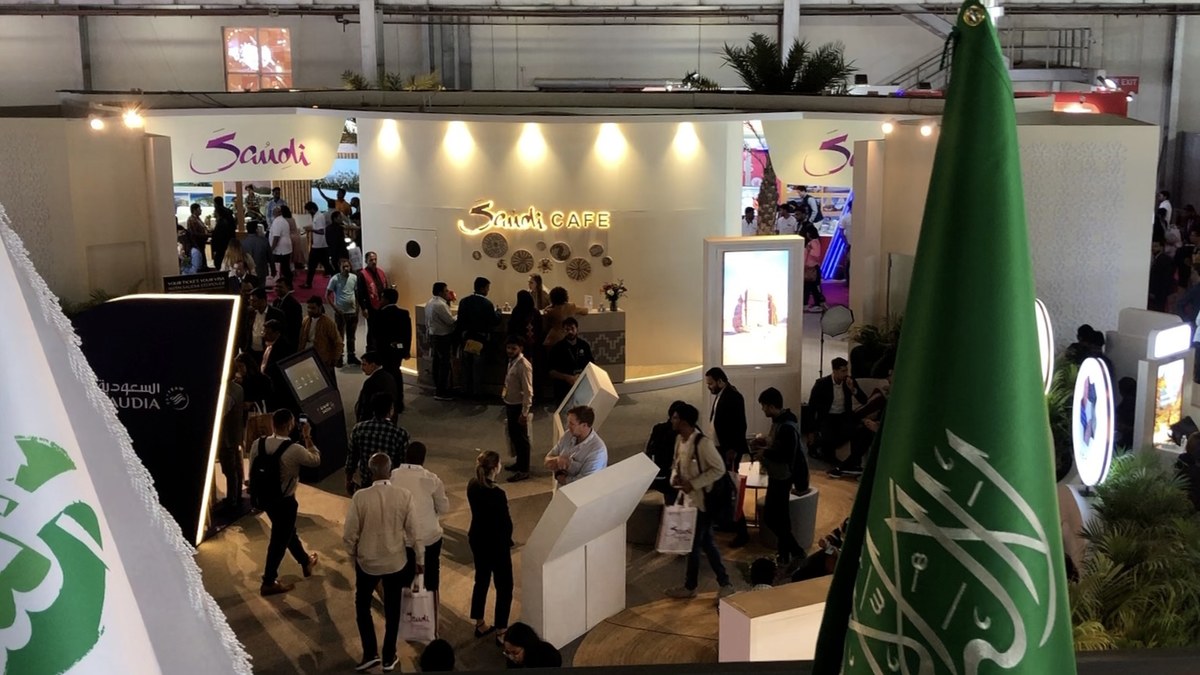


Saudi Arabia's pavilion at the South Asian Travel and Tourism Exchange in Noida, in the Indian capital region, is seen on Feb. 11, 2023. (AN Photo)

Abhishek Sharma, a tour operator who traveled over 200 km from Agra to take part in the exhibition, said that he wanted to explore new destinations that could cater to the Indian market.
“We already see that a lot of people have visited Europe, they have visited Thailand, they have visited Sri Lanka. Now they want to explore new places. Those people who have seen the world, they want to see the Saudi also, what type of culture they have,” he said.
“And the Saudis are bringing in some new destinations for them.”
Some Indian industry players, who have been observing the changes Saudi Arabia has undergone under Vision 2030, forecast that in the near future, tourism sites in the Kingdom may become more appealing to Indians than those in Dubai — their current favorite destination in the Middle East.
“The way Saudi Arabia is opening the economy and promoting tourism, it’s pretty clear that it can exceed anyone in the Gulf. Definitely,” said Nihal Mirza, a travel operator from New Delhi.
“They are doing a good job over here. This could be a better decision for tourism, better than Dubai. That’s very possible.”  
For Hotelier Vijendra Manocha, Saudi Arabia’s offerings are more diverse and appealing to a wider audience than what tourists may experience in Dubai.
“They are promoting islands where you can explore the local life of Saudi Arabia. You are not getting that in Dubai,” he told Arab News.
“In Dubai you get luxurious life, in Saudi Arabia you get culture also.”


Ministry of Culture-backed incubator helped Jeddah local create her first graphic novel

Saudi visual storyteller Noura Alashwali’s debut graphic novel began as a way to process grief in private. (Supplied)
Updated 04 January 2026
Follow

Ministry of Culture-backed incubator helped Jeddah local create her first graphic novel

  • ‘I feel seen,’ says Saudi storyteller Noura Alashwali

JEDDAH: Visual storyteller Noura Alashwali is one of a generation of Saudi artists whose personal journeys mirror the Kingdom’s cultural transformation, meaning their creative impulses are increasingly backed by public institutions and have an audience ready to listen.

“Creative expression was never just a hobby for me; it was a need,” Alashwali, 37, told Arab News. “From a young age, whether through writing or drawing, creativity felt like a part of who I was. And it still is.”

It was her education at Dar Al-Hekma University, where she obtained a degree in graphic design, that gave structure and language to an instinct she had carried since childhood. 

Saudi visual storyteller Noura Alashwali’s debut graphic novel began as a way to process grief in private. (Supplied)

“My earliest memory of drawing with pen and paper is when I was four years old, and I still have those drawings,” she said. Like many artists, she experimented with various mediums as she grew older. Eventually, she found her way to a Saudi art center that she described as “a very popular and wonderful place to learn art.”

At university, Alashwali’s work turned digital. “When I learned about the major, I immediately felt that I belonged. Graphic design is about visual communication. It’s not just about creating art, but about communicating ideas, thoughts, and stories.”

Those ideas would take on a personal weight in 2023 with “Deema and the Old Letters,” her debut graphic novel.

When an idea comes to me (now), I take it more seriously. I honor it and commit to it. I say, ‘Thank you for choosing me. I’m going do my best to manifest you.’

Noura Alashwali, Saudi storyteller

“It was a way for me to process my grief after my mother passed away in 2023,” Alashwali explained. “I was simply writing and drawing while processing very heavy emotions.” 

Noura Alashwali's creativity was supported by the Literature, Publishing and Translation Commission's Authors’ Incubator Program in 2024. (Supplied)

What transformed that intimate archive into a published work was institutional support. In early 2024, Alashwali came across an open call from the Ministry of Culture’s Literature, Publishing and Translation Commission for its Authors’ Incubator program. 

The inclusion of graphic novels and comics among the supported genres caught her attention. She assembled her materials into a PDF, applied, and was accepted.

For the six-month Riyadh-based program she was paired with a mentor, Dr. Hanan Al-Ghadi from Princess Nourah University, and supported logistically. By November 2024, she had signed with Rashm, a publishing house collaborating with the commission.

Alashwali contrasts the protagonist’s depression with the warmth of Jeddahwi landscapes. (Supplied)

Beyond the mentorship and funding, the experience reshaped her sense of self.

“It felt like a dream. Because of institutional support from the Ministry of Culture, I feel validated. I feel seen,” she said. “It encouraged me to take my practice seriously — not just as self-expression, but as something that contributes to the Saudi cultural scene.”

Initiatives such as the incubator program do not merely teach skills; they signal that deeply personal stories of grief, love and memory have a place in the public cultural sphere.

Alashwali contrasts the protagonist’s depression with the warmth of Jeddahwi landscapes. (Supplied)

While Alashwali hopes her work will be translated into English, publishing in Arabic for Saudi readers was the natural choice. “It’s great to contribute to the local scene with an Arabic graphic novel,” she said.

“Deema and the Old Letters” traces a young woman’s journey through pain and grief, using moonlit symbolism and visual poetry to explore art as a means of self-discovery and healing.

“I wanted it to feel intimate and personal. So ‘Deema’ is also designed like a journal,” Alashwali noted.

The protagonist’s depression is juxtaposed with the warmth of Jeddahwi landscapes. 

“Jeddah is home. And when you are home, you’re being your most authentic self,” Alashwali said. “It’s a very kind and happy city; very welcoming and down-to-earth.”

The literature commission’s incubator also expanded Alashwali’s creative world, connecting her to artists from across the Kingdom, including Riyadh, Baha, and the Eastern Province. 

“We have lots of beautiful cultures and stories in Saudi Arabia,” she said. “I have developed close friendships which contributed to my creative practice and personal growth.”

This sense of cross-regional exchange reflects a shift: Artists who once worked in silos are now being given room to meet, collaborate and be heard. 

“What I enjoy most about being a storyteller in Saudi Arabia is that the scene is still fresh. People notice new work and genuinely connect with it,” Alashwali said. “It doesn’t feel overcrowded and overwhelming.”

Besides the literature commission, she has worked with the Visual Arts Commission and the Heritage Commission, including a workshop on creating eyeglass frames using Saudi craft techniques, created in collaboration with Italian gallery Moi Aussi and the Saudi Artisanal Company. 

At Hayy Jameel in December, as part of the three-day “Soul of Palestine” program, Alashwali led a visual storytelling workshop where participants created digital illustrations to celebrate Palestinian heritage and culture.

Earlier in 2025, she participated in the Jeddah Book Fair and the Riyadh International Book Fair. In Jeddah, she worked with younger audiences on transforming emotions into short comics. In Riyadh, the focus shifted to books and artistic practice. 

Across these settings, her metric for success remains emotional rather than technical. “It’s when I feel the participants have opened their hearts and try to transform their emotions into a comic, regardless of the drawing skills,” she explained.

Alashwali’s next project is inspired by conversations with her five-year-old daughter. “One day, after smelling a vanilla perfume she loves, she told me: ‘Mama, I think this is the smell of my heart.’ She believed it completely,” she said. “That idea stayed with me — the thought that the world might be kinder if we could smell hearts. So, the project will take the form of a directory of heart scents.”

Her plans for 2026 are modest. “I hope to dedicate more time and energy to my art,” she said. “If that doesn’t happen, publishing my next book will be enough.”

Underpinning it all is a philosophy she returns to — one espoused in one of her favorite books, “Big Magic,” in which Elizabeth Gilbert writes about ideas as living entities searching for someone to bring them into the world.

“As a Muslim, I believe these ideas are created by God,” said Alashwali. “When an idea comes to me now, I take it more seriously. I honor it and commit to it. I say, ‘Thank you for choosing me. I’m going do my best to manifest you.’”