

Pakistan PM calls Syrian counterpart, offers sympathies over quake tragedy

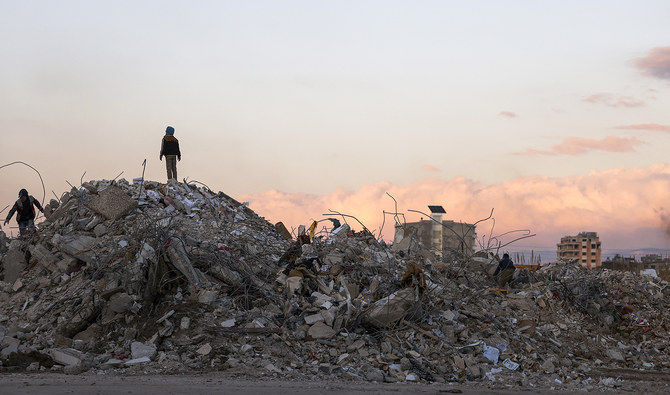
Syrians search building rubble for items to salvage in the regime-controlled town of Jableh in the province of Latakia, northwest of the capital, on February 10, 2023, in the aftermath of a deadly earthquake. (Photo courtesy: AFP)
Short Url
Updated 11 February 2023
Follow

Pakistan PM calls Syrian counterpart, offers sympathies over quake tragedy

  • Prime Minister Shehbaz Sharif promised to send a medical team from Pakistan to help quake-affected people in Syria
  • Pakistan has already sent humanitarian assistance to Syria and plans to dispatch more relief goods via air, land routes

ISLAMABAD: Prime Minister Shehbaz Sharif called his Syrian counterpart on Saturday to extend sympathies in the wake of a massive quake that claimed over 3,500 lives in the Arab state as rescue workers pulled more people out of the rubble amid fading hope to find more survivors.

The 7.8-magnitude earthquake that jolted Syria and Türkiye on Monday is said to be the world’s seventh deadliest natural disaster this century in which the collective death toll has already exceeded 25,000.

Sharif told Syrian Prime Minister Hussein Arnous the Pakistani administration would offer all possible support with the relief efforts.

“Offering condolences to the Syrian Prime Minister on his personal loss of family members in the horrific natural calamity, Prime Minister Sharif expressed concern with regard to the reports emanating from the region of severe aftershocks,” said an official statement issued in Islamabad after the phone call.

“He shared that Pakistan had already dispatched the first batch of humanitarian assistance which was being followed-up with more relief goods sent via air and land routes,” the statement added while quoting the Pakistani premier. “He added that a medical team from Pakistan would also support the humanitarian efforts in Syria.”

Pakistan suffered from a massive natural calamity last year when record monsoon rains triggered flash floods and destroyed houses, farmlands and public infrastructure in different parts of the country. Given the extent of devastation, the country urged the international community for significant financial assistance amid an ongoing economic crisis.

However, the government has still managed to dispatch rescue teams to the quake-affected region and sent relief items including tents and winterized blankets to help people.

Prime Minister Arnous also thanked the government and people of Pakistan for demonstrating solidarity with Syrian citizens at such a difficult hour, the statement added.


World Bank approves $400 million to expand water, sanitation services in Pakistan’s Punjab

Updated 4 sec ago
Follow

World Bank approves $400 million to expand water, sanitation services in Pakistan’s Punjab

  • Project aims to improve access for 4.5 million people and curb waterborne diseases
  • Program to prioritize women’s participation and climate-resilient urban infrastructure

ISLAMABAD: The World Bank this week approved $400 million for a new project to expand access to safe water, sanitation and hygiene services for around 4.5 million people in Pakistan’s most populous Punjab province, aiming to curb waterborne diseases and reduce long-term public health costs.

The project, known as the Punjab Inclusive Cities Program (PICP), is the second phase of the World Bank-supported Pakistan Urban Water, Sanitation and Hygiene Services Multiphase Programmatic Approach. It will focus on rehabilitating water supply networks, sewerage systems and wastewater treatment plants, while expanding stormwater drainage infrastructure across 16 secondary cities in Punjab.

Punjab faces persistent challenges in providing safe drinking water and adequate sanitation, with many urban households relying on contaminated sources. Weak infrastructure and limited hygiene services contribute to high rates of waterborne diseases such as diarrhea, typhoid and hepatitis, which disproportionately affect children and low-income communities.

“Reducing child stunting is essential for Pakistan’s future. Through the Punjab Inclusive Cities Program, we are investing in safe water, sanitation, and hygiene services to break the cycle of malnutrition and disease that holds back so many children from reaching their full potential,” the World Bank quoted its Country Director for Pakistan, Bolormaa Amgaabazar, as saying in a statement.

“In collaboration with the Punjab Government, the program represents a significant step forward in improving urban infrastructure and strengthening local institutions, thereby laying the foundation for healthier communities and a more prosperous Pakistan.”

Child stunting, a form of chronic malnutrition that leaves children too short for their age, is often linked to repeated infections, poor sanitation and unsafe drinking water, and remains a major public health concern in Pakistan.

Beyond water and sanitation, the project will also support solid waste management systems to improve sanitary waste disposal, extending services to an additional two million people in Punjab’s urban areas. The program will strengthen the capacity of local governments, including efforts to improve revenue generation and long-term service sustainability.

“The program complements infrastructure investments with capacity building and revenue generation, helping to ensure that service delivery is well sustained,” the statement quoted Amena Raja, Senior Urban Specialist at the World Bank, as saying.

“It will also help Punjab’s cities better withstand floods and droughts, ensuring urban development is both environmentally responsible and resilient to climate change.”

The program includes a gender-focused component, prioritizing the hiring of women in decision-making roles, establishing gender-compliant service desks and supporting skills development. It also aims to mobilize private capital to support water and sanitation services in Punjab’s secondary cities.

Pakistan has been a member of the World Bank since 1950 and has received more than $48 billion in assistance since. The Bank’s current portfolio in the country comprises 54 projects with total commitments of $15.7 billion, while its private-sector arm, the International Finance Corporation, has invested about $13 billion since 1956.

Earlier this year, Pakistan and the World Bank signed a first-of-its-kind agreement for a plan to focus $20 billion in lending to the cash-strapped nation over the coming decade on development issues like the impact of climate change as well as boosting private-sector growth.