

Pakistan’s army chief meets UAE president, discusses defense relations

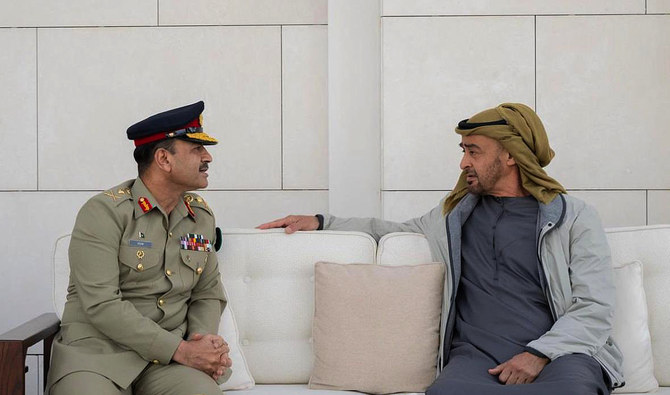
This handout picture, released by the UAE Embassy in Islamabad, shows UAE President Sheikh Mohamed bin Zayed Al Nahyan and Pakistan's army chief General Asim Munir during a meeting at Qasr Al Shati Palace in Abu Dhabi on February 11, 2023. (Photo courtesy: Twitter/uaeembassyisb)
Short Url
Updated 11 February 2023
Follow

Pakistan’s army chief meets UAE president, discusses defense relations

  • Gen. Munir’s visit to Abu Dhabi came a month after the UAE announced to support Pakistan’s cash-strapped economy
  • The UAE is home to a large number of overseas Pakistani workers who remitted $5.10 billion to their country last year

ISLAMABAD: Pakistan’s army chief General Asim Munir had a meeting with President of the United Arab Emirates (UAE) Sheikh Mohamed bin Zayed Al Nahyan in Abu Dhabi to discuss various aspects of bilateral relations between the two countries, the UAE embassy in Pakistan announced on Saturday.

The army chief’s visit came only a month after the UAE president assured the cash-strapped South Asian state of full support before rolling over his country’s existing deposit of $2 billion in Pakistan’s central bank.

President Al Nahyan also announced that the UAE would lend an additional $1 billion to help the administration in Islamabad which has been actively seeking external financing from allies and multilateral organizations to shore up its dwindling forex reserves and manage an ongoing economic crisis.

“H.H Sheikh Mohamed bin Zayed Al Nahyan, President of UAE, receives at Qasr Al Shati Palace Abu Dhabi General Asim Munir, Chief of Army Staff of the Islamic Republic of Pakistan,” the embassy said in a Twitter post.

It added that during the meeting, which took place on Friday, the two sides discussed ways of further enhancing bilateral cooperation.

According to some media reports, the meeting also focused on defense and military affairs.

Pakistan has always maintained close diplomatic ties with the UAE which employs a large number of its workers who remitted $5.10 billion to their home country last year.

The UAE is also Pakistan’s largest trade partner in the region, and the two sides are currently striving to increase the quantum of their trade which stood at $10.6 billion during the last calendar year.


Pakistan cuts fuel prices at year-end amid push for economic reform

Updated 4 sec ago
Follow

Pakistan cuts fuel prices at year-end amid push for economic reform

  • Petrol price has been cut by Rs 10.28, diesel by Rs 8.57 per liter from Jan. 1
  • Relief comes as inflation eases but household purchasing power remains weak

KARACHI: Pakistan cut prices of petrol and high-speed diesel at the turn of the year, with a government notification on Wednesday announcing relief of up to Rs 10.28 per liter as Islamabad presses ahead with economic reforms following recent macroeconomic stabilization.

The price cuts come as inflation has eased in recent months after a prolonged slowdown, though households continue to complain of limited purchasing power following years of high prices, currency weakness and sluggish growth.

“The Government has revised the prices of the petroleum products based on recommendations of OGRA,” the Ministry of Energy said in a notification, referring to the Oil and Gas Regulatory Authority.

Under the revised rates, the price of high-speed diesel was cut by Rs 8.57 per liter to Rs 257.08, while petrol prices were reduced by Rs 10.28 per liter to Rs 253.17, effective from Jan. 1 for the next fortnight.

Fuel prices in Pakistan are reviewed every two weeks and are influenced by global oil market trends, currency movements and changes in domestic taxation. The pricing mechanism passes changes in import costs on to consumers, helping sustain the country’s fuel supply chain.

Petrol is primarily used for private transport, motorcycles, rickshaws and small vehicles, while diesel powers heavy transport used to move goods across the South Asian country.

While Pakistan has seen signs of macroeconomic stabilization, including a slowdown in inflation, many consumers say their purchasing power remains strained after years of economic stress.

Last year, the country was hit by devastating monsoon floods once again that damaged farmlands in the eastern province of Punjab — Pakistan’s breadbasket — pushing up food prices nationwide.