

US says China balloon could collect intelligence signals

1 / 4
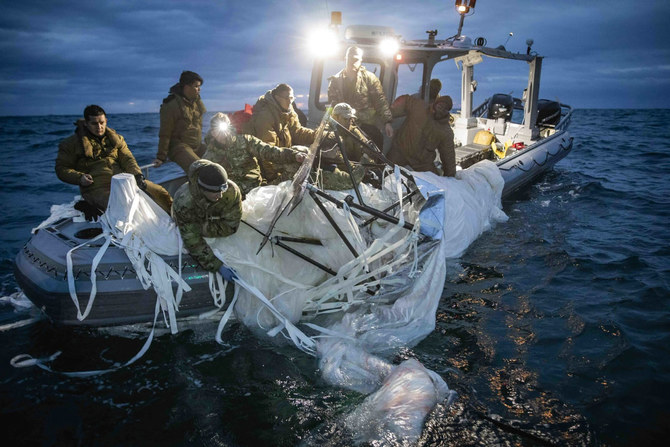
US Navy sailors recovering a high-altitude surveillance balloon off the coast of Myrtle Beach, South Carolina on Feb. 5, 2023, after it was shot down by an air force jet fighter. (US Navy via AP)
2 / 4
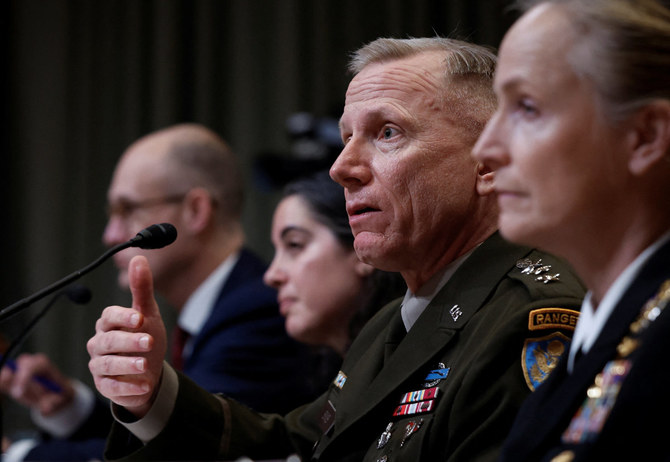
US defense officials testify during a Senate hearing in Washington D.C. on Feb. 9, 2023, about the suspected Chinese spy balloon that was shot down off North Carolina. (Reuters)
3 / 4
US Navy sailors recovering a high-altitude surveillance balloon off the coast of Myrtle Beach, South Carolina on Feb. 5, 2023, after it was shot down by an air force jet fighter. (US Navy via AP)
4 / 4
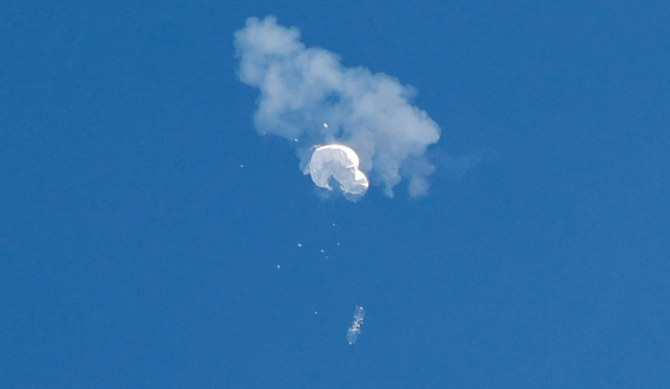
The suspected Chinese spy balloon drifts to the ocean after being shot down off the coast in Surfside Beach, South Carolina, on Feb. 4, 2023. (REUTERS)
Short Url
Updated 10 February 2023
Follow

US says China balloon could collect intelligence signals

  • Claims that a fleet of balloons operates under the direction of China's People’s Liberation Army and is used specifically for spying
  • China insists that the large unmanned balloon was a civilian meteorological airship that had blown off course

WASHINGTON: The China balloon shot down by the US was equipped to detect and collect intelligence signals as part of a huge, military-linked aerial surveillance program that targeted more than 40 countries, the Biden administration declared Thursday, citing imagery from American U-2 spy planes.
A fleet of balloons operates under the direction of the People’s Liberation Army and is used specifically for spying, outfitted with high-tech equipment designed to gather sensitive information from targets across the globe, the US said. Similar balloons have sailed over five continents, according to the administration.
A statement from a senior State Department official offered the most detail to date linking China’s military to the balloon that was shot down by the US last weekend over the Atlantic Ocean. The public details outlining the program’s scope and capabilities were meant to refute China’s persistent denials that the balloon was used for spying, including a claim Thursday that US accusations about the balloon amount to “information warfare.”
On Capitol Hill, the House voted unanimously to condemn China for a “brazen violation” of US sovereignty and efforts to “deceive the international community through false claims about its intelligence collection campaigns.” Republicans have criticized President Joe Biden for not acting sooner to down the balloon, but both parties’ lawmakers came together on the vote, 419-0.
In Beijing, before the US offered its new information, Chinese Foreign Ministry spokesperson Mao Ning repeated her nation’s insistence that the large unmanned balloon was a civilian meteorological airship that had blown off course and that the US had “overreacted” by shooting it down.
“It is irresponsible,” Mao said. The latest accusations, she said, “may be part of the US side’s information warfare against China.”

Underscoring the tensions, China’s defense minister refused to take a phone call from Defense Secretary Lloyd Austin to discuss the balloon issue on Saturday, the Pentagon said. Secretary of State Antony Blinken canceled a planned weekend trip to Beijing.
The US flatly contradicted China’s version of events, saying that imagery of the balloon collected by American U-2 spy planes as it crossed the country showed that it was “capable of conducting signals intelligence collection” with multiple antennas and other equipment designed to upload sensitive information and solar panels to power them.
Jedidiah Royal, the US assistant defense secretary for the Indo-Pacific, told a Senate Appropriations subcommittee that the military has “some very good guesses” about what intelligence China was seeking. More information was expected to be provided in a classified setting.
Senior FBI officials who briefed reporters on the condition of anonymity under ground rules set by the bureau said just a few pieces of the balloon had arrived at the FBI’s Quantico, Virginia, lab for investigation. So far, investigators have parts of the balloon canopy, wiring, and what one official called “a very small amount of electronics.” The official said it was “very early for us to assess what the intent was and how the device was operating.”
According to two US officials, the balloon recovery efforts were temporarily suspended on Thursday due to high seas. They said some balloon debris was intact on the ocean floor and divers had recovered potentially high-value equipment over the past day and a half. Another official said that some of the recovered equipment components had English writing or markings on them but it wasn’t clear if they were American parts or from another English speaking country. The official said the more highly technical parts recovered did not have any overt markings.
Much of the debris is concentrated in two separate sections of an area 15 football fields long and 15 fields across, according to the officials who spoke on condition of anonymity because of the sensitivity of the collection process.
The State Department official, providing details to reporters by email, also on condition of anonymity, said an analysis of the balloon debris was “inconsistent” with China’s explanation that it was a weather balloon that went off course. The US is reaching out to countries that have also been targeted, the official said, to discuss the scope of the Chinese surveillance program, and is looking into potential action that “supported the balloon’s incursion into US airspace.”
The official said the US has confidence that the manufacturer of the balloon shot down on Saturday has “a direct relationship with China’s military and is an approved vendor of the” army. The official cited information from an official PLA procurement portal as evidence for the connection between the company and the military.
State Department spokesman Ned Price would not identify the other countries the US says have also been targeted. Nor would he reveal how the US knows there have been Chinese incursions over those countries’ territory, saying to do so could compromise intelligence sources and methods.
The release of new information appeared part of a coordinated administration response, with multiple officials appearing before congressional committees to face questions about the balloon.
Testifying before the Senate Foreign Relations Committee, Deputy Secretary of State Wendy Sherman said officials had taken “all necessary steps to protect sensitive information” and had been able to study and scrutinize the balloon and its equipment.
“We will continue to answer the dangers posed by the PRC with determination and resolve,” Sherman said, referring to the People’s Republic of China. “We will make clear to the PRC that violations of our sovereignty and the sovereignty of other countries are unacceptable.”
At a separate Senate subcommittee hearing, lawmakers repeatedly pressed administration officials, including Pentagon military leaders, about why the balloon was not shot down over sparsely populated areas of Alaska. And they questioned whether allowing the balloon to transit such a large area set a precedent for future spying efforts by China and others.
“It defies belief that there was not a single opportunity to safely shoot this spy balloon prior to the coast of South Carolina,” said Sen. Susan Collins, R-Maine. “By the administration’s logic we would allow the Chinese to fly surveillance balloons over the Pentagon or other sensitive sites and populated areas.”
Melissa Dalton, assistant defense secretary of Homeland Defense, and Lt. Gen. Doug Sims, director of operations for the Joint Chiefs of Staff, said the US wanted to avoid any injuries or deaths from the debris field if the balloon was shot down over Alaska.
And they added that shooting it down over the frigid, icy waters in that region would have made it more difficult and dangerous to recover the pieces for more analysis.
“We thought before we shot,” said Sims.This is not the first time the US government has publicly called out alleged activities of the People’s Liberation Army. In a first-of-its-kind prosecution in 2014, the Obama administration Justice Department indicted five accused PLA hackers of breaking into the computer networks of major American corporations in an effort to steal trade secrets.


Democrats poised to trigger government shutdown if White House won’t meet demands for ICE reform

Updated 2 sec ago
Follow

Democrats poised to trigger government shutdown if White House won’t meet demands for ICE reform

  • That would bring the government a step closer to a partial shutdown if Republicans and the White House do not agree to new restrictions on President Donald Trump’s surge of immigration enforcement
  • Senate Democrats are poised to block legislation that would fund the Department of Homeland Security and several other agencies on Thursday
WASHINGTON: Senate Democrats are threatening to block legislation that would fund the Department of Homeland Security and several other agencies Thursday, potentially bringing the government a step closer to a partial shutdown if Republicans and the White House do not agree to new restrictions on President Donald Trump’s surge of immigration enforcement.
As the country reels from the deaths of two protesters at the hands of federal agents in Minneapolis, irate Senate Democrats laid out a list of demands ahead of a Thursday morning test vote, including that officers take off their masks and identify themselves and obtain warrants for arrest. If those are not met, Democrats say they are prepared to block the wide-ranging spending bill, denying Republicans the votes they need to pass it and triggering a shutdown at midnight on Friday.
Senate Democratic leader Chuck Schumer said Wednesday that Democrats won’t provide needed votes until US Immigration and Customs Enforcement is “reined in and overhauled.”
“The American people support law enforcement, they support border security, they do not support ICE terrorizing our streets and killing American citizens,” Schumer said.
There were some signs of possible progress as the White House has appeared open to trying to strike a deal with Democrats to avert a shutdown. The two sides were talking as of Wednesday evening, according to a person familiar with the negotiations who requested anonymity to speak about the private talks. One possible option discussed would be to strip the funding for the Homeland Security Department from the larger bill, as Schumer has requested, and extend it for a short period to allow time for negotiations, the person said. The rest of the bill would fund government agencies until September.
Still, with no agreement yet and an uncertain path ahead, the standoff threatened to plunge the country into another shutdown just two months after Democrats blocked a spending bill over expiring federal health care subsidies, a dispute that closed the government for 43 days as Republicans refused to negotiate.
That shutdown ended when a small group of moderate Democrats broke away to strike a deal with Republicans, but Democrats are more unified this time after the fatal shootings of Alex Pretti and Renee Good by federal agents.
Democrats lay out their demands
There’s a lot of “unanimity and shared purpose” within the Democratic caucus, Minnesota Sen. Tina Smith said after a lunch meeting Wednesday.
“Boil it all down, what we are talking about is that these lawless ICE agents should be following the same rules that your local police department does,” Smith said. “There has to be accountability.”
Amid the administration’s immigration crackdown, Schumer said Democrats are asking the White House to “end roving patrols” in cities and coordinate with local law enforcement on immigration arrests, including requiring tighter rules for warrants.
Democrats also want an enforceable code of conduct so agents are held accountable when they violate rules. Schumer said agents should be required to have “masks off, body cameras on” and carry proper identification, as is common practice in most law enforcement agencies.
The Democratic caucus is united in those “common sense reforms” and the burden is on Republicans to accept them, Schumer said, as he has pushed for the Homeland spending to be separated out to avoid a broader shutdown.
Senate Majority Leader John Thune, R-S.D., has indicated that he might be open to considering some of the Democrats’ demands, but he encouraged Democrats and the White House to talk and find agreement.
Many obstacles to a deal
As the two sides negotiated, it was still unclear whether they could agree on anything that would satisfy Democrats who want Trump’s aggressive crackdown to end.
The White House had invited some Democrats for a discussion to better understand their positions and avoid a partial government shutdown, a senior White House official said, but the meeting did not happen. The official requested anonymity to discuss the private invitation.
The House passed the six remaining funding bills last week and sent them to the Senate as a package, making it more difficult to strip out the homeland security portion as Democrats have demanded. Republicans could break the package apart with the consent of all 100 senators or through a series of votes that would extend past the Friday deadline.
Even if the Senate can resolve the issue, House Republicans have said they do not want any changes to the bill they have passed. In a letter to Trump on Tuesday, the conservative House Freedom Caucus wrote that its members stand with the president and ICE.
“The package will not come back through the House without funding for the Department of Homeland Security,” according to the letter.
Republican opposition
Several Republican senators have said they would be fine with Democrats’ request to separate the Homeland Security funds for further debate and pass the other bills in the package. But it might be more difficult to for Democrats to find broad GOP support for their demands on ICE.
North Carolina Sen. Thom Tillis said he’s OK with separating the bills, but is opposed to the Democrats’ proposal to require the immigration enforcement officers to unmask and show their faces, even as he blamed Homeland Security Secretary Kristi Noem for decisions that he said are “tarnishing” the agency’s reputation.
“You know, there’s a lot of vicious people out there, and they’ll take a picture of your face, and the next thing you know, your children or your wife or your husband are being threatened at home,” Tillis said. “And that’s just the reality of the world that we’re in.”
Republican Sen. John Cornyn of Texas said that “what happened over the weekend is a tragedy,” but Democrats shouldn’t punish Americans with a shutdown and a “political stunt.”
Democrats say they won’t back down.
“It is truly a moral moment,” said Sen. Richard Blumenthal, D-Connecticut “I think we need to take a stand.”