WASHINGTON: Senate Democrats are threatening to block legislation that would fund the Department of Homeland Security and several other agencies Thursday, potentially bringing the government a step closer to a partial shutdown if Republicans and the White House do not agree to new restrictions on President Donald Trump’s surge of immigration enforcement.
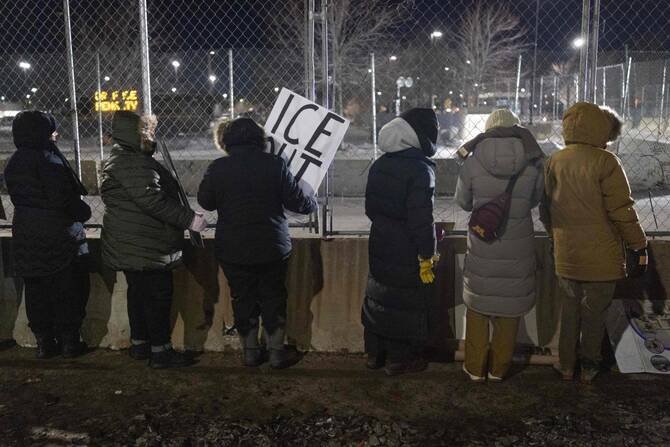
As the country reels from the deaths of two protesters at the hands of federal agents in Minneapolis, irate Senate Democrats laid out a list of demands ahead of a Thursday morning test vote, including that officers take off their masks and identify themselves and obtain warrants for arrest. If those are not met, Democrats say they are prepared to block the wide-ranging spending bill, denying Republicans the votes they need to pass it and triggering a shutdown at midnight on Friday.
Senate Democratic leader Chuck Schumer said Wednesday that Democrats won’t provide needed votes until US Immigration and Customs Enforcement is “reined in and overhauled.”
“The American people support law enforcement, they support border security, they do not support ICE terrorizing our streets and killing American citizens,” Schumer said.
There were some signs of possible progress as the White House has appeared open to trying to strike a deal with Democrats to avert a shutdown. The two sides were talking as of Wednesday evening, according to a person familiar with the negotiations who requested anonymity to speak about the private talks. One possible option discussed would be to strip the funding for the Homeland Security Department from the larger bill, as Schumer has requested, and extend it for a short period to allow time for negotiations, the person said. The rest of the bill would fund government agencies until September.
Still, with no agreement yet and an uncertain path ahead, the standoff threatened to plunge the country into another shutdown just two months after Democrats blocked a spending bill over expiring federal health care subsidies, a dispute that closed the government for 43 days as Republicans refused to negotiate.
That shutdown ended when a small group of moderate Democrats broke away to strike a deal with Republicans, but Democrats are more unified this time after the fatal shootings of Alex Pretti and Renee Good by federal agents.
Democrats lay out their demands
There’s a lot of “unanimity and shared purpose” within the Democratic caucus, Minnesota Sen. Tina Smith said after a lunch meeting Wednesday.
“Boil it all down, what we are talking about is that these lawless ICE agents should be following the same rules that your local police department does,” Smith said. “There has to be accountability.”
Amid the administration’s immigration crackdown, Schumer said Democrats are asking the White House to “end roving patrols” in cities and coordinate with local law enforcement on immigration arrests, including requiring tighter rules for warrants.
Democrats also want an enforceable code of conduct so agents are held accountable when they violate rules. Schumer said agents should be required to have “masks off, body cameras on” and carry proper identification, as is common practice in most law enforcement agencies.
The Democratic caucus is united in those “common sense reforms” and the burden is on Republicans to accept them, Schumer said, as he has pushed for the Homeland spending to be separated out to avoid a broader shutdown.
Senate Majority Leader John Thune, R-S.D., has indicated that he might be open to considering some of the Democrats’ demands, but he encouraged Democrats and the White House to talk and find agreement.
Many obstacles to a deal
As the two sides negotiated, it was still unclear whether they could agree on anything that would satisfy Democrats who want Trump’s aggressive crackdown to end.
The White House had invited some Democrats for a discussion to better understand their positions and avoid a partial government shutdown, a senior White House official said, but the meeting did not happen. The official requested anonymity to discuss the private invitation.
The House passed the six remaining funding bills last week and sent them to the Senate as a package, making it more difficult to strip out the homeland security portion as Democrats have demanded. Republicans could break the package apart with the consent of all 100 senators or through a series of votes that would extend past the Friday deadline.
Even if the Senate can resolve the issue, House Republicans have said they do not want any changes to the bill they have passed. In a letter to Trump on Tuesday, the conservative House Freedom Caucus wrote that its members stand with the president and ICE.
“The package will not come back through the House without funding for the Department of Homeland Security,” according to the letter.
Republican opposition
Several Republican senators have said they would be fine with Democrats’ request to separate the Homeland Security funds for further debate and pass the other bills in the package. But it might be more difficult to for Democrats to find broad GOP support for their demands on ICE.
North Carolina Sen. Thom Tillis said he’s OK with separating the bills, but is opposed to the Democrats’ proposal to require the immigration enforcement officers to unmask and show their faces, even as he blamed Homeland Security Secretary Kristi Noem for decisions that he said are “tarnishing” the agency’s reputation.
“You know, there’s a lot of vicious people out there, and they’ll take a picture of your face, and the next thing you know, your children or your wife or your husband are being threatened at home,” Tillis said. “And that’s just the reality of the world that we’re in.”
Republican Sen. John Cornyn of Texas said that “what happened over the weekend is a tragedy,” but Democrats shouldn’t punish Americans with a shutdown and a “political stunt.”
Democrats say they won’t back down.
“It is truly a moral moment,” said Sen. Richard Blumenthal, D-Connecticut “I think we need to take a stand.”


![]()

Democrats poised to trigger government shutdown if White House won’t meet demands for ICE reform
Short Url
https://arab.news/wtabw
Democrats poised to trigger government shutdown if White House won’t meet demands for ICE reform
- That would bring the government a step closer to a partial shutdown if Republicans and the White House do not agree to new restrictions on President Donald Trump’s surge of immigration enforcement
- Senate Democrats are poised to block legislation that would fund the Department of Homeland Security and several other agencies on Thursday


Latest updates


© 2026 SAUDI RESEARCH & PUBLISHING COMPANY, All Rights Reserved And subject to Terms of Use Agreement.