

Emissions from fertilizers could be slashed by 2050: Study

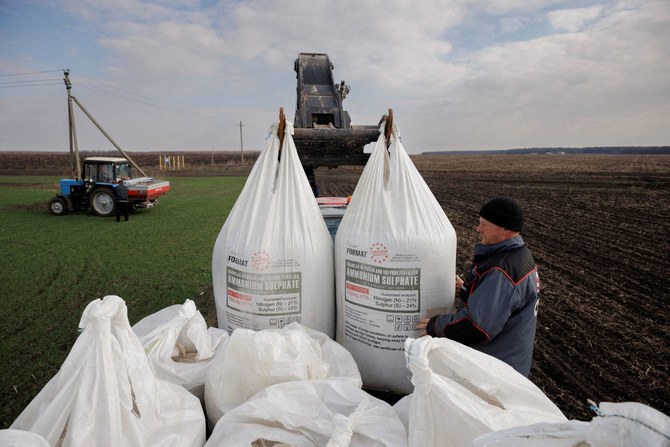
The production and use of nitrogen fertilizers accounts for 5% of global greenhouse gas emissions, which can be reduced with a few interventions, a study said. Reuters/File
Short Url
Updated 09 February 2023
Follow

Emissions from fertilizers could be slashed by 2050: Study

PARIS: The production and use of nitrogen fertilizers accounts for 5 percent of global greenhouse gas emissions, which can be massively reduced with a few available interventions, a new study said on Thursday.

Nitrogen fertilizers — produced and used across the world —are crucial for global food security.

But their harmful emissions contributing to global warming exceed the aviation sector, and are on par with the iron and steel, cement and plastics industries.

Most existing research has focused on emissions associated with the production of fertilizers, but Thursday’s study showed that the majority — two thirds — come from the use of the fertilizers in croplands.

“There is the perception that the petrochemical industry has been causing the emissions producing the fertilizers, but actually that doesn’t seem to be the case. That was very surprising for us,” co-author Andre Cabrera Serrenho from Cambridge University told AFP.

The findings are important because they show “where we should prioritize action to reduce emissions,” he added.

Carbon emissions could be reduced by up to 80 percent by 2050 while still producing enough food to feed a growing global population, said the study published in the journal Nature Food.

“The interventions we propose in our study do not imply loss in crop productivity, and they consider the future growing demand for food to feed a growing global population,” Serrenho confirmed.

“We are currently really inefficient in the way we use fertilizers,” he said. “We put much more fertilizers in croplands than the amount of nitrogen that actually crops need to grow.”

The main emissions in the use phase come from the degradation of fertilizer by bacteria that exist in the soil and produce nitrous oxide, one of the most powerful greenhouse gases.

Carbon dioxide and methane are also emitted in the use phase, but simply using less fertilizer could help to slash those harmful emissions.

But convincing farmers to use fertilizers more efficiently — for example, applying them daily in smaller quantities instead of spraying in large doses them once a season — will require policy shifts.

“If we could have more economic incentives to farmers to change practices to reduce emissions, that seems to be the most obvious place to start,” Serrenho said.


Saudi Arabia, Japan trade rises 38% between 2016 and 2024, minister says

Updated 5 sec ago
Follow

Saudi Arabia, Japan trade rises 38% between 2016 and 2024, minister says

RIYADH: Trade between Saudi Arabia and Japan has increased by 38 percent between 2016 and 2024 to reach SR138 billion ($36 billion), the Kingdom’s investment minister revealed.
 
Speaking at the Saudi-Japanese Ministerial Investment Forum 2026, Khalid Al-Falih explained that this makes the Asian country the Kingdom’s third-largest trading partner, according to Asharq Bloomberg.

This falls in line with the fact that Saudi Arabia has been a very important country for Japan from the viewpoint of its energy security, having been a stable supplier of crude oil for many years.
 
It also aligns well with how Japan is fully committed to supporting Vision 2030 by sharing its knowledge and advanced technologies.
 
“This trade is dominated by the Kingdom's exports of energy products, specifically oil, gas, and their derivatives. We certainly look forward to the Saudi private sector increasing trade with Japan, particularly in high-tech Japanese products,” Al-Falih said.
 
He added: “As for investment, Japanese investment in the Kingdom is good and strong, but we look forward to raising the level of Japanese investments in the Kingdom. Today, the Kingdom offers promising opportunities for Japanese companies in several fields, including the traditional sector that links the two economies: energy.”
 
The minister went on to note that additional sectors that both countries can also collaborate in include green and blue hydrogen, investments in advanced industries, health, food security, innovation, entrepreneurship, among others.
 
During his speech, Al-Falih shed light on how the Kingdom’s pavilion at Expo 2025 in Osaka achieved remarkable success, with the exhibition receiving more than 3 million visitors, reflecting the Japanese public’s interest in Saudi Arabia.
 
“The pavilion also organized approximately 700 new business events, several each day, including 88 major investment events led by the Ministry of Investment. Today, as we prepare for the upcoming Expo 2030, we look forward to building upon Japan’s achievements,” he said.
 
The minister added: “During our visit to Japan, we agreed to establish a partnership to transfer the remarkable Japanese experience from Expo Osaka 2025 to Expo Riyadh 2030. I am certain that the Japanese pavilion at Expo Riyadh will rival the Saudi pavilion at Expo Osaka in terms of organization, innovation, and visitor turnout.”
 
Al-Falih also shed light on how Saudi-Japanese relations celebrated their 70th anniversary last year, and today marks the 71st year of these relations as well as how they have flourished over the decades, moving from one strategic level to an even higher one.