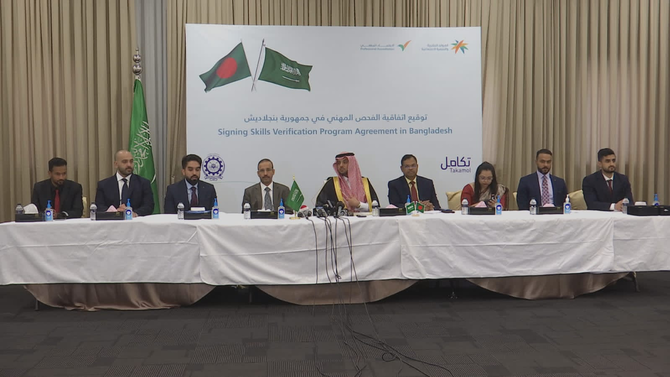
DHAKA: Bangladesh is preparing to send skilled workers to Saudi Arabia for the first time under the newly launched Skill Verification Program, authorities said on Wednesday.
Under the Workers’ Recruitment and Skill Verification Program, which aims to improve the professional competence of employees in the Saudi labor market, the Kingdom will recruit skilled workers from the South Asian country.
In its initial phase, the program will focus on five professions: Plumbers, electricians, welders, automotive electricians and air conditioning technicians.
The SVP deal between Saudi and Bangladeshi authorities came into effect this week.
“Saudi authorities will hire the first batch of skilled workers as a pilot program. One thousand migrant workers will be hired ... the number will be increased gradually. We are going to begin this recruitment process very soon,” Mohammad Salah Uddin, training director at the Bangladeshi Bureau of Manpower Employment and Training, told Arab News.
“We are very well prepared. Initially, the Saudi authorities want to conduct the testing process of migrant workers in the capital. Later on, we will expand the testing process outside of Dhaka, in accordance with our capacity and demand.”
The bureau has 95 training centers and will soon launch another 15, Uddin said.
“We have sufficient infrastructure and capability to prepare skilled workers as per demand from the Saudi authorities.”
BRAC, the largest development organization based in Bangladesh, sees the employment of skilled workers as a new trend in the country’s work migration.
“I think the migration process in the coming days will follow this system. All the migrant-receiving countries will ask for skilled workers. All of our training centers run by the government and private organizations need to strengthen their efforts in this regard,” Shariful Hasan, head of BRAC’s migration program, told Arab News.
“Most of our migrant workers are currently unskilled, and they don’t have any kind of certificate to be considered skilled workers. They don’t receive training from any training center and get employed as unskilled workers. The new initiative opens a horizon of prospects,” Hasan told Arab News.
With about 2 million people joining the Bangladeshi workforce every year, having at least a fourth of that number trained should not be a problem for the South Asian nation.
“If the government takes the initiative to prepare at least half a million people as skilled workers, I don’t see any problems with it. We have technical training centers at the grassroots level also. There is no point in providing conventional university degrees to all the youth. Rather, if we equip many of them with technical knowledge, it will bring good results in the long run,” Hasan said.
“It’s an opportunity since the workers will get a higher salary as skilled workers and their migration costs will be reduced significantly.”
About 2.8 million Bangladeshi nationals live in Saudi Arabia, with most employed in low-profile jobs at construction sites or as household staff. They play a significant role in the Bangladeshi economy by sending large amounts of remittances home, contributing more than 5 percent to the country’s gross domestic product.
Riyadh’s Ambassador to Dhaka, Essa Al-Duhailan, told reporters in the Bangladeshi capital on Tuesday evening that the new employment program would guarantee higher salaries for Bangladeshis — at least double those of average workers.
“If he is an ordinary worker, he might get SR800 ($213) to 1,000, but a skilled worker will get SR1,500 to 1,800, or even more,” Al-Duhailan said.
“His remittance will be higher because the salary will be higher. It will contribute to strengthening the Bangladeshi economy.”

Bangladesh sending skilled workers to Saudi Arabia under new employment scheme
Short Url
https://arab.news/58xjj
Bangladesh sending skilled workers to Saudi Arabia under new employment scheme
- Kingdom’s recruitment to guarantee higher salaries for Bangladeshis, Saudi envoy says
- Initial phase targets plumbers, electricians, welders and AC technicians
Backlash as Australia kills dingoes after backpacker death
- The euthanization program has stirred debate about how to manage the local population of dingoes
- Wildlife experts said killing the animals was the wrong response and may threaten the island’s dingo population
SYDNEY: Australian authorities have sparked a backlash by killing a group of dingoes linked to the death of a young Canadian woman on an island in the country’s east.
The Queensland government said six animals were put down after 19-year-old backpacker Piper James’s body was found on January 19 at a beach on the World Heritage-listed island of K’gari.
The euthanization program has stirred debate about how to manage the local population of dingoes, a sandy-colored canine believed to have first arrived in Australia 4,000 to 5,000 years ago.
An autopsy conducted on James’ body found evidence “consistent with drowning” but also detected injuries corresponding to dingo bites.
“Pre-mortem dingo bite marks are not likely to have caused immediate death,” said a spokesperson for the Coroners Court of Queensland.
The coroner’s investigation into the cause of death was expected to take several weeks.
In response, the Queensland government said a pack of 10 dingoes involved would be euthanized after rangers had observed some “aggressive behavior.”
Six of the dingoes had already been euthanized, the state’s environment minister, Andrew Powell, told reporters Sunday.
“Obviously, the operation will continue,” he said.
The traditional owners of K’gari, the Butchulla people, said the state’s failure to consult with them before euthanizing the dingoes — or wongari in their language — was “unexpected and disappointing.”
“Once again, it feels as though economic priorities are being placed above the voices of the people and traditional owners, which is frustrating and difficult to accept,” the Butchulla Aboriginal Corporation said in a statement to Australian media this week.
‘You are food’
Wildlife experts said killing the animals was the wrong response and may threaten the island’s dingo population, estimated at just 70-200 animals.
Given their small numbers, killing a pack of 10 animals would harm the population’s genetic diversity, said Mathew Crowther, professor of quantitative conservation biology at the University of Sydney.
“There’s no moral from the dingoes’ point of view. They’re just being wild animals, doing wild things,” Crowther said.
Dingoes tend to lose their fear of people as they interact with tourists, some of whom defy advice against feeding the animals.
“That’s the worst thing you can do to a wild animal,” Crowther said.
“They just relate humans to food, and if you don’t give them food, well, you are food — that’s basically how it is.”
Dingoes are wild, predatory animals and need to be treated with respect, said Bill Bateman, associate professor in the school of molecular and life sciences at Curtin University.
The canines are more likely to attack children or people who are alone, and may be triggered when people turn their backs or run, he said.
“These are important animals, and therefore we need to change the way we deal with them, otherwise we’re just going to keep reacting to these attacks and driving the population of dingoes down,” Bateman said.
Wildlife managers, rangers, Indigenous people and tourism operators need to work together so that humans and dingoes can coexist on the island, he said.
Todd James, the father of Piper, has described on social media how his family’s hearts were “shattered” by her death.
News of the dingoes’ euthanization was “heart-wrenching,” he told Australian media, adding however that he recognized it may be necessary for safety because of the pack’s behavior.
The Queensland government said six animals were put down after 19-year-old backpacker Piper James’s body was found on January 19 at a beach on the World Heritage-listed island of K’gari.
The euthanization program has stirred debate about how to manage the local population of dingoes, a sandy-colored canine believed to have first arrived in Australia 4,000 to 5,000 years ago.
An autopsy conducted on James’ body found evidence “consistent with drowning” but also detected injuries corresponding to dingo bites.
“Pre-mortem dingo bite marks are not likely to have caused immediate death,” said a spokesperson for the Coroners Court of Queensland.
The coroner’s investigation into the cause of death was expected to take several weeks.
In response, the Queensland government said a pack of 10 dingoes involved would be euthanized after rangers had observed some “aggressive behavior.”
Six of the dingoes had already been euthanized, the state’s environment minister, Andrew Powell, told reporters Sunday.
“Obviously, the operation will continue,” he said.
The traditional owners of K’gari, the Butchulla people, said the state’s failure to consult with them before euthanizing the dingoes — or wongari in their language — was “unexpected and disappointing.”
“Once again, it feels as though economic priorities are being placed above the voices of the people and traditional owners, which is frustrating and difficult to accept,” the Butchulla Aboriginal Corporation said in a statement to Australian media this week.
‘You are food’
Wildlife experts said killing the animals was the wrong response and may threaten the island’s dingo population, estimated at just 70-200 animals.
Given their small numbers, killing a pack of 10 animals would harm the population’s genetic diversity, said Mathew Crowther, professor of quantitative conservation biology at the University of Sydney.
“There’s no moral from the dingoes’ point of view. They’re just being wild animals, doing wild things,” Crowther said.
Dingoes tend to lose their fear of people as they interact with tourists, some of whom defy advice against feeding the animals.
“That’s the worst thing you can do to a wild animal,” Crowther said.
“They just relate humans to food, and if you don’t give them food, well, you are food — that’s basically how it is.”
Dingoes are wild, predatory animals and need to be treated with respect, said Bill Bateman, associate professor in the school of molecular and life sciences at Curtin University.
The canines are more likely to attack children or people who are alone, and may be triggered when people turn their backs or run, he said.
“These are important animals, and therefore we need to change the way we deal with them, otherwise we’re just going to keep reacting to these attacks and driving the population of dingoes down,” Bateman said.
Wildlife managers, rangers, Indigenous people and tourism operators need to work together so that humans and dingoes can coexist on the island, he said.
Todd James, the father of Piper, has described on social media how his family’s hearts were “shattered” by her death.
News of the dingoes’ euthanization was “heart-wrenching,” he told Australian media, adding however that he recognized it may be necessary for safety because of the pack’s behavior.
© 2026 SAUDI RESEARCH & PUBLISHING COMPANY, All Rights Reserved And subject to Terms of Use Agreement.


