

Pakistan minister asks world if ‘economic interests’ alone will decide fate of Kashmiris

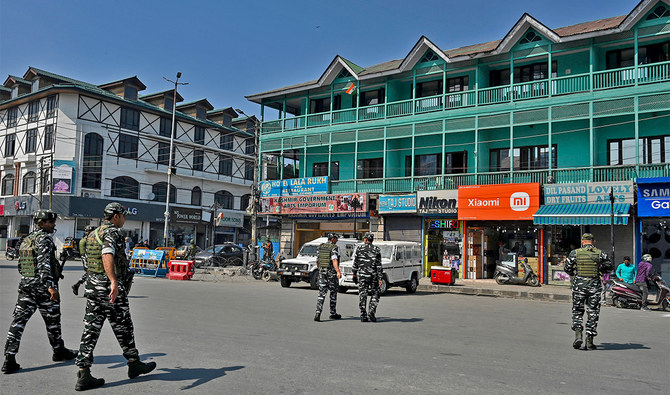
Indian paramilitary troopers patrol along a street in Srinagar on October 4, 2022, during India's Home Minister Amit Shah's visit to Jammu and Kashmir. (AFP/File)
Short Url
Updated 05 February 2023
Follow

Pakistan minister asks world if ‘economic interests’ alone will decide fate of Kashmiris

  • The statement comes as Pakistan observes Kashmir Solidarity Day to express solidarity with Kashmiris
  • Ahsan Iqbal calls out the world for its ‘double standards’ on Russia’s annexation of Ukraine and Kashmir 

ISLAMABAD: Pakistan’s Planning Minister Ahsan Iqbal on Saturday criticized the international community for its role toward the resolution of the Kashmir conflict, questioning if “economic interests” alone would decide the fate of Kashmiris. 

Iqbal’s statement came ahead of the Kashmir Solidarity Day, which Pakistan observes every year on the February 5 to express solidarity with the people of Indian-administered Kashmir. 

The Muslim-majority Himalayan region of Kashmir has been a flashpoint between Pakistan and India since their independence from the British rule in 1947. Both Pakistan and India rule parts of the Himalayan territory, but claim it in full and have fought two of their four wars over the disputed region. 

However, many in Pakistan believe the world’s lukewarm response to the resolution of Kashmir dispute has much to with India’s economic growth over the past years, which allows New Delhi to ignore international conventions. 

“Unfortunately, India feels that it can ignore the international conventions, it can violate the fundamental rights of people in Jammu and Kashmir and it can use its brutal force because it is an attractive market for other countries,” Iqbal told Arab News in an exclusive interview. 

“We have to decide whether economics alone will decide the fate of humanity or fundamental rights, law, justice, self-determination and democratic values have any place. If we will only settle for dollars and cents and commercial and economic interests, then this world will become very brutal.” 

Ties between bitter rivals India and Pakistan stand frozen since August 5, 2019, when New Delhi revoked Kashmir’s special status, taking away the territory’s autonomy and dividing it into three federally administered territories. 

Pakistan calls the revocation of Kashmir’s autonomy part of New Delhi’s alleged attempts to change the demography of the region, and has demanded the world fraternity take notice of it. 

Iqbal, however, called out the international community for its “double standards” on Russia’s annexation of Ukraine and the Kashmir issue.

“It is quite an irony that on the one hand the whole western world is fighting a war against annexation… of the eastern parts in Ukraine and they are not willing to compromise on the geography and on the area which has been annexed by Russia, but in Kashmir the international community easily feels it convenient to ignore the annexation by India,” he said. 

“These are double standards. And when such double standards are exercised it gives rise to extremism. If we want to see a world which is peaceful, we have to find peaceful ways to resolve conflicts.” 


Pakistani, Chinese firms sign 79 MoUs worth $4.5 billion at Islamabad agriculture summit — minister

Updated 11 sec ago
Follow

Pakistani, Chinese firms sign 79 MoUs worth $4.5 billion at Islamabad agriculture summit — minister

  • The summit saw participation from over 300 Pakistani, Chinese firms focusing on modern agricultural techniques and solutions
  • Food security minister says these investments will modernize Pakistan’s agricultural value chains and enhance productivity

KARACHI: The Pakistan–China Agriculture Investment Conference in Islamabad has resulted in 79 Memoranda of Understanding (MoUs) between Pakistani and Chinese companies with an approximate investment value of $4.5 billion, Pakistani Food Security Minister Rana Tanveer Hussain said on Tuesday, signaling confidence of Chinese investors in Pakistan’s agriculture and food sectors.

At least 119 Chinese companies and over 191 Pakistani firms participated in the event held on Monday, focusing on fertilizers, seed varieties, machinery, precision farming and smart irrigation systems, according to the organizers.

The conference was billed by Pakistan’s Ministry of National Food Security and Research as a platform for deepening bilateral agricultural ties and supporting broader economic engagement between the two countries.

Hussain said the scale and depth of investment commitments at the conference reflected a decisive shift from dialogue to on-ground, investment-led collaboration between the two countries.

“The conference was specifically structured to deliver tangible outcomes through direct B2B (business to business) matchmaking, targeted sectoral engagement and project-based investment facilitation, rather than conventional discussions,” he was quoted as saying by his ministry.

Pakistan and China have been expanding cooperation in agriculture under the China-Pakistan Economic Corridor (CPEC) framework, with a focus on mechanization, high-yield seeds, livestock development and value-added food processing. Officials say stronger agricultural ties could help Pakistan boost exports, ensure food security and create jobs, while offering Chinese companies access to a large farming market and new investment opportunities.

Pakistan’s exports to China reached approximately $2.38 billion in Fiscal Year 2024–25 that ended in June, while imports stood at $16.3 billion, reflecting growing demand on both sides despite global economic headwinds, according to the minister.

The food security ministry undertook extensive preparatory work prior to the conference, including structured engagements with Pakistani industry bodies and Chinese enterprises, to align investment proposals with market demand, technology requirements and national priorities, according to Hussain.

As a result, investment agreements were concluded across ten high-impact agricultural and allied sub-sectors, including food processing and value addition, agri-technology, seeds and plant protection, livestock and dairy, meat and poultry, fruits and vegetables, fisheries and aquaculture, animal feed, post-harvest infrastructure, and agricultural inputs.

“These investments will modernize Pakistan’s agricultural value chains, introduce advanced production and processing technologies, and significantly enhance productivity,” the minister said.

“The inflow of capital and technology is expected to generate large-scale employment, particularly in rural areas, strengthen farm-to-market linkages, and reduce post-harvest losses, thereby improving farmer incomes and rural livelihoods.”