

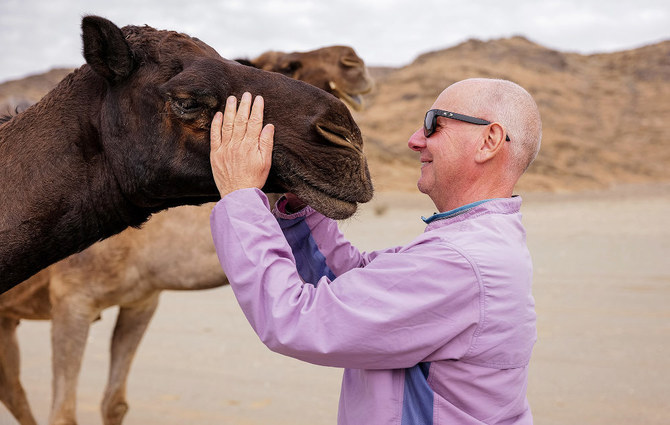

RIYADH: At first thought the freezing Arctic and scorching Arabian desert would seem to have little in common, but according to British explorer Mark Evans, their similarities lie in the people who live there.
It has been only a few days since Evans completed the Heart of Arabia expedition across the Empty Quarter of Saudi Arabia, a journey taken by the great explorer and writer Harry St. John Philby in 1917. Philby greatly contributed to the documentation of the region and felt so at home that he converted to Islam and named himself Abdullah.
The team of four, including Philby’s granddaughter Reem Philby, photographer Ana-Maria Pavalache, and regional expert Alan Morrissey, was led by Evans from the Eastern Province of Saudi Arabia to the west in a 1,300 km journey that ended on Jan. 30.

Mark Evans and Saudi explorer Reem Philby on the second leg of the Heart of Arabia expedition following in Abdullah Philby's footsteps from 1917. (Photo/Ana-Maria Pavalache)
Every day, Evans and Reem would set off at sunrise, walking or sometimes mounted on camels, leaving the vehicles to catch up later in the day as they followed Philby’s route. Through Philby’s photographic documentation and detailed journals in the early 1900s, the group was able to pinpoint the exact locations almost 105 years later.
Evans has lived in the region for over 25 years, and is head of Outward Bound Oman, an experiential learning organization dedicated to developing outdoor skills, the first of its kind in the Arab region.
Before traveling around the Middle East, he lived a neo-nomadic lifestyle, honoring the beauty of uninhabited places through his travels, which included crossing Greenland’s ice sheet, and hunting for evidence of William Edward Parry’s 1820 Artic expedition on Melville Island.
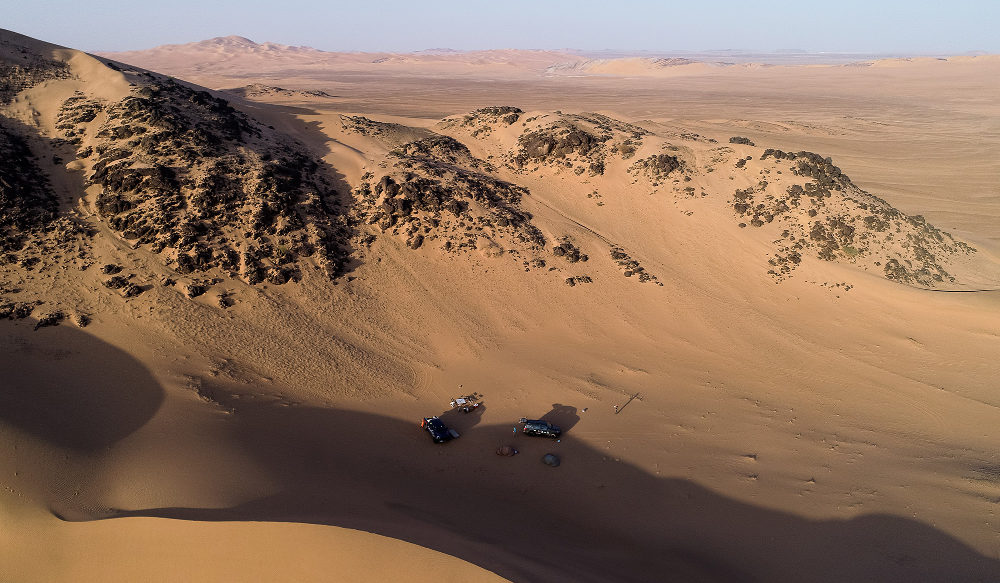
A resting point for the Heart of Arabia expedition team between the Saudi desert sand dunes during the second leg of the journey, which kicked off from Diriyah in January. (Photo/Ana-Maria Pavalache)
Most journeys are spent in isolation, far away from the chaos and daily demands of the world, giving explorers a great opportunity for reflection and a chance to focus on the research at hand. These meaningful expeditions have allowed Evans to reframe the notion of isolation.
“I really like the word serenity because I find great peace and contentment in the desert. One of the best parts of the day is the first half an hour when I get into my sleeping bag and I just put my head on my pillow and look at the stars above that are just unbelievable,” he said. He said that he prefers to sleep on the sand rather than in a tent.
Having spent a whole year in the Arctic, including four months of total darkness with temperatures as low as minus 37 C, two weeks in the Saudi desert are relatively straightforward for Evans.
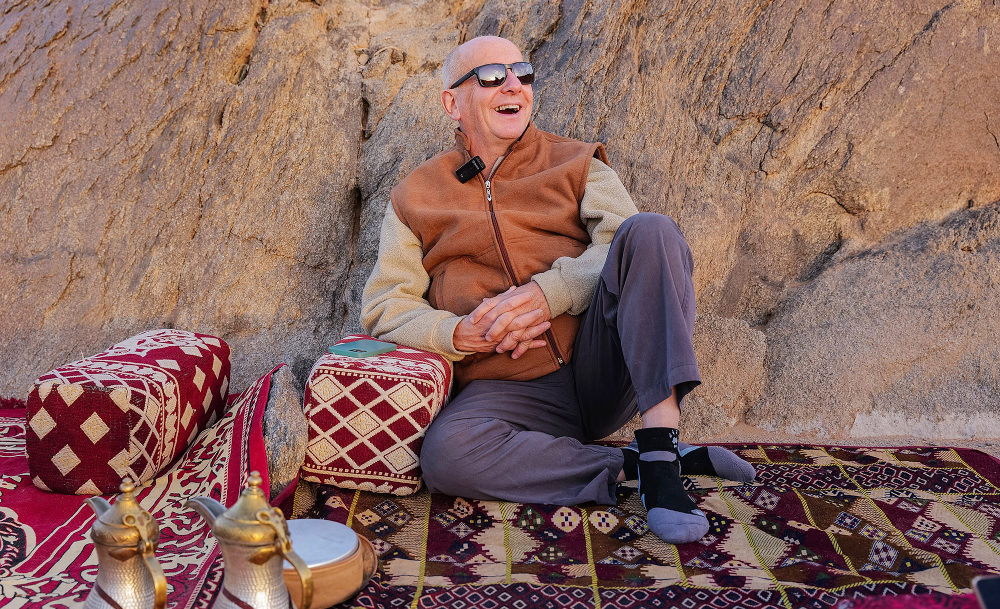
Much of British explorer Mark Evans' expeditions are spent in isolation from the chaos and happenings of the world, which provide great opportunity for reflection and focus. (Photo/Ana-Maria Pavalache)
Growing up in the British countryside, Evans’ exploring instincts were honed at an early age.
“I grew up in a time where you had to create your own entertainment. I was already very content in silent places and quiet places close to nature. That was my childhood. I was less comfortable going into noisy restaurants and discotheques,” he said.
I feel that my role in life is to try to inspire others and to give other people the opportunity that I had when I was a young person, to shape their own lives and make a positive difference to society.
Mark Evans, British explorer
Aged 17, he had the chance to join a six-week expedition to northern Norway through an educational charity in London. He shared a tent with two strangers in a place where the sun never set.
“I just fell in love with a life that was outside of my small rural life back in Britain,” Evans said.
That period set him off on a flurry of expeditions in the years to come. He spent 10 years in the Arctic, giving back to the youth and future generations in the same way the charity invested in him at an early age.
“It was a chance for me to step up and invest a bit of my time to support society,” he said.
HIGHLIGHTS
• The Heart of Arabia expedition that follows in Abdullah Philby’s footsteps included his granddaughter Reem Philby, photographer Ana-Maria Pavalache, regional expert Alan Morrissey, and seasoned explorer Mark Evans who led the group from the Eastern Province of Saudi Arabia to the west in a 1,300 km journey that ended on Jan. 30.
• Since the Heart of Arabia expedition began, the expedition’s official podcast has garnered nearly 3,000 downloads in 53 countries around the world, along with steady growth in followers across social media platforms. Listeners can follow the group’s documentation of everyday life in the Kingdom’s deserts.
But while his travels and philanthropic ventures were a great way to see the world, they paid far from a livable wage, which led him to become an educator.
Although Evans claims he went into teaching “for the wrong reasons,” it brought him to the Middle East, initially to Bahrain, then for four years at the British School in Riyadh, and later Oman.
Initially, he thought he would not particularly enjoy the region, but he quickly fell in love with the culture, heritage, and hospitality of the people.
“There’s a real connection between those two places in my life. Arctic and Arabia both start with a letter ‘A,’ and the one thing they have in common is that people who live in the Arctic and who live in Arabia live on the extremes of human comfort.
“One lives in extreme cold, one lives in extreme heat. As (explorer and writer) Wilfred ‘Mubarak bin Landan’ Thesiger said: ‘The harder the life, the finer the person.’”
During winter nights, the Arctic sky would come alive with the electrifying energy of the aurora borealis. The sunlight, however, came in waves: From total darkness in early February to slivers of sunshine on the horizon, the season eventually turns to unbroken daylight.
“I hadn’t seen the sun for three months. I remember breaking down and crying because I knew that winter was coming to an end and summer was coming. And that was quite emotional,” Evans said.
Moments such as these are what keep the traveler curious for more. At the age of 61, he continues his quest to experience the glorious offerings of nature and serenity.
“Being here, I find total contentment. I wouldn’t find it working in a busy office in a noisy city,” he said.
As Evans grows older, his legacy is becoming a prime motivator. He continues to find ways to secure sustainable outcomes that influence the behavior and thinking of others, much like Abdullah Philby did.
Since the Heart of Arabia expedition began, their podcast has garnered nearly 3,000 downloads in 53 countries around the world, along with steady growth in followers across social media platforms. Listeners can follow the group’s documentation of everyday life in the Kingdom’s deserts.
The team has also launched the Philby Arabia Fund, which is dedicated to researchers looking to initiate projects in Saudi Arabia.
“Funding can be a real challenge,” Evans said. “You have an idea, but you just don’t know where to start. I feel that my role in life is to try to inspire others and to give other people the opportunity that I had when I was a young person, to shape their own lives and make a positive difference to society.”

keywords


