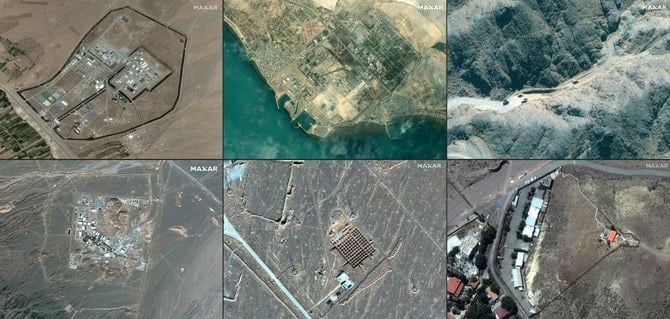
IAEA chides Iran for undeclared change to Fordow uranium enrichment setup

The UN nuclear watchdog criticised Iran for making an undeclared change to the interconnection between the two clusters of advanced machines enriching uranium to up to 60% purity, close to weapons grade, at its Fordow plant. (File/AFP)
Short Url
Updated 01 February 2023
Follow

IAEA chides Iran for undeclared change to Fordow uranium enrichment setup

  • IAEA found the change during an unannounced inspection on Jan. 21 at the Fordow Fuel enrichment Plant
  • Fordow is so sensitive that the 2015 nuclear deal between Iran and major powers banned enrichment there

VIENNA: The UN nuclear watchdog criticized Iran on Wednesday for making an undeclared change to the interconnection between the two clusters of advanced machines enriching uranium to up to 60 percent purity, close to weapons grade, at its Fordow plant.
The International Atomic Energy Agency found the change during an unannounced inspection on Jan. 21 at the Fordow Fuel enrichment Plant (FFEP), a site dug into a mountain where inspectors are stepping up checks after Iran said it would dramatically expand enrichment.
Fordow is so sensitive that the 2015 nuclear deal between Iran and major powers banned enrichment there. Since the United States pulled out of the deal in 2018 and re-imposed sanctions against Iran, the Islamic Republic has breached many of the deal’s restrictions on its nuclear activities.
In a confidential report to member states seen by Reuters, the IAEA did not say how the interconnection between the two cascades of IR-6 centrifuges had been changed except that “they were interconnected in a way that was substantially different from the mode of operation declared by Iran (to the IAEA).”
In a public statement summarising that confidential report, the IAEA said its chief Rafael Grossi “is concerned that Iran implemented a substantial change in the design information of FFEP in relation to the production of high-enriched uranium without informing the Agency in advance.”
“This is inconsistent with Iran’s obligations under its Safeguards Agreement and undermines the Agency’s ability to adjust the safeguards approach for FFEP and implement effective safeguards measures at this facility.”
The IAEA has had regular access to Fordow to carry out verification activities like inspections and it is in talks with Iran on stepping up those activities, the report said.
“The Agency and Iran have continued their discussions. The Agency has increased the frequency and intensity of its verification activities at FFEP. However, some other safeguards measures are still required and are being discussed with Iran,” the report added.


US military transfers first 150 Daesh detainees from Syria to Iraq

Updated 3 sec ago
Follow

US military transfers first 150 Daesh detainees from Syria to Iraq

  • Transfer follows Syrian government forces taking control of Al-Hol camp from SDF
  • US Central Command says up to 7,000 detainees could be transferred to Iraqi-controlled facilities
AL-HOL, Syria: The US military said Wednesday it has started transferring detainees from the Daesh group being held in northeastern Syria to secure facilities in Iraq.
The move came after Syrian government forces took control of a sprawling camp, housing thousands of mostly women and children, from the US-backed Syrian Democratic Forces, or SDF, which withdrew as part of a ceasefire. Troops on Monday seized a prison in the northeastern town of Shaddadeh, where some Daesh detainees escaped and many were recaptured, state media reported.
The Kurdish-led SDF still controls more than a dozen detention facilities holding around 9,000 Daesh members.
US Central Command said the first transfer involved 150 Daesh members, who were taken from Syria’s northeastern province of Hassakah to “secure locations” in Iraq. The statement said that up to 7,000 detainees could be transferred to Iraqi-controlled facilities.
“Facilitating the orderly and secure transfer of Daesh detainees is critical to preventing a breakout that would pose a direct threat to the United States and regional security,” said Adm. Brad Cooper, CENTCOM commander. He said the transfer was in coordination with regional partners, including Iraq.
US troops and their partner forces detained more than 300 Daesh operatives in Syria and killed over 20 last year, the US military said. An ambush last month by Daesh militants killed two US soldiers and one American civilian interpreter in Syria.
An Iraqi intelligence general told The Associated Press that an agreement was reached with the US to transfer 7,000 detainees from Syria to Iraq. He said that Iraqi authorities received the first batch of 144 detainees Wednesday night, after which they will be transferred in stages by aircraft to Iraqi prisons.
The general, who spoke on condition of anonymity because he was not authorized to speak to the media, said the Daesh members who will be transferred to Iraq are of different nationalities. He said they include around 240 Tunisians, in addition to others from countries including Tajikistan and Kazakhstan and some Syrians.
“They will be interrogated and then put on trial. All of them are commanders in Daesh and are considered highly dangerous,” the general said. He added that in previous years, 3,194 Iraqi detainees and 47 French citizens have been transferred to Iraq.

Regional threat despite battle setbacks

The Daesh group was defeated in Iraq in 2017, and in Syria two years later, but the group’s sleeper cells still carry out deadly attacks in both countries. The SDF played a major role in defeating Daesh.
Tom Barrack, the US envoy to Syria, said in a statement on Tuesday that the SDF’s role as the primary anti-Daesh force “has largely expired, as Damascus is now both willing and positioned to take over security responsibilities.”
He added that the “recent developments show the US actively facilitating this transition, rather than prolonging a separate SDF role.”
Syria’s Foreign Ministry welcomed the transfer of detainees, calling it “an important step to strengthen security and stability.”
Earlier on Wednesday, a convoy of armored vehicles with government forces moved into the Al-Hol camp following two weeks of clashes with the SDF, which appeared closer to merging into the Syrian military, in accordance with government demands.
At its peak in 2019, some 73,000 people were living at Al-Hol. Their number has since declined with some countries repatriating their citizens.
The camp is still home to some 24,000, most of them women and children. They include about 14,500 Syrians and nearly 3,000 Iraqis. Some 6,500 others, many of them loyal Daesh supporters who came from around the world to join the extremist group, are separately held in a highly secured section of the camp.
The Syrian government and the SDF announced a new four-day truce on late Tuesday after a previous ceasefire broke down.