

In rural Indonesia, women join climate action in fight for survival

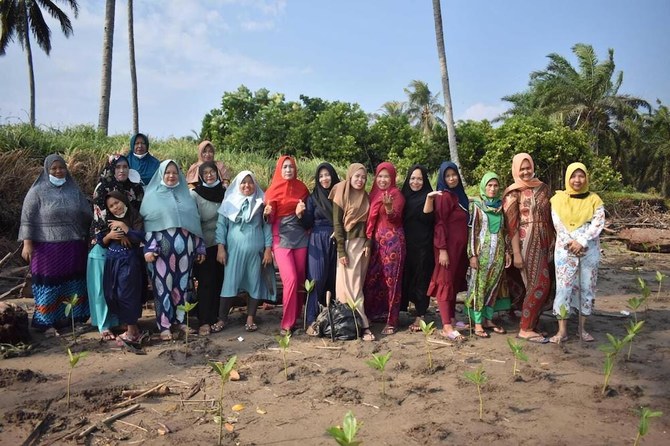
The women of Pondok Kelapa village in Indonesia’s Bengkulu province pose for a photo during a mangrove-planting event near their homes. In 2020, they formed a group to advocate for government climate resilience assistance. (Indonesian Forum for the Environment)
Short Url
Updated 01 February 2023
Follow

In rural Indonesia, women join climate action in fight for survival

  • Nearly half of coastal cities, districts in Indonesia are at risk of tidal flooding by 2050
  • Indonesia is one of the most vulnerable countries in terms of risks posed by climate change

JAKARTA: For the past few years, Rania has been constantly living in fear of the day she and her family would have to abandon their home when everything they own falls into the ocean. 

Life and livelihood in Rania’s village, Pondok Kelapa in Bengkulu province on the western coast of Indonesia’s Sumatra Island, have been increasingly affected by erosion. 

Environmentalists estimate that seawater has already entered 30 m into the mainland since 2011 and the pace at which it reclaims more is increasing. 

The village has been also losing its main source of livelihood, fisheries, as tidal waves destroy marine vegetation and fish habitats, leaving many men jobless and trapping the whole community in a poverty cycle. 

“Where we live is being eroded by the waves. Tidal floods are greatly affecting our lives,” Rania, 47, told Arab News. 

“We are trying our best, but some children don’t go to school. Some of them have had to leave because there’s simply not enough money.” 

Pondok Kelapa is not the only place affected, as coastal erosion and tidal flooding are threatening many more communities in the archipelagic nation of 270 million. 

A recent study by Indonesia’s biggest daily, Kompas, showed that nearly 200 out of about 500 coastal cities and districts are at risk of being submerged by 2050, as the country is one of the most vulnerable in terms of risks posed by the changing climate.

In Rania’s village of 4,300 people, women have decided to fight back. 

In 2020, she and over 20 other village women formed a group to advocate for government climate resilience assistance to build a seawall and help the community adapt to the rapidly changing conditions with proper infrastructure. 

“Because of climate change, seawater has increasingly eroded our place in Pondok Kelapa,” she said. 

“Now the women are stepping up and trying to confront this issue. Who knows, maybe the government will respond to us ladies.” 

Action is urgently needed not only in Pondok Kelapa but along the coast of the whole Bengkulu province, according to the Indonesian Forum for the Environment, a non-governmental organization, which is part of the Friends of the Earth International network. 

“A number of villages are in danger of sinking because of coastal erosion and tidal flooding…These tidal floods in Bengkulu province are very hard to predict, and they have impacted the earnings of fishermen and subsequently affected their livelihood,” Dodi Faisal, who heads the forum’s advocacy in the province, told Arab News. 

“It’s very worrying. The provincial and local governments have yet to take any concrete action.” 

Masmarawati, another member of Rania’s group, said she hopes action will come soon.

“We can still survive in the village for now,” she said. 

“But what about next year? In five years? What’s going to happen to our children and grandchildren?” 


Bangladesh’s leading contender for PM returns after 17 years in exile 

Updated 5 sec ago
Follow

Bangladesh’s leading contender for PM returns after 17 years in exile 

DHAKA: Millions of supporters crowded the streets of Dhaka on Thursday to welcome Tarique Rahman, acting chairman of the Bangladesh Nationalist Party, who has returned to his country after more than 17 years in exile. 

Rahman, the son of ailing former Prime Minister Khaleda Zia, waved to the large crowds from the front of a BNP bus escorted by security, as people lined the route from the capital’s airport to a reception venue, waving national and party flags, chanting slogans and carrying banners and flowers. 

His return comes in the wake of former Prime Minister Sheikh Hasina’s ouster last year and as Bangladesh gears up to hold general elections in February, for which he is emerging as a leading contender to become prime minister. 

“As a member of the BNP, I want to say in front of you that I have a plan for the people of my country, for my country,” Rahman said as he addressed a throng of supporters in Dhaka. 

“This plan is for the interest of the people of the country, for the development of the country and for changing the fate of the people. For this, I need support from each and every one of this country.  If you people stand beside us, God willing, we would be able to implement those plans.” 

The 60-year-old lived in London after he fled Bangladesh in 2008 over what he called a politically motivated persecution. 

After facing multiple criminal convictions in Bangladesh, including money laundering and charges linked to an alleged plot to assassinate Hasina, courts acquitted him following Hasina’s removal from office, clearing the legal obstacles that delayed his return. 

Rahman’s homecoming is “significant” as it comes as Bangladesh is going through a “very critical political crisis,” said analyst Prof. Dilara Choudhury. 

“People of Bangladesh, they are expecting that there will be free and fair elections, and whoever wins will form the government and forward to the transition. In that sense, his return is significant.” 

Bangladesh will hold parliamentary elections on Feb. 12, its first vote since a student-led uprising removed Hasina and her Awami League-led government from power in August 2024. 

The South Asian nation of nearly 175 million people has since been led by interim leader Muhammad Yunus, a Nobel Prize-winning economist, who took over governance after Hasina fled to India, where she is now in self-exile. 

As the Yunus-led administration has banned Awami League from all activities, meaning the former ruling party would not be able to join the upcoming race, the BNP is on course to win the largest number of parliamentary seats, according to a survey published in December by the US-based International Republican Institute. 

“I believe a new era in our politics will start with the arrival of Tarique Rahman in the country,” political analyst Mahbub Ullah told Arab News. 

“He will take the realms of his party with his own hand and he will do all kinds of things to organize the party and lead the party to victory in the next election.”