

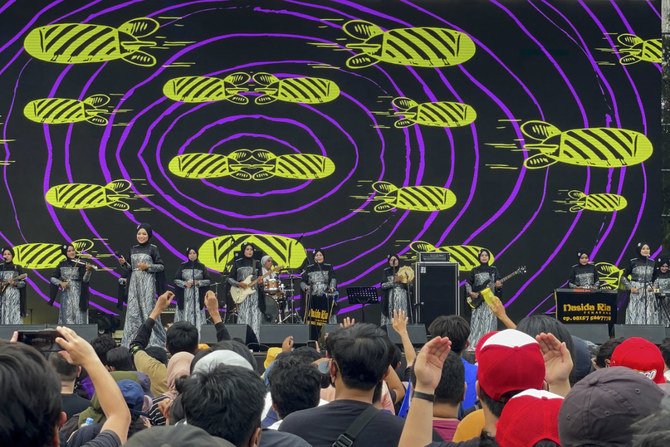


JAKARTA: At a packed festival in central Jakarta, hijab-clad sexagenarian singer Rien Djamain bursts into an upbeat track about nuclear destruction to a crowd of thousands, mostly young Indonesians.
Behind the frontwoman of the all-female Nasida Ria band are her fellow musicians, dressed in silver and black sequined dresses, backing up her velvety vocals with bongos, violins, mandolins, bamboo flutes and tambourines.
“O cursed creator of the nuclear bomb, why do you invite the day of judgment?” she sang on the track “Bom Nuklir.”
Young concert-goers swung from side to side during the macabre ditty, shouting “mother!” at their favorite band members.
Originally formed 47 years ago as a Qur'an recital group, the band now numbers a dozen performers, fusing Arabic and traditional Indonesian dangdut music, which was once thought tacky and dated in cosmopolitan circles.
Their humorous Islamic pop tunes about serious themes, such as justice and human rights, have caught on with social media-obsessed young people looking for some levity in their playlists.
Riding the wave of Indonesia’s increasingly vibrant music scene, the band’s droll lyrics have gained them a certain notoriety.
Their songs are laden with similes and metaphors, comparing womanizers to “seditious bats” or describing how “monkeys like to carry rifles, humans like to show nipples.”
Twenty-three-year-old Fathul Amin said he thinks the band is “more than just cool.”

The Nasida Ria band performs on stage at a festival in Jakarta on January 6, 2023. (AFP)
“Why? Because all of the members are women who can play more than three musical instruments,” he said.
Screen grabs of Nasida Ria’s expressive words have been widely shared as memes, forging a connection between the band and the younger generation.
“That is how youths communicate nowadays, and that is OK. More importantly, it shows that our messages through the songs are well accepted,” Djamain told AFP.
“I am grateful that despite the mostly old members, Nasida Ria is still loved by the youths. That our music is still enjoyable to them.”
Music consumption in Indonesia is evolving, experts say, with listeners adding combinations of genres that include more traditional sounds — such as dangdut with Javanese lyrics or reggae-pop sung in eastern Indonesian dialects — to their Western favorites.
That growing trend has made Nasida Ria more relevant than ever, according to music journalist Shindu Alpito.
“The younger generations tend to celebrate music with a sense of humor. They are attracted not only to the musical aesthetics but also musical comedy,” he told AFP.
Dangdut music has been increasing in popularity, with acts now playing at festivals across Indonesia, performing for young audiences alongside rock bands, in addition to gigs for their usual crowds in smaller villages.
“A lot of youths in... Jakarta are re-embracing local music. Now, these types of music are what they call a guilty pleasure,” Alpito said.
“Islamic songs are usually serious, with lyrics carefully quoting Islamic teachings. However, Nasida Ria have charmed broader society through a language style that is easy to understand and amusing.”
The group capitalized on the demand for entertainment while the world was stuck indoors and concert venues were closed during the Covid-19 pandemic.
Nasida Ria’s youngest member, 27-year-old Nazla Zain, attributes their success to modern technology allowing people from all backgrounds to be exposed to their music.
“We are keeping up with the trend by using YouTube and other music applications,” she said.
“So now youths with mobile phones can listen to our songs. That might be a reason why they like us.”
They have seen their YouTube subscriber count surge six-fold since March 2020 to nearly 500,000.
They also boast nearly 50,000 listeners every month on streaming platform Spotify and 38,000 followers on Instagram.
“They are so cool as they still perform at a not-so-young age,” said 32-year-old metal and punk fan Ricky Prasetyo.
“No wonder many people call them the indie mothers.”


