

Indonesia sees Saudi Arabia as ‘priority partner’ to boost Mideast trade

1 / 2
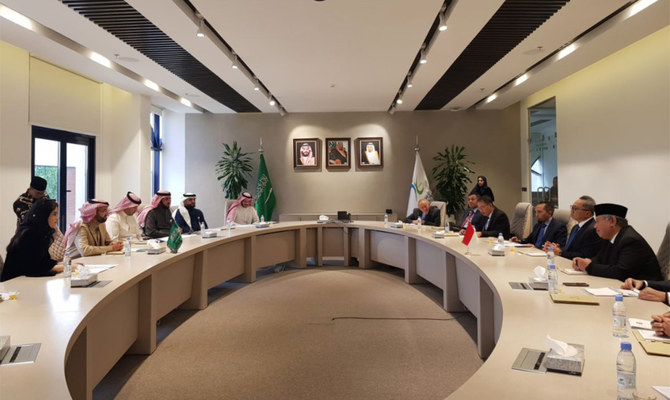
Indonesian Trade Minister Zulkifli Hasan meets Hisham bin Saad Al-Jadhey, executive president of the Saudi Food and Drug Authority in Saudi Arabia last year. (Indonesian Ministry of Trade)
2 / 2
Indonesia’s trade delegation led by Minister Zulkifli Hasan meets representatives of the Saudi Food and Drug Authority in Riyadh. (Indonesian Ministry of Trade)
Short Url
Updated 01 February 2023
Follow

Indonesia sees Saudi Arabia as ‘priority partner’ to boost Mideast trade

  • Bilateral trade rose 45% between January and November 2022
  • Indonesia’s trade minister in Riyadh last week to tap export potential

JAKARTA: Saudi Arabia is Indonesia’s strategic and priority market, a top trade ministry official said on Tuesday, as Southeast Asia’s biggest economy seeks to increase its presence in the Middle East.

Trade between Indonesia and Saudi Arabia has been on the rise, increasing to $7 billion, or by about 45 percent, between January and November last year, compared to the same period the previous year.

Trade Minister Zulkifli Hasan visited Riyadh last week, leading a special delegation seeking to explore untapped export potential with the Kingdom.

“Trade potential between Indonesia and Saudi Arabia is very huge and very strategic,” Didi Sumedi, director general of national export development at the Indonesian Ministry of Trade, told Arab News, adding that it “has not been maximized.”

Boosting ties with the Kingdom would also help Indonesia increase its presence in the Middle East.

“Saudi Arabia in this case is a priority because it is a strategic partner with the biggest economy in the Middle East,” Sumedi said.

Improving relations with Saudi Arabia would also help pave the way for better ties with GCC countries, as Indonesia is pushing for a trade pact with the bloc.

Indonesia signed a trade agreement with the UAE in July last year, expecting to boost its Emirates-bound exports by nearly 8 percent a year.

The agreement, which erases about 99 percent of existing tariffs, is still pending ratification by the Indonesian House of Representatives.

In Saudi Arabia, Indonesia wants to increase exports of processed food and everyday items, including paper and clothes.

“We see we can further improve trade between the two countries,” Sumedi said.

The ministry is also looking into supporting Indonesian retail businesses to open in Madinah, Makkah and Jeddah, he added.

“Our hope is that with modern shops in Saudi Arabia, Indonesian business owners, including small businesses, can easily market their products,” Sumedi said.

“This would certainly push forward our national exports as well.”


Venezuela’s acting president calls for oil industry reforms to attract more foreign investment

Updated 16 January 2026
Follow

Venezuela’s acting president calls for oil industry reforms to attract more foreign investment

  • In her speech, Rodríguez said money earned from foreign oil sales would go into two funds: one dedicated to social services for workers and the public health care system, and another to economic development and infrastructure projects

CARACAS, Venezuela: Venezuela’s acting President Delcy Rodriguez used her first state of the union address on Thursday to promote oil industry reforms that would attract foreign investment, an objective aggressively pushed by the Trump administration since it toppled the country’s longtime leader less than two weeks ago.
Rodríguez, who has been under pressure from the US to fall in line with its vision for the oil-rich nation, said sales of Venezuelan oil would go to bolster crisis-stricken health services, economic development and other infrastructure projects.
While she sharply criticized the Trump administration and said there was a “stain on our relations,” the former vice president also outlined a distinct vision for the future between the two historic adversaries, straying from her predecessors, who have long railed against American intervention in Venezuela.
“Let us not be afraid of diplomacy” with the US, said Rodriguez, who must now navigate competing pressures from the Trump administration and a government loyal to former President Nicolás Maduro.
The speech, which was broadcast on a delay in Venezuela, came one day after Rodríguez said her government would continue releasing prisoners detained under Maduro in what she described as “a new political moment” since his ouster.
Trump on Thursday met at the White House with Venezuelan opposition leader María Corina Machado, whose political party is widely considered to have won 2024 elections rejected by Maduro. But in endorsing Rodríguez, who served as Maduro’s vice president since 2018, Trump has sidelined Machado.
In her speech, Rodríguez said money earned from foreign oil sales would go into two funds: one dedicated to social services for workers and the public health care system, and another to economic development and infrastructure projects.
Hospitals and other health care facilities across the country have long suffered. Patients are asked to provide practically all supplies needed for their care, from syringes to surgical screws. Economic turmoil, among other factors, has pushed millions of Venezuelans to migrate from the South American nation in recent years.
In moving forward, the acting president must walk a tightrope, balancing pressures from both Washington and top Venezuelan officials who hold sway over Venezuela’s security forces and strongly oppose the US Her recent public speeches reflect those tensions — vacillating from conciliatory calls for cooperation with the US, to defiant rants echoing the anti-imperialist rhetoric of her toppled predecessor.
American authorities have long railed against a government they describe as a “dictatorship,” while Venezuela’s government has built a powerful populist ethos sharply opposed to US meddling in its affairs.
For the foreseeable future, Rodríguez’s government has been effectively relieved of having to hold elections. That’s because when Venezuela’s high court granted Rodríguez presidential powers on an acting basis, it cited a provision of the constitution that allows the vice president to take over for a renewable period of 90 days.
Trump enlisted Rodríguez to help secure US control over Venezuela’s oil sales despite sanctioning her for human rights violations during his first term. To ensure she does his bidding, Trump threatened Rodríguez earlier this month with a “situation probably worse than Maduro.”
Maduro, who is being held in a Brooklyn jail, has pleaded not guilty to drug-trafficking charges.
Before Rodríguez’s speech on Thursday, a group of government supporters was allowed into the presidential palace, where they chanted for Maduro, who the government insists remains the country’s president. “Maduro, resist, the people are rising,” they shouted.