TEHRAN: Iran has accused Iraq-based Kurdish groups of being “involved” in a drone attack last week against a defense ministry site in the central province of Isfahan, Iranian media reported Wednesday.
“Parts of the drones that attacked the workshop complex of the defense ministry in Isfahan, along with explosive materials, were transferred to Iran with the participation and guidance of the Kurdish anti-revolutionary groups based in Iraq’s Kurdistan region,” Nour news agency said.
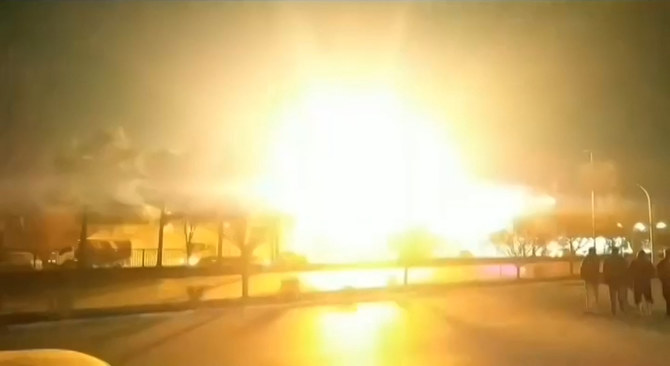
Iranian authorities reported an “unsuccessful” drone attack late Saturday that targeted a defense ministry “workshop complex” in Isfahan province, home to the Natanz nuclear enrichment facility.
An anti-aircraft system destroyed one drone and two others exploded, the defense ministry said, adding that there were no casualties and only minor damage to the site.
Nour charged that Kurdish groups brought the drone parts and explosive materials into Iran from “one of the hardly accessible routes in the northwest” upon “the order of a foreign security service.”
The news agency, considered close to the Islamic republic’s Supreme National Security Council, did not specify which country’s security service it accused of being behind the attack. It said the drone parts were delivered to the “service’s liaison in a border city.”
“The parts and materials have been assembled and used for sabotage in an advanced workshop by trained forces,” Nour said.
Some Western media have blamed the attack on Iran’s arch foe Israel.
Iraq’s autonomous Kurdish region hosts camps and rear-bases operated by several Iranian Kurdish rebel groups, which Iran has accused of serving Western or Israeli interests in the past.
In November, Iran launched cross-border missile and drone strikes against several of the groups in Iraq, accusing them of stoking the nationwide protests triggered by the death in custody in September of Iranian Kurdish woman Mahsa Amini.

Iran says Iraq-based Kurd groups ‘involved’ in drone attack
https://arab.news/6kz4w
Iran says Iraq-based Kurd groups ‘involved’ in drone attack
- Iranian authorities earlier reported “unsuccessful” drone attack
Bahrain arrests four for spying for Iran’s IRGC as Gulf attacks intensify
- Investigators said the suspects were found to have sent pictures and coordinates of vital locations in Bahrain to the IRGC via encrypted software
MANAMA: Bahrain has detained four citizens suspected of spying for Iran’s Islamic Revolutionary Guard Corps (IRGC), as Tehran’s retaliatory strikes on Gulf states show no signs of letting up.
Bahrain’s General Directorate of Criminal Investigation and Forensic Science identified the four detainees as Murtadha Hussain Awal, 25; Ahmed Isa Al Haiki, 34; Sarah Abdulnabi Marhoon, 36; and Elias Salman Mirza, 22. A fifth suspect, Ali Mohammed Hassan Al Shaikh, 25, remains at large abroad.
Investigators said Murtadha Hussain and his cohorts, acting on IRGC instructions, used high-resolution equipment to photograph and record coordinates of vital locations in Bahrain, transmitting the data to the IRGC via encrypted software.
The arrests come as Iran escalates attacks across the Gulf. Bahrain’s Interior Ministry issued an advisory urging residents in Hidd, Arad, Qalali and Samaheej to stay indoors and seal windows against smoke from fires sparked by Iranian strikes. Fuel tanks at a facility in Muharraq Governorate, northeast of Manama, were among the targets. Oman’s Port of Salalah also battled blazes at fuel storage tanks following separate Iranian drone strikes.
Elsewhere in the region, two Iranian drones struck near Dubai International Airport, wounding four people, though flights continued uninterrupted. A fire broke out at a luxury apartment tower in Dubai Creek Harbour after another drone hit — extinguished by Thursday morning.
Iran also targeted commercial ships and struck what officials described as the world’s busiest international airport on Wednesday, as US and Israeli strikes continued to pound Tehran.
A war now 12 days old — and costly
The conflict began on February 28, when US and Israeli forces launched coordinated strikes on Iran. Tehran has since retaliated by targeting Gulf states, US and Israeli assets, and critical energy infrastructure.
Iran has declared a blockade on energy shipments through the Strait of Hormuz, a vital chokepoint for global oil and gas flows, sending commodity prices surging and rattling international markets.
The Pentagon told Congress this week that the first week of war cost the United States $11.3 billion — including $5 billion in munitions in the conflict’s opening weekend alone.
The UN Security Council on Wednesday voted to approve a resolution demanding a halt to Iran’s attacks on its Gulf neighbors. Bahrain’s UN Ambassador Jamal Alrowaiei welcomed the move.
“The international community is resolute in rejecting these Iranian attacks against sovereign countries that are threatening the stability of the peoples, especially in a region of strategic importance to global economy, energy security and global trade,” he said.
Despite the resolution, there were no immediate signs the conflict was easing.
(With AP)



