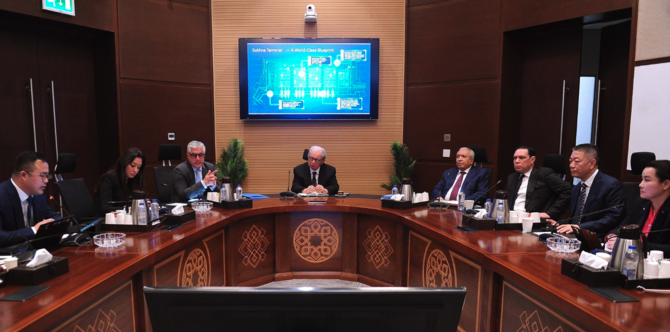

RIYADH: Chinese companies are set to invest around $2.4 billion in Egypt, including the development of a logistics and commercial zone as well as a container terminal at Ain Sokhna Port.
Backed by an estimated $2 billion, the logistics and commercial zone will span 3 million sq. meters, comparable in scale to China’s city of Yiwu.
The container terminal at Ain Sokhna Port will be developed with an initial $400 million investment and a designed capacity of 2 million containers.
The project will be undertaken by Jiangsu Provincial Port Group Co., Ltd. and Shanghai Huanshi Logistics Co., Ltd., according to a statement published on the Egyptian Cabinet Presidency’s Facebook account.
This momentum aligns with broader investment activity in the Suez Canal Economic Zone, which announced in December plans to host three new industrial projects with a combined investment of $1.15 billion. This brings total investments in the zone to $5.1 billion in the first half of the 2025/26 fiscal year, underscoring its growing role as a regional industrial and logistics hub.
The newly released statement said: “At the beginning of the meeting, the deputy prime minister for economic affairs emphasized the Egyptian government’s commitment to strengthening cooperation with China in various economic fields, noting that China is a strategic partner for Egypt.”
Walid Gamal El-Din, chairman of the General Authority for the SCZONE, underlined that Chinese companies are among the most prominent investors in the SCZONE, affirming his readiness to provide all possible support to companies wishing to establish new investments in the economic zone.
Counselor Mohamed El-Homsani, the official spokesman for the Cabinet, stated that the meeting reviewed a number of new projects that Chinese companies intend to implement in the Egyptian market, specifically within the SCZONE, the New Administrative Capital, and various industrial zones.
El-Homsani added that the meeting also reviewed the Chinese Hurricane Group’s plan to establish a 100,000 sq. meter industrial zone, which would include production lines for chemical products, fast-moving consumer goods, and household appliances, as well as regional storage centers and smart logistics systems.
This would contribute to forming an integrated supply chain network serving the Egyptian market and the markets of Africa, the Middle East, and Europe. Approximately 70 percent of the production would be directed toward export, while 30 percent would be allocated to the local market.
The official spokesperson also stated that the Chinese side expressed interest in establishing a customs warehouse for re-exporting used machinery to African markets.
The delegation from the Asian country also explored the possibility of strengthening cooperation between the Chinese Chamber of Commerce and the Egyptian government, with the aim of attracting more investments to the Egyptian market, in accordance with the sectors identified by the government.
Representatives of the Chinese side confirmed that more than 160 companies are operating in various sectors and are ready to make new investments in the north African country’s market.
Beijing’s growing role in Egypt’s SCZONE is part of China’s broader Belt and Road Initiative, in which state-linked firms anchor Chinese industry in countries that keep global trade moving.