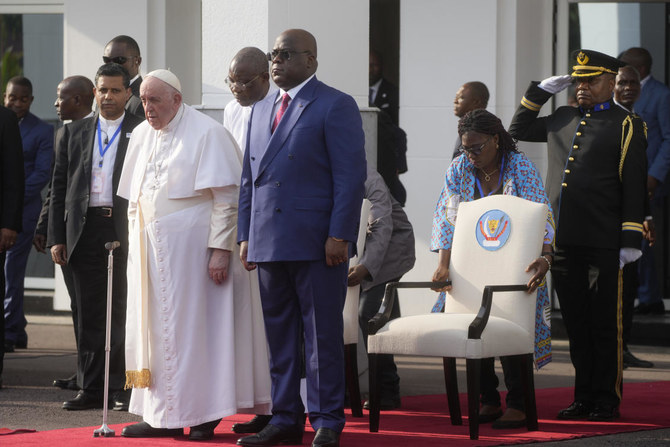
KINSHASA: Pope Francis denounced the “poison of greed” for mineral resources driving conflict in Democratic Republic of Congo as he began a visit there on Tuesday, saying the rich world could no longer ignore the tragic plight of many African nations.
The 86-year-old Francis is the first pontiff to visit Congo since John Paul II in 1985, when it was still known as Zaire. About half of Congo’s population of 90 million are Roman Catholics.
Tens of thousands of people cheered as he traveled from the airport into the capital Kinshasa in his popemobile, with some breaking away to chase his convoy while others chanted and waved flags in one of the most vibrant welcomes of his foreign trips.
But the mood changed when the pope gave a speech to dignitaries at the presidential palace, condemning “terrible forms of exploitation, unworthy of humanity” in Congo, where vast mineral wealth has fueled war, displacement and hunger.
“It is a tragedy that these lands, and more generally the whole African continent, continue to endure various forms of exploitation,” he said. “The poison of greed has smeared its diamonds with blood,” he said, referring to Congo specifically.
“Hands off the Democratic Republic of the Congo! Hands off Africa! Stop choking Africa: it is not a mine to be stripped or a terrain to be plundered,” he said.
Congo has some of the world’s richest deposits of diamonds, gold, copper, cobalt, tin, tantalum and lithium, but those have stoked conflict between militias, government troops and foreign invaders. Mining has also been linked to inhumane exploitation of workers, including children, and environmental degradation.
Compounding these problems, eastern Congo has been plagued by violence connected to the long and complex fallout from the 1994 genocide in neighboring Rwanda.
An estimated 5.7 million people are internally displaced in Congo and 26 million face severe hunger, largely because of the impact of armed conflict, according to the United Nations.
’PILGRIMAGE OF PEACE’
The Catholic Church plays a crucial role in running schools and health facilities in the country, as well as promoting democracy.
The pope criticized rich countries for closing their eyes and ears to the tragedies unfolding in Congo and elsewhere in Africa.
“One has the impression that the international community has practically resigned itself to the violence devouring it (Congo). We cannot grow accustomed to the bloodshed that has marked this country for decades, causing millions of deaths,” he said.
First scheduled for last July, the pope’s trip was postponed because he was suffering a flare-up of a chronic knee ailment. He had originally planned to travel to Goma, in eastern Congo, but that stop was scrapped because of a resurgence in fighting between the M23 rebel group and government troops.
In an apparent reference to the M23 and other militias active in Congo’s eastern regions, the pope said the Congolese people were fighting to preserve their territorial integrity “against deplorable attempts to fragment the country.”
On Wednesday, Francis will celebrate Mass at a Kinshasa airport and meet victims of violence from the east, further highlighting the issues he raised in his speech.
Francis will stay in Kinshasa until Friday morning, when he will fly to South Sudan, another country grappling with conflict and poverty.
In a first, he will be accompanied for that leg of his journey by the Archbishop of Canterbury, leader of the global Anglican Communion, and by the Church of Scotland Moderator. The religious leaders have described their joint visit as a “pilgrimage of peace.”


![]()

Pope condemns “poison of greed” stoking conflict in Congo
Short Url
https://arab.news/btmgk
Pope condemns “poison of greed” stoking conflict in Congo
- The 86-year-old Francis is the first pontiff to visit Congo since John Paul II in 1985
- "It is a tragedy that these lands, and more generally the whole African continent, continue to endure various forms of exploitation," he said


Latest updates


© 2026 SAUDI RESEARCH & PUBLISHING COMPANY, All Rights Reserved And subject to Terms of Use Agreement.