

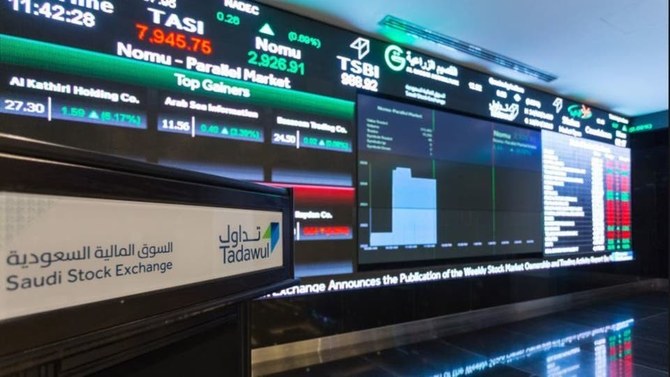
Closing bell: TASI falls 0.2% to close at 10,793 

TASI’s total trading turnover of the benchmark index on Tuesday was SR4.59 billion ($1.22 billion), with 97 stocks of the listed 224 advancing and 114 retreating. File
Short Url
Updated 31 January 2023
Follow

Closing bell: TASI falls 0.2% to close at 10,793 

RIYADH: Saudi Arabia’s Tadawul All Share Index on Tuesday fell 17.83 points — or 0.16 percent — to close at 10,792.85. 

MSCI Tadawul 30 Index and the parallel market Nomu fell flat to close at 1,488.36 and 19,140.41, respectively. 

TASI’s total trading turnover of the benchmark index on Tuesday was SR4.59 billion ($1.22 billion), with 97 stocks of the listed 224 advancing and 114 retreating. 

Allied Cooperative Insurance Group was the topmost gainer of the day, rising 8.77 percent to SR12.40. 

The other top gainers were Gulf General Cooperative Insurance Co., Wataniya Insurance Co., Saudi Enaya Cooperative Insurance Co.and Arabia Insurance Cooperative Co. 

The worst performer on Tuesday was Middle East Paper Co., which fell 4.73 percent to SR30.20. 

Other stocks that performed poorly included Abdulmohsen Alhokair Group for Tourism and Development, Fawaz Abdulaziz Alhokair Co., National Industrialization Co., and Al-Baha Investment and Development Co. 

Among sectoral indices, 12 of the 21 listed on the stock exchange declined, while one stayed flat and the rest advanced. 

On the announcements front, Jarir Marketing Co., also known as Jarir Bookstores, reported that its net profits, after zakat and tax, declined 2.23 percent to SR969.80 million in 2022 compared to SR991.90 million a year ago. 

The firm witnessed an annual rise of 3.34 percent in revenue to SR9.39 billion in 2022 from SR 9.08 billion in the earlier year, according to the statement to Tadawul. 

Earnings per share retreated to SR8.08 during the January-December 2022 period from SR8.27 in 2021. Its share price on Tuesday increased 0.27 percent to SR150.40 

Nomu-listed Edarat Communications and Information Technology Co. also reported a net profit of SR12.6 million in 2022, up 95 percent compared to SR6.5 million in the previous year, driven by a 58 percent year-on-year increase in revenue. Gross profit also jumped 83 percent during the period under review. 

On Tuesday, National Agricultural Development Co. also informed the stock exchange that it sealed a memorandum of understanding with Saudi Investment Recycling Co. to recycle biowaste to contribute to environmental protection. 

In a statement to Tadawul, both parties intend to recycle approximately 400,000 tons of biological waste per annum and process them into high-efficient, organic fertilizers. 

The company also announced its 2023-2027 strategy to strengthen its leadership locally and regionally through expanding the current business operations, developing new markets, expanding its product range, and entering into new ventures. 

NADEC aims to become a vertically integrated food business, targeting SR6 billion in revenue by 2027. Its share price gained 1.04 percent to SR23.24. 

Meanwhile, the Saudi Investment Bank, on Jan. 31, began offering the second tranche of its Saudi riyal-denominated tier 1 sukuk with a minimum subscription value of SR1 million. The offer ends on Feb. 5, 2023. SIB’s share price added 1.35 percent to SR17.98. 

Alqemam for Computer System Co. debuted on Nomu-Parallel Market on Jan. 31 as its first direct listing with the symbol 9558 at SR80 per share. Unfortunately, its share price crashed 9.37 percent on its opening day to end at SR72.50. 

On the dividends front, Alkhabeer Capital announced paying a dole out of 1.05 percent, or SR0.105 per unit, to Alkhabeer REIT Fund unitholders for the period from Oct. 1 to Dec. 31, 2022, totaling SR14.81 million. 


Saudi-built AI takes on financial crime

Updated 30 January 2026
Follow

Saudi-built AI takes on financial crime

  • Mozn’s FOCAL reflects the Kingdom’s growing fintech ambitions

RIYADH: As financial institutions face increasingly complex threats from fraud and money laundering, technology companies are racing to build systems that can keep pace with evolving risks. 

One such effort is FOCAL, an AI-powered compliance and fraud prevention platform developed by Riyadh-based enterprise artificial intelligence company Mozn.

Founded in 2017, Mozn was established with a focus on building AI technology tailored to regional market needs and regulatory environments. Over time, the company has expanded its reach beyond Saudi Arabia, developing advanced AI solutions used by financial institutions in multiple markets. It has also gained international recognition, including being listed among the World’s Top 250 Fintech Companies for the second consecutive year.

In January 2026, Mozn’s flagship product, FOCAL, was named a Category Leader in Chartis Research’s RiskTech Quadrant 2025 for both AML Transaction Monitoring and KYC (Know Your Customer) Data and Solutions, placing it among 10 companies globally to receive this designation.

Malik Alyousef, co-founder of Mozn and chief technology officer of FOCAL, told Arab News that the platform initially focused on core anti-money laundering functions when development began in 2018. These included customer screening, watchlists, and transaction monitoring to support counter-terrorism financing efforts and the detection of suspicious activity.

As financial crime tactics evolved, the platform expanded into fraud prevention. According to Alyousef, this shift introduced a more proactive model, beginning with device risk analysis and later incorporating tools such as device fingerprinting, behavioral biometrics, and transaction fraud detection.

More recently, FOCAL has moved toward platform convergence through its Financial Crime Intelligence layer, a vendor-neutral framework designed to bring together multiple systems into a single interface for investigation and reporting. The approach allows institutions to gain a consolidated view without replacing their existing technology infrastructure.

“Our architecture eliminates blind spots in financial crime detection. It gives institutions a complete view of the user journey, combining transactional and non-transactional behavioral data,” Alyousef said.

DID YOU KNOW?

• Some electronic money institutions using the platform have reported fraud reductions of up to 90 percent.

• The platform combines anti-money laundering and fraud prevention into a single financial crime intelligence system.

• FOCAL integrates with existing banking systems without requiring institutions to replace their technology stack.

Beyond its underlying architecture, Alyousef pointed to several areas where FOCAL aims to differentiate itself in a competitive market. One is its emphasis on proactive fraud prevention, which assesses risk throughout the customer lifecycle — from onboarding and login behavior to ongoing account activity — with the goal of stopping fraud before losses occur.

He described the platform as an “expert-led model,” highlighting the availability of on-the-ground support for system design, tuning, assessments, and continuous optimization throughout its use.

“FOCAL is designed to be extended,” Alyousef added, noting its adaptability and the ability for clients to customize schemas, rules, and data fields to match their business models and risk tolerance. This flexibility, he said, allows institutions to respond more quickly to emerging fraud patterns.

Alyousef also emphasized the importance of local context in the platform’s development.

“The platform incorporates regional regulatory requirements and language considerations. Global tools often struggle with local context, naming conventions and compliance nuances — we are designed specifically with these realities in mind,” he said.

FOCAL is currently used by a range of organizations, including traditional banks, digital banks, fintech firms, electronic money institutions, payment companies, and other financial service providers. Alyousef said results from live deployments have been significant, with some large EMI clients reporting fraud reductions of up to 90 percent.

“Clients benefit not only from reduced fraud losses but also from an improved customer experience, as the system minimizes unnecessary friction and false rejections,” he said. “Beyond financial services, we also work with organizations in e-commerce and telecommunications.”

Looking ahead, Alyousef said the company sees agentic AI as a key direction for the future of financial crime prevention, both in the region and globally. Mozn, he added, is investing heavily in this area to enhance investigative workflows and operational efficiency, building on the capabilities of its Financial Crime Intelligence layer.

“We are pioneers in introducing agentic AI for financial crime investigation and rule-building. Our roadmap increasingly emphasizes automation, advanced machine learning and AI-assisted workflows to improve investigator productivity and reduce false positives.”

As AI tools become more widely available, Alyousef warned that the risk of misuse by criminals is also increasing, raising the bar for defensive technologies.

“Our goal is to stay ahead of that curve and to contribute meaningfully to positioning Saudi Arabia and the region as globally competitive leaders in AI,” he said.