

Conflicting reports emerge about Pakistani Taliban’s ‘responsibility’ for Peshawar mosque attack 

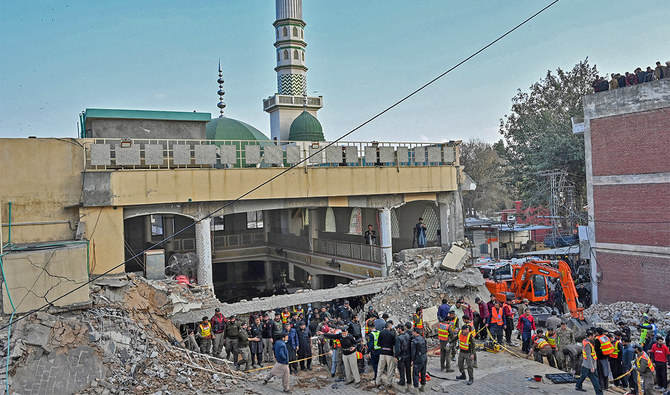
Security personnel and rescue workers prepare to search for the blast victims in the debris of a damaged mosque inside the police headquarters in Peshawar, Pakistan, on January 30, 2023. (AFP)
Short Url
Updated 31 January 2023
Follow

Conflicting reports emerge about Pakistani Taliban’s ‘responsibility’ for Peshawar mosque attack 

  • Group says attacking mosques, madrasas, other sacred places “an impeachable crime”
  • TTP commander Sarbakaf Mohmand claims responsibility for attack in a post on Twitter

Karachi: The Pakistani Taliban group said late on Monday the militant group was not behind an explosion at a mosque in the northwestern city of Peshawar in which at least 87 people were killed, while one commander of the group said on Twitter the outfit was responsible for the latest assault.

Police said up to 350 worshipers were inside the mosque for afternoon Zuhr prayers on Monday when the bomber struck.

“Tehreek-e-Taliban Pakistan (TTP) has nothing to do with this incident,” the group said in a statement shared with journalists. “Any action in mosques, madrasas, funeral homes and other sacred places is an impeachable crime.”

However, TTP commander Sarbakaf Mohmand claimed responsibility for the attack in a post on Twitter.

While the TTP as a group denied responsibility for the bombing, it has recently carried out similar attacks, with assaults on the rise since last November when the outlawed outfit called off a cease-fire signed with the government in May.

“The death toll has now surged to 87 as of 8:00 a.m. today (Tuesday),” Muhammad Asim, a spokesperson at the Lady Reading Hospital (LRH) in Peshawar, told Arab News. “Almost 50 wounded are under treatment in the hospital while the rest were either died or discharged after treatment,” he added. 

Commissioner Peshawar Riaz Mehsud said a “big explosion” had completely damaged the mosque’s roof.

“It will be premature to say whether it was a suicide explosion,” he told Arab News on Monday afternoon.

“We haven’t yet confirmed how many policemen are dead and wounded but I think 90 percent casualties are of police personnel because most of those offering prayers in the mosque were policemen.”


Pakistan urges pilgrims to complete Saudi biometrics as Hajj preparations gain pace

Updated 30 January 2026
Follow

Pakistan urges pilgrims to complete Saudi biometrics as Hajj preparations gain pace

  • Government warns pilgrims biometric verification is required for Hajj visas
  • Step follows tighter oversight after last year’s Hajj travel disruptions

ISLAMABAD: Pakistan’s government on Friday urged aspiring pilgrims to complete mandatory Saudi biometric verification for Hajj visas, as preparations for the 2026 pilgrimage gather pace following stricter oversight of the Hajj process.

The announcement comes only a day after Pakistan’s Religious Affairs Minister Sardar Muhammad Yousuf said regulations for private Hajj operators had been tightened, reducing their quota following widespread complaints last year, when tens of thousands of pilgrims were unable to travel under the private Hajj scheme.

“Saudi biometric verification is mandatory for the issuance of Hajj visas,” the Ministry of Religious Affairs said in a statement, urging pilgrims to complete the process promptly to avoid delays.

“Hajj pilgrims should complete their biometric verification at home using the ‘Saudi Visa Bio’ app as soon as possible,” it added.

The statement said the pilgrims who were unable to complete biometric verification through the mobile application should visit designated Saudi Tasheer centers before Feb. 8, adding that details of the centers were available on Pakistan’s official Hajj mobile application.

Pakistan has been steadily implementing digital and procedural requirements for pilgrims ahead of Hajj 2026, including mandatory training sessions, biometric checks and greater use of mobile applications, as part of efforts to reduce mismanagement.

Saudi Arabia has allocated Pakistan a quota of 179,210 pilgrims for Hajj 2026, with the majority of seats reserved under the government scheme and the remainder allocated to private tour operators.