Carrier Emirates test flies Boeing 777 on sustainable fuel

1 / 3
Emirates aircraft technicians prepare a Boeing 777-300ER on Jan. 30, 2023 at Dubai airport for a demonstration flight using sustainable aviation fuel. (AFP)
2 / 3
Emirates aircraft technicians prepare a Boeing 777-300ER on Jan. 30, 2023 at Dubai airport for a demonstration flight using sustainable aviation fuel. (AFP)
3 / 3
A picture taken on January 30, 2023 at Dubai airport, shows the first milestone demonstration flight on a Emirates Boeing 777-300ER. (AFP)
Short Url
Updated 31 January 2023
Follow

Carrier Emirates test flies Boeing 777 on sustainable fuel

  • Airplane and engine manufacturers have been designing more-efficient models, in part to help keep down costs of jet fuel — one of the biggest expenses airlines face

DUBAI: Long-haul carrier Emirates successfully flew a Boeing 777 on a test flight Monday with one of its two engines entirely powered by so-called sustainable aviation fuel. This comes as carriers worldwide try to lessen their carbon footprint.
Flight 2646 flew for just under an hour over the coastline of the United Arab Emirates, after taking off from Dubai International Airport, the world’s busiest for international travel, and heading out into the Arabian Gulf before circling to land. The second of the plane’s General Electric Co. engines ran on conventional jet fuel for safety.
“This flight is a milestone moment for Emirates and a positive step for our industry as we work collectively to address one of our biggest challenges — reducing our carbon footprint,” Adel Al-Redha, Emirates’ chief operation officer, said in a statement.
Emirates, a state-owned airline under Dubai’s ruler Sheikh Mohammed bin Rashid Al Maktoum, described the sustainable fuel as a blend “that mirrored the qualities of jet fuel.” It included fuel from Neste, a Finnish firm, and Virent, a Madison, Wisconsin-based company.
Virent describes itself as using plant-based sugars to make the compounds needed for sustainable jet fuel, while Neste’s fuel comes from vegetable oils and animal fats. Those fuels reduce the release of heat-trapping carbon dioxide typically burned off by engines in flight.
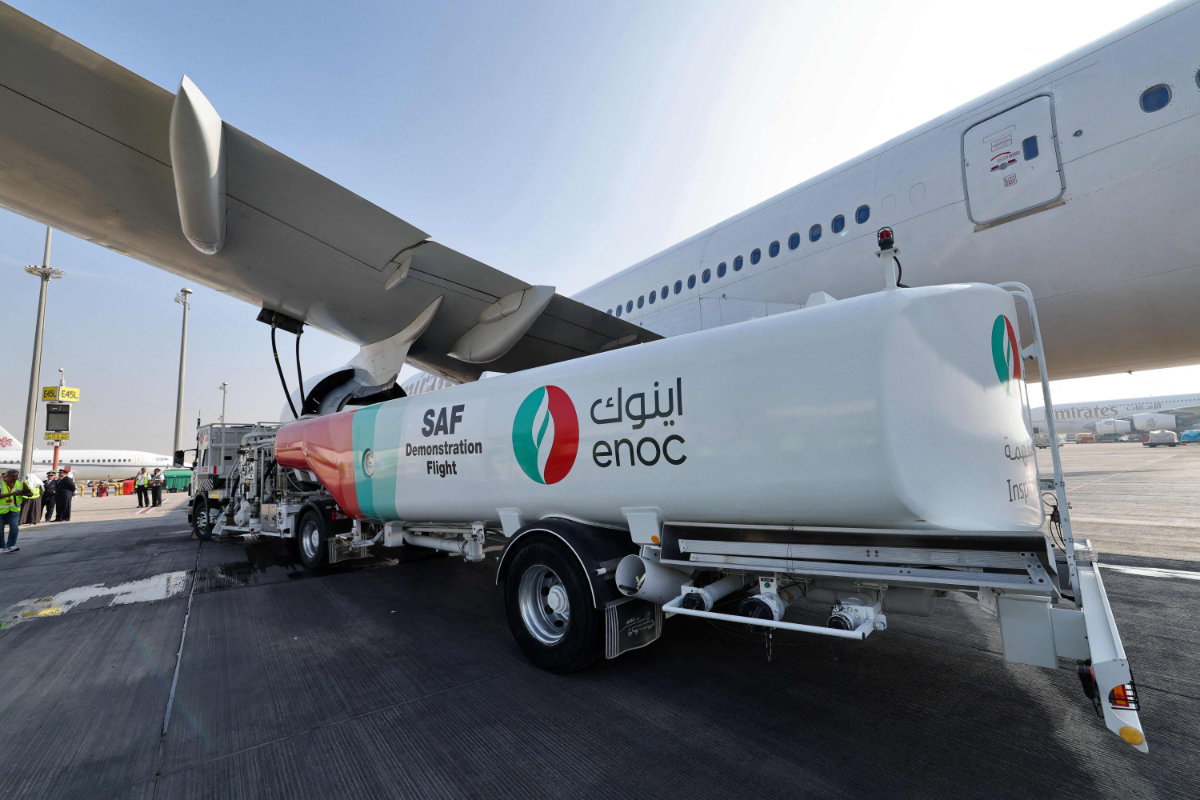


An Emirates Boeing 777-300ER is filled with sustainable aviation fuel in preparation for a milestone demonstration flight on Jan. 30, 2023 at Dubai airport. (AFP)

Aviation releases only one-sixth the amount of carbon dioxide produced by cars and trucks, according to World Resources Institute, a nonprofit research group based in Washington. However, airplanes are used by far fewer people per day — meaning aviation is a higher per-capita source of greenhouse-gas emissions.
Airplane and engine manufacturers have been designing more-efficient models, in part to help keep down costs of jet fuel — one of the biggest expenses airlines face. Emirates, for instance, used over 5.7 million tons of jet fuel last year alone, costing it $3.7 billion out of its $17 billion in annual expenses.
But analysts suggest sustainable fuels can be three times or more the cost of jet fuel, likely putting ticket prices even higher as aviation restarts following the lockdowns during the coronavirus pandemic.
It wasn’t immediately clear how much the fuel used in the Emirates’ test on Monday cost per barrel. Jet fuel cost on average $146 a barrel at the end of last week, according to S&P Global Platts.
The UAE, a major oil producer and OPEC member, is to host the next United Nations climate negotiations, or COP28, beginning in November. Already, the seven sheikhdom federation has been criticized for nominating the CEO of Abu Dhabi’s state oil company to lead the UN negotiations known as the Conference of the Parties — where COP gets its name.


Sudan paramilitary advances near Ethiopia border

Updated 3 sec ago
Follow

Sudan paramilitary advances near Ethiopia border

KHARTOUM: Sudanese paramilitary forces have advanced on army positions near the southeastern border with Ethiopia, according to the group and an eyewitness who spoke to AFP Wednesday.
Control over Sudan’s southeastern Blue Nile State, bordering both Ethiopia and South Sudan, is split between the army and a faction of the Sudan People’s Liberation Movement-North, allies of the paramilitary Rapid Support Forces.
In a statement released Tuesday, the SPLM-N, led by Abdelaziz Al-Hilu, said they had “liberated the strategic city of Deim Mansour and areas of Bashir Nuqu and Khor Al-Budi.”
Since April 2023, the Sudanese army has been at war with the RSF. In February of last year, the RSF announced a surprise alliance with the SPLM-N, securing experienced fighters, land and border access.
Deim Mansour lies between the SPLM-N stronghold Yabus, birthplace of their deputy commander Joseph Tuka, and the army-held town of Kurmuk, which hosts a large army contingent.
Babiker Khaled, who fled to Kurmuk, told AFP that SPLM-N fighters began amassing in the forests around Deim Mansour on Sunday.
“The shelling began on Monday, they entered the city on Tuesday,” he said, adding that “some people fled into Ethiopia, others arrived in Kurmuk.”
From its foothold in the southern Blue Nile, a thin strip of land jutting south between Ethiopia and South Sudan, the SPLM-N maintains reported supply lines from both countries, building on decades-old links.
Close to three years of war in Sudan have left tens of thousands dead and around 11 million displaced, creating the world’s largest hunger and displacement crises.
It has also torn the country apart, with the army holding the center, north and east of Sudan while the RSF and its allies dominate the west and parts of the south.
Sudan’s Kordofan region, where the SPLM-N has its other foothold in the Nuba Mountains, is currently the war’s fiercest battleground.
On Tuesday, the army broke a paramilitary siege on South Kordofan state capital Kadugli, days after breaking another on the nearby city of Dilling.