

Bomb kills 59 at mosque inside Peshawar police compound — hospital spokesperson

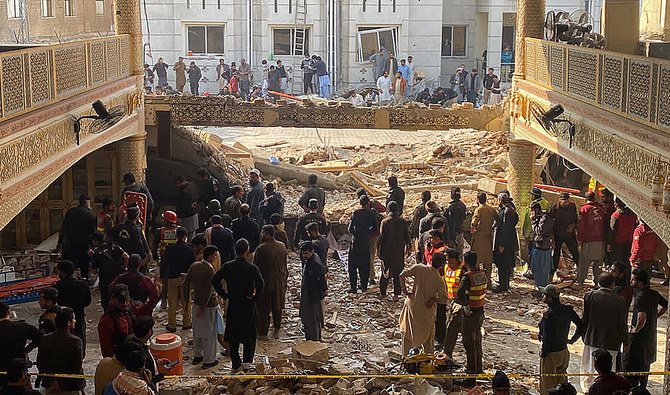
Security officials inspect the site of a mosque blast inside the police headquarters in Peshawar, Pakistan on January 30, 2023. (AFP)
Short Url
Updated 30 January 2023
Follow

Bomb kills 59 at mosque inside Peshawar police compound — hospital spokesperson

  • Security officials say too early to determine if attack was carried out by suicide bomber
  • Such attacks have increased since Pakistan Taliban called off truce with government last year

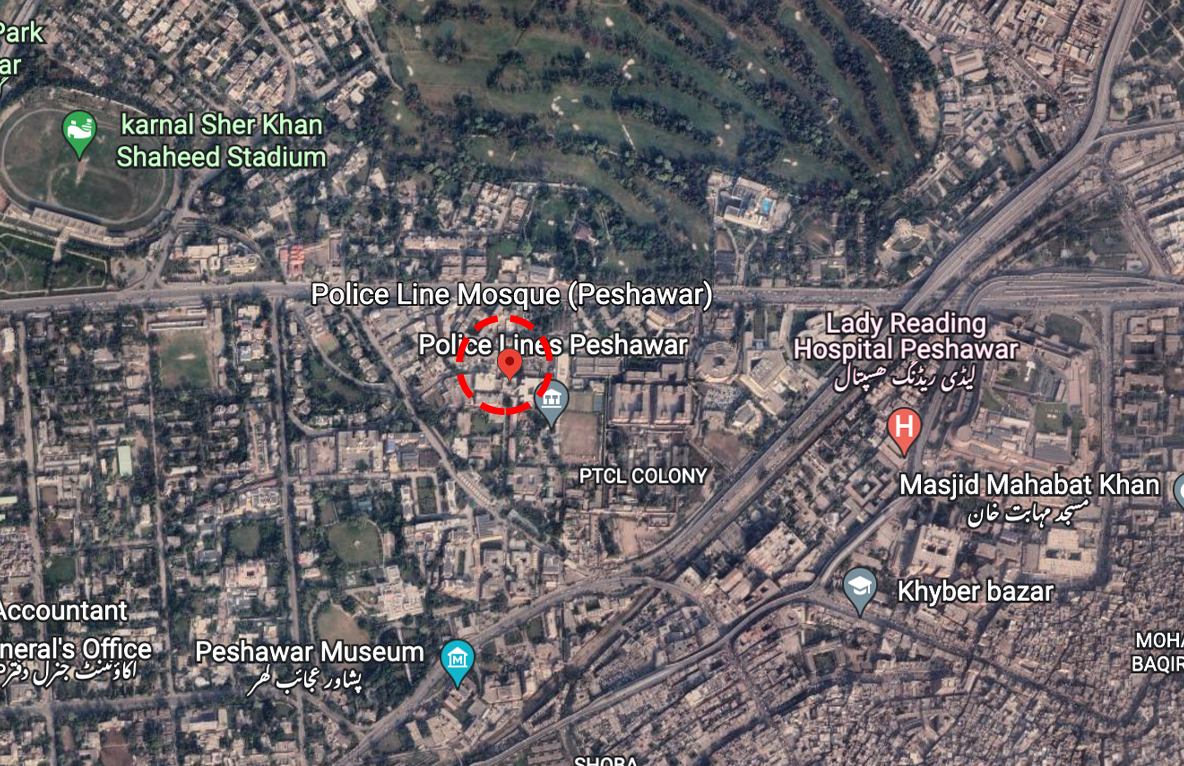
PESHAWAR: Up to 59 people were killed and 157 wounded when an explosion ripped through a mosque inside a compound where the headquarters of the provincial police force are located in Peshawar, the spokesman of the largest health facility in the northwestern city said.

Police said up to 350 worshipers were inside the mosque for afternoon prayers when the bomber detonated his explosives.
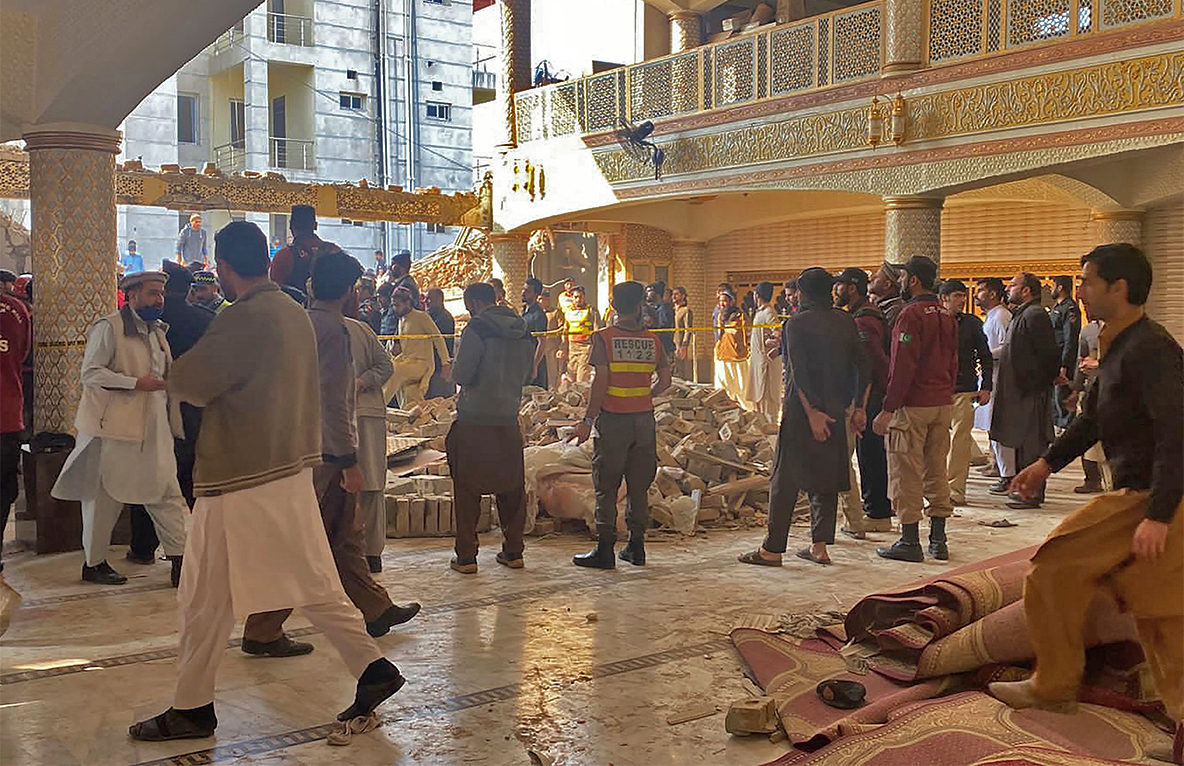


Security officials inspect the site of a mosque blast inside the police headquarters in Peshawar, Pakistan, on January 30, 2023. (AFP)

"The death tally has reached 59," Muhammad Asim, a spokesman for the Lady Reading Hospital (LRH) said in a statement. "About 157 people injured in the blast were brought to LRH."

Commissioner Peshawar Riaz Mehsud said a “big explosion" had completely damaged the mosque’s roof.

"It will be premature to say whether it was a suicide explosion,” he told Arab News. "We haven't yet confirmed how many policemen are dead and wounded but I think 90 percent casualties are of police personnel because most of those offering prayers in the mosque were policemen."

Muhammad Ijaz Khan, the Capital City Police Officer (CCPO), said many people, including policemen, were still trapped under the debris.

“We can’t as of yet determine what caused the explosion but it was a security lapse,” Khan said.
No one immediately claimed responsibility for the bombing but the Pakistani Taliban group have recently carried out similar attacks, with assaults on the rise since last November when the group called off a ceasefire signed with the government in May.

Ahmad Khan, a police constable who was inside the mosque when the blast occurred, said the roof collapsed after the explosion.

“It was the time for Zuhr (afternoon) prayers,” Khan said. “I was in the second row among worshippers when the blast took place. The roof of the mosque collapsed with many worshippers trapped but I managed to come out with small injuries.”

Soon after the blast, the provincial health department declared a state of emergency at the city’s hospitals.

Prime Minister Shehbaz Sharif urged people, especially followers of his Pakistan Muslim League-Nawaz ruling party, to donate blood to those injured in the attack.

“Reach Lady Reading Hospital, Peshawar, and contribute to saving precious human lives,” he tweeted.

The prime minister's office later reported that Sharif had flown via helicopter to Peshawar.

"Terrorists are making a sinister attempt to create an atmosphere of fear and terror by attacking the institutions responsible for the defense of Pakistan, which will be thwarted by the strength of the unity of the state and the people," the PM was quoted as saying in a statement from Peshawar.

"Pakistan has made great sacrifices against terrorism, we will not let the sacrifices of martyrs go in vain," the PM added, promising that the capacity and efficiency of anti-terrorist institutions and police would be enhanced.


Pakistan to promote mineral sector at Saudi forum this month with 13 companies

Updated 5 sec ago
Follow

Pakistan to promote mineral sector at Saudi forum this month with 13 companies

  • Delegation will take part in the Future Minerals Forum in Riyadh from Jan. 13-15
  • Petroleum minister will lead Pakistan, participate in a 90-minute country session

ISLAMABAD: Around 13 Pakistani state-owned and private companies will attend the Future Minerals Forum (FMF) in Saudi Arabia from Jan. 13 to 15, an official statement said on Friday, as the country seeks to ramp up global engagement to develop its mineral resources.

The FMF is an international conference and investment platform for the mining sector, hosted by mineral-rich countries to attract global investors, companies and governments.

Petroleum Minister Ali Pervaiz Malik confirmed Pakistan’s participation in a meeting with the Saudi envoy, Nawaf bin Said Al-Malki.

Pakistan hosts one of the world’s largest copper-gold zones. The Reko Diq mine in southwestern Balochistan, with an estimated 5.9 billion tons of ore, is partly owned by Barrick Gold, which calls it one of the world’s largest underdeveloped copper-gold deposits. Its development is expected to boost Pakistan’s struggling economy.

“Upon an invitation of the Government of the Kingdom of Saudi Arabia, the Federal Minister informed the Ambassador that Pakistan will fully participate in the upcoming Future Minerals Forum (FMF), scheduled to be held in Riyadh later this month,” Pakistan’s Press Information Department (PID) said in an official statement.

The Pakistani minister will lead his country’s delegation at the FMF and take part in a 90-minute country showcase session titled “Unleashing Potential: Accelerating Pakistan’s Mineral Revolution” along with local and foreign investors.

Pakistan will also establish a dedicated pavilion to highlight the vast potential of its rich geological landscape to the global mineral community.

The Saudi envoy welcomed Pakistan’s decision to participate in the forum and discussed enhancing bilateral cooperation in the minerals and energy sectors during the meeting.

According to the statement, he highlighted the potential for cooperation between Saudi Arabia and Pakistan in the minerals and energy sectors, expressing confidence that the FMF would provide a platform to expand collaboration.
Pakistan’s mineral sector, despite its rich reserves of salt, copper, gold and coal, contributes only 3.2 percent to the country’s GDP and just 0.1 percent to global mineral exports.

However, many countries, including the United States, have shown interest in Pakistan’s underdeveloped mineral sector, particularly in copper, gold and other critical resources.

In October, Pakistan dispatched its first-ever shipment of rare earth and critical minerals to the United States, according to a Chicago-based US public relations firm’s report.