

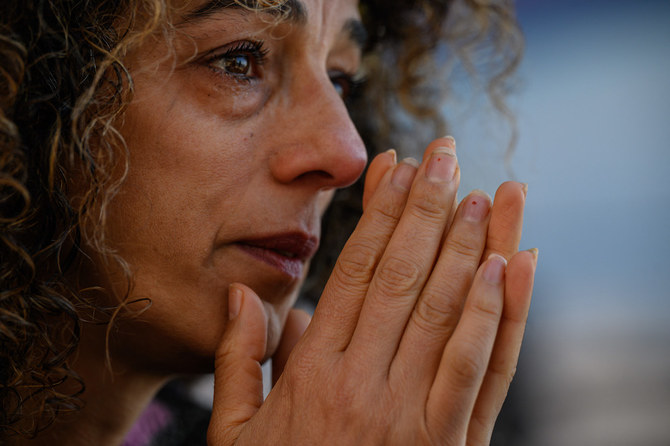

NEW YORK: The US Justice Department’s announcement on Friday of the arrest of three East European men with ties to Tehran in the plot to kill Iranian-American journalist and human rights activist Masih Alinejad has hardly surprised experts and analysts.
The news has recalled many deja-vus of such Iranian activities on American soil, including the 2011 plot to kill then-Saudi Ambassador to the US Adel Al-Jubeir.
Analysts lament the absence of deterrents for Iran, and warn that if stronger actions are not taken, such plots will continue to unfold on US territory.
The three men are now facing murder-for-hire and money-laundering charges for plotting to kill Alinejad.
One of the men was arrested last summer in the Brooklyn neighborhood where Alinejad lives. At the time, he was charged with possessing a firearm after police found an AK-47-style rifle in the back seat of his car along with ammunition.
The incident raised many suspicions then, until the backstory of how it transpired was revealed on Friday.
The Justice Department said in a statement that since at least July, the three men have been “tasked with carrying out” the murder of Alinejad, “who previously has been the target of plots by the government of Iran to intimidate, harass and kidnap” her.
“As recently as 2020 and 2021, Iranian intelligence officials and assets plotted to kidnap (Alinejad) from within the United States for rendition to Iran in an effort to silence (her) criticism of the regime.”
All three of the defendants, Attorney General Merrick Garland said on Friday, are currently in custody.
Deputy Attorney General Lisa Monaco said at a news conference unveiling the charges: “Today’s indictment exposes a dangerous menace to national security — a double threat posed by a vicious transnational crime group operating from what it thought was the safe haven of a rogue nation. That rogue nation is the Islamic Republic of Iran.”
Jason Brodsky, policy director at United Against Nuclear Iran, told Arab News that Friday’s arrests demonstrate that “there’s an absence of deterrents with respect to the Islamic Republic operating on US soil, and we have to change that calculus otherwise we can only expect more of these plots in the future.”
On Oct. 11, 2011, two Iranian nationals were charged in a federal court in New York with plotting to assassinate Al-Jubeir.
What became known as the Iran assassination plot or the Iran terror plot involved planning to plant a bomb outside the restaurant where Al-Jubeir was dining, and subsequently to bomb the Saudi and Israeli embassies in Washington, DC.
“These cases are handled as law enforcement matters. They’re handled usually with an indictment, a strongly worded warning and a statement from a senior US official,” Brodsky said.
“And then likely there will be some sanctions levied in the future. And that is, in the long run, not going to change the calculus because the costs are usually, in (Iranian officials’) minds, absorbable. You’re dealing with piecemeal sanctions on individuals who have no assets in the US,” he added.
“You’re dealing with a statement that there’s been so many warnings about, it doesn’t seem to deter them.
“And the indictments usually also don’t necessarily deter. In this case, it’s interesting because they were able to take into custody these three individuals.
“But this will be absorbable for Tehran because these aren’t Iranian officials. These are members of an Eastern European criminal syndicate.”
Stemming Iranian criminal activities on Western territories requires, in the long run, a “multilateral perspective,” Brodsky said. “This is an issue that’s affecting not just the US (but) our European allies as well.”
Last November, two British-Iranian journalists working in the UK for TV channel Iran International were warned by police of a “credible” plot by Tehran to kill them.
The outlet accused Iran’s Islamic Revolutionary Guard Corps of being part of a “significant and dangerous escalation” of Tehran’s “campaign to intimidate Iranian journalists working abroad.”
Earlier this month, French satirical magazine Charlie Hebdo was hit by a cyberattack after publishing a caricature of Iran’s Supreme Leader Ali Khamenei.
“A digital attack doesn’t leave anyone dead, but it sets the tone. The mullahs’ regime feels in such danger that it considers it vital to its existence to hack the website of a French newspaper,” Charlie Hebdo said.
Hossein Salami, commander in chief of the IRGC, on Tuesday threatened the staff of the French magazine with revenge.
Brodsky said it is important “to start considering a potential kinetic retaliation for these kinds of plots, to deter Iran’s system from going any further.”
He cited yet another indictment that was unsealed last summer, and which charged an IRGC member with a murder-for-hire scheme of a former US national security adviser.
“So if we continue to handle these cases as just really law enforcement matters with a very minimal or nonexistent policy response, we can only expect the Iranian system to continue this vicious cycle,” Brodsky said.
Although the IRGC is designated as a terrorist organization in the US, it is still not listed as such in European jurisdictions. Brodsky said it is of paramount urgency for the EU and UK to do so “and quickly.”
It is “overdue for the IRGC to be sanctioned as a terrorist organization in (European) jurisdictions. It would have a substantive impact in the fact that it would increase market deterrence with respect to the Islamic Republic,” and would ban former IRGC businessmen and their families from profiting off illicit wealth in Western jurisdictions, he added.
Most crucially, designating the IRGC as terrorist would also have a “symbolic” impact, and would be “the signal from the leading democracies of the world that they stand with the Iranian people who were bravely protesting and chanting, ‘Death to the IRGC,’ and it would show that (Europe is) standing with the people and not their oppressors,” he said. “Not to mention the many Arab countries (that) are also victims of the IRGC.”


