

Sri Lankan foreign minister’s trip to Saudi Arabia yields ‘positive vibes’

1 / 2
Sri Lankan Minister Ali Sabry met with several Saudi officials and ministers during his recent visit to the Kingdom. (AN photo by Saad Aldossari)
2 / 2
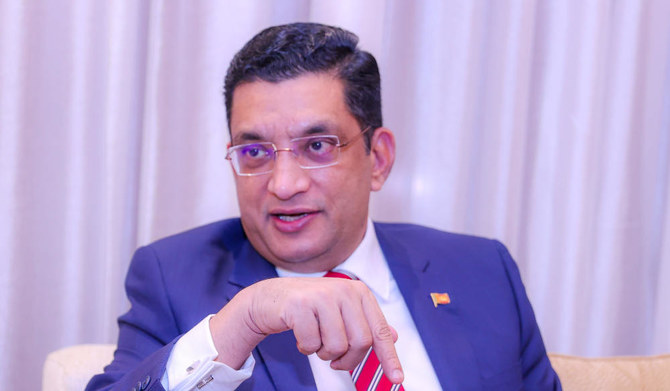
Sri Lankan Foreign Minister Ali Sabry speaking to Arab News. (AN photo by Saad Aldossari)
Short Url
Updated 28 January 2023
Follow

Sri Lankan foreign minister’s trip to Saudi Arabia yields ‘positive vibes’

  • Sri Lanka, Saudi Arabia sign double tax avoidance deal to boost trade, investment
  • Framework agreement with GCC in the works

RIYADH: Sri Lankan Minister of Foreign Affairs Ali Sabry has held talks with ministers and senior officials in Saudi Arabia, as the crisis-hit island nation seeks to boost cooperation with the Kingdom and other Gulf countries.

Sabry met with his Saudi counterpart Prince Faisal bin Farhan, Secretary-General of Organization of Islamic Cooperation Hissein Brahim Taha, Secretary-General of the Gulf Cooperation Council Nayef Falah M. Al-Hajraf, and CEO of the Saudi Fund for Development Sultan Al-Marshad, as well as officials from the Islamic Development Bank.

Sabry said that his visit to the Kingdom was “successful and that it will further cement and strengthen the bilateral relationship between our two countries as we see a lot of positive vibes that have been infused into our relations.”

Talks between the two foreign ministers covered enhancement of bilateral relations, increased investment with Sri Lanka as a gateway to South Asia, and employment for Sri Lankans in the Kingdom.

HIGHLIGHT

Ali Sabry, the Sri Lankan minister of Foreign Affairs, signed the double tax avoidance deal with the Kingdom’s Zakat, Tax and Customs Authority to boost trade and investment. Sri Lanka is said to be facing the worst economic crisis since its independence in 1948.

“Saudis have identified Sri Lanka as a very important geographical location, so (there are) investment opportunities in renewable energy, petroleum and hospitality industries,” Sabry said.

“We are interested in getting Saudi investment into the renewable energy sector for development, energy security and making Sri Lanka a regional energy hub.”

Discussions also took place around resuming airline services between Saudi Arabia and Sri Lanka following their suspension during the global pandemic.

In a bid to enhance trade and investment relations between both countries, the visiting minister “signed a double tax avoidance agreement with the Zakat and Income Tax Authority here” to prevent fiscal evasion on income.

Sri Lanka is facing its worst economic crisis since independence in 1948, with the government battling a shortage of foreign earnings, runaway inflation and recession.

The Sri Lankan minister thanked the Kingdom for its help with debt restructuring at the International Monetary Fund and Paris Club.

The Paris Club of creditor nations has proposed a 10-year debt moratorium on Sri Lankan debt and 15 years of debt restructuring as a formula to resolve the island nation’s currency crisis.

Sri Lanka is also in discussions with the IMF to secure a $2.9 billion bailout seen as vital to getting its economy back on track.

Sabry highlighted Saudi Arabia and Sri Lanka’s long-standing relations and the former’s support in international forums.

“Sri Lanka and Saudi Arabia have been traditional friends for a long period of time. To strengthen bilateral relationship, particularly in the multilateral fora — the UN and other agencies — we have to support each other,” he said.  

“They (Saudis) have been supporting us when we have been cornered unfairly by some powers for no reason. They have stood by us time and again. So we need to strengthen that relationship.”

Sabry and Al-Marshad discussed development issues of common interest, and the Sri Lankan minister praised the Kingdom’s efforts in developing infrastructure in Sri Lanka through SFD projects.

The minister’s meeting with Al-Hajraf focused on ties between Sri Lanka and the GCC.

“GCC is very important. We are looking at signing a framework agreement with the GCC, we want to expedite it as soon as possible,” Sabry said.

On his discussions with Taha and OIC observer status, Sabry said: “They are exploring the possibility of observer status, but we haven’t made the decision yet. Traditionally, we have had good relationships.”

Sabry also reassured Taha about the conditions of the Muslim community in Sri Lanka.


Threat to Kingdom’s security is ‘red line’ that will be ‘addressed and neutralized,’ Saudi envoy says

Updated 14 January 2026
Follow

Threat to Kingdom’s security is ‘red line’ that will be ‘addressed and neutralized,’ Saudi envoy says

  • Abdulaziz Alwasil tells UN Security Council the situation in southern Yemen is ‘a just cause with social and historic dimensions’ that can only be resolved through dialogue
  • Recent military activity in the south was unilateral, resulting in an escalation that harms the interests of Yemeni people and undermines efforts to address issues in the south, he said

NEW YORK CITY: Any attempt to threaten Saudi Arabia’s national security is a “red line” and will be met with decisive action, the Kingdom’s ambassador to the UN told the Security Council on Wednesday.

Speaking during a meeting of the council to discuss Yemen, Abdulaziz Alwasil said the situation in the south of the country is “a just cause with social and historic dimensions” that can only be resolved through dialogue.

“We stress that any attempt to threaten our national security is a red line, and we will not hesitate to take the necessary actions and steps to address it and neutralize it,” he added.

Alwasil reaffirmed Saudi Arabia’s support for Yemeni President Rashad Al-Alimi, the Presidential Leadership Council, and the Yemeni government in their efforts to achieve security, stability, development and peace while preserving national unity.

He said military activity by Southern Transitional Council forces in Hadramout and Al-Mahra on Dec. 2, 2025, was unilateral, did not have the approval of the Presidential Leadership Council, and was not carried out in coordination with the Coalition to Restore Legitimacy in Yemen.

It had resulted in an unjustified escalation that harmed the interests of the Yemeni people, undermined efforts to address the issues in the south, and ran counter to the coalition’s objectives, Alwasil added.

The Kingdom, working with its coalition partners, the Presidential Leadership Council and the Yemeni government, had moved to contain the situation by dispatching a military force to coordinate arrangements with the Southern Transitional Council in Aden, he said.

The aim was to ensure the return of the southern council’s forces to their previous positions outside of Hadramout and Al-Mahra, and the handover of camps to legitimate government forces and local authorities in line with agreed procedures, Alwasil added.

He expressed regret over the military operations that took place in Hadramout and Al-Mahra, close to Saudi Arabia’s southern border, which he said posed a direct threat to the Kingdom’s national security, as well as the security of Yemen and regional stability. Such steps were extremely dangerous, he added, and contradicted the principles on which the Coalition to Restore Legitimacy in Yemen had been founded.

Alwasil welcomed a prisoner and detainee exchange agreement signed in Muscat on Dec. 23, which he described as an important humanitarian measure to alleviate suffering and build confidence.

He praised Oman for hosting and sponsoring the consultations and supporting negotiations, and commended the efforts of UN’s special envoy for Yemen, Hans Grundberg, the International Committee of the Red Cross and all others that has played a part.

Regarding the political efforts to resolve the crisis, Alwasil said Saudi Arabia welcomed President Al-Alimi’s call for an inclusive conference in Riyadh to bring together all stakeholders to discuss just solutions to the situation in southern Yemen.

Preparations for the conference have begun, he added, in cooperation with the Yemeni government and southern representatives, reflecting the close ties between the two countries and their shared interests in stabilizing Yemen.

He urged all southern stakeholders to participate actively and constructively in the talks, to help find comprehensive and just solutions that meet the legitimate aspirations of the people of southern Yemen.

Alwasil called on all Yemeni forces and stakeholders to cooperate and intensify their efforts to reach a lasting political settlement that would ensure security and stability.

He described the southern issue as “a just cause with social and historic dimensions,” adding that “the only way to address it is through dialogue that leads to a comprehensive political solution” based on nationally and internationally agreed terms of reference.