

All eyes on turnout as Tunisia votes again after boycott

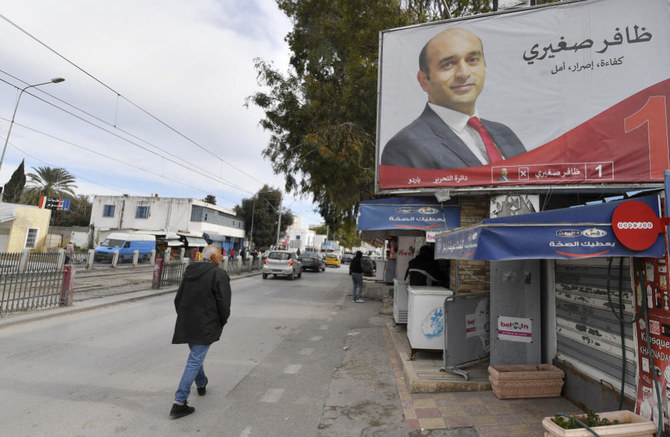
A man walks past an electoral billboard for the Tunisian national election scheduled for January 29, in Tunisia's capital Tunis, on January 25, 2023. (AFP)
Short Url
Updated 28 January 2023
Follow

All eyes on turnout as Tunisia votes again after boycott

  • Lawyer and political expert Hamadi Redissi said the new assembly would 'not have to approve the government, nor can it censor it without a two-thirds majority' of both parliament & a council of regional representatives, whose make-up has yet to be defined

TUNIS: Tunisians are to vote again on Sunday in elections for a parliament stripped of its powers, the final pillar of President Kais Saied’s remake of politics in the country.
The second-round vote comes as Tunisia grapples with a grave economic crisis and deep political divisions over Saied’s actions in July 2021.
Some 262 candidates, including just 34 women, are running for 131 seats in an election whose first round last month saw just 11.2 percent of registered voters take part.
That was the lowest turnout of any national vote since the 2011 revolt that overthrew Zine El Abidine Ben Ali.
The final round comes 18 months after Saied sacked the government and suspended parliament, later moving to dominate the judiciary and bringing in a constitution last July that gave his office almost unlimited executive power.
Youssef Cherif, the director of Columbia Global Centers in Tunis, said Tunisians had a “lack of interest” in politics.
“This parliament will have very little legitimacy, and the president, who is all-powerful thanks to the 2022 constitution, will be able to control it as he sees fit,” he said.
Lawyer and political expert Hamadi Redissi said the new assembly would “not have to approve the government, nor can it censor it without a two-thirds majority” of both parliament and a council of regional representatives, whose make-up has yet to be defined.
The legislature will have almost zero power to hold the president to account.
As during the first round, most political parties — which have been sidelined by a system that bans candidates from declaring allegiance to a political grouping — called for a boycott.
On the streets of Tunis, campaigning has been muted, with few posters on the walls and few well-known candidates.
And despite Saied’s break with the traditional political class, many Tunisians are sceptical of all politicians.
“I don’t feel I can trust anyone, so I’m not going to vote,” said carpenter Ridha.
The electoral board has organised televised debates to try to spark interest among those voters who supported Saied’s bid for the presidency in 2019.
But Tunisians, struggling with inflation of over 10 percent and repeated shortages of basic goods from milk to petrol as well as transport workers’ and teachers’ strikes, have more urgent priorities than politics.
Last week’s delivery of 170 trucks of food, a gift from the Tripoli-based government of war-torn Libya, was seen by many as a humiliation.
Redissi said the country was on “the edge of collapse.”
“Along with soaring prices, we’re seeing shortages and the president is pathetically blaming ‘speculators, traitors and saboteurs’,” he said.
But Cherif said that, despite widespread discontent, it was “possible that the status quo will continue as long as the average Tunisian doesn’t see a credible alternative to President Saied.”
Saied faced calls to quit after the first round of the election, but the opposition remains divided into three blocs: the National Salvation Front including the Ennahda party, a grouping of leftist parties, and the Free Destourian Party, seen as nostalgic for Ben Ali’s tough rule.
The election takes place in the shadow of Tunisia’s drawn-out negotiations with the International Monetary Fund for a bailout worth some $2 billion.
Cherif said the talks were stumbling over the United States’ concerns for the future of Tunisian democracy and Saied’s apparent reluctance to “accept the IMF’s diktats” on politically sensitive issues including subsidy reform.
Redissi said there was a “blatant discrepancy” between Saied’s rhetoric against the IMF and the program his government proposed to the lender “on the sly.”
“We have a president who opposes his own government,” he said.
He said the country’s only hope lay in a “rescue plan” proposed by the powerful UGTT trade union federation, the League for Human Rights, Tunisia’s Bar Association and the socio-economic rights group FTDES.


Refugees, migrants in Lebanon find rare sanctuary from Israeli strikes in Beirut church 

Updated 3 sec ago
Follow

Refugees, migrants in Lebanon find rare sanctuary from Israeli strikes in Beirut church 

  • Beirut church offers safe haven for displaced migrants, refugees
  • Many refugees lived through 2024 war, but are now more vulnerable
BEIRUT: When Israeli strikes began pummelling Beirut’s southern suburbs early on Monday, Sudanese refugee Ridina Muhammad and her family ​had no choice but to flee home on foot, eventually reaching the only shelter that would accept them: a church.
Eight months pregnant, Muhammad, 32, walked with her husband and three children for hours in the dark streets until they found a car to take them to the St. Joseph Tabaris Parish, which has opened its doors to refugees and migrants.
They are among 300,000 people displaced across Lebanon this week by heavy Israeli strikes, launched in response to a rocket and drone attackinto Israel by the Lebanese armed group Hezbollah.
Just 100,000 of the displaced are in government shelters. Others are staying ‌with relatives ‌or sleeping in the streets. But migrants and refugees say government ​shelters ‌were ⁠never an option ​for ⁠them, saying they were turned away during the last war between Hezbollah and Israel.
Muhammad’s oldest daughter, now seven, stopped speaking after the 2024 war.
This time, they are even more vulnerable: their home was destroyed in this week’s strikes and Muhammad is due to give birth at the end of the month.
“I don’t know if there’s a doctor or not, but I’m really scared about it because I haven’t prepared any clothes for the baby, nor arranged a hospital, and I don’t know where to go,” she told ⁠Reuters as her younger daughter leaned against her pregnant belly.
Muhammad ‌said she was registered with the United Nations’ refugee agency (UNHCR) ‌but had not received support.
“Us, as refugees, why did we ​register with the UN, if they are not ‌helping us in the most difficult times?” she said.
Dalal Harb, a spokesperson for UNHCR ‌Lebanon, said the agency had mobilized but reaching everyone immediately was extremely challenging given the scale and speed of displacement. The UNHCR operation in Lebanon is currently only around 14 percent funded, she said.
The Jesuit Refugee Service (JRS), which helped the church host displaced in 2024, is doing so again.
Michael Petro, JRS’ Emergency Shelter Director, said the church was ‌full within the first day of strikes, with 140 people from South Sudan, Ethiopia, Bangladesh, and other countries sheltering there.
“There are many, many more ⁠people coming than there ⁠were in 2024, and we have fewer and fewer places to put them,” he said.
Petro said he was told weeks ago that government shelters would be open to migrants if war erupted.
But when the strikes began and even Lebanese struggled to find shelter, the policy seemed to change, he said.
“We’re hearing from hotlines up to government officials and ministries that migrants are not welcome,” Petro said.
Lebanon’s Minister for Social Affairs Haneen Sayyed did not respond to a request for comment. On Thursday, Sayyed said Beirut shelters were full.
When Israeli strikes began, Othman Yahyeh Dawood, a 41-year-old Sudanese man, put his two young sons on his motorcycle.
They drove 75 kilometers (46 miles) from the southern Lebanese town of Nabatieh to St. Joseph’s, where they had sheltered in 2024.
“I know the area ​is safe and there are people who ​will welcome us,” he said.
“We don’t know where to go; there’s war there (in the south), war here (in Beirut), war in Sudan, and nowhere else to go,” he said.