

Health authorities in Pakistan trace poliovirus in Lahore’s sewage sample back to Afghanistan

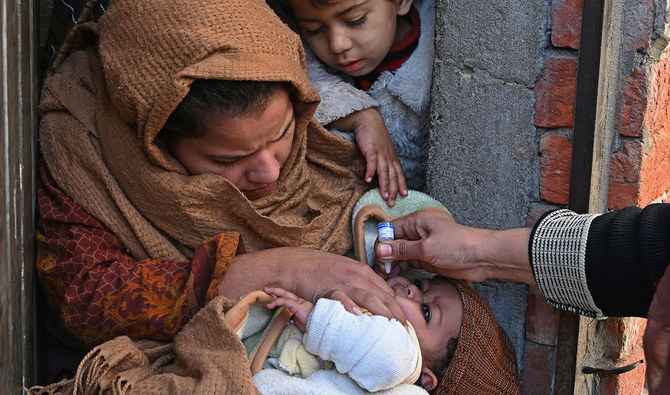
A health worker administers polio vaccine drops to a child during a vaccination campaign in Lahore on January 16, 2023. (AFP/FILE)
Short Url
Updated 25 January 2023
Follow

Health authorities in Pakistan trace poliovirus in Lahore’s sewage sample back to Afghanistan

  • Officials call it ‘critical’ for parents in Lahore to get their children vaccinated in the upcoming anti-polio campaign
  • Pakistani authorities say the country cannot get rid of the crippling disease until its transmission ends in Afghanistan

ISLAMABAD: Pakistan’s health authorities said on Tuesday a wild poliovirus detected in an environmental sample in Lahore earlier this year had links with a poliovirus found in Nangahar, Afghanistan, last November.

The discovery was made by the country’s polio laboratory that works under the National Institute of Health in Islamabad.

Polio is a highly infectious disease that mainly affects children under the age of five years by invading their nervous system. The illness cannot be cured and results in paralysis or even causes death.

Polio has been eradicated across the world, though Pakistan and Afghanistan remain the only two countries where it is still endemic.

“While the isolation of the virus is a cause of concern, it is excellent to note that it was detected promptly,” said the country’s health minister Abdul Qadir Patel in a statement while pointing out that Pakistan and Afghanistan were together in their fight against the disease.

“This timely detection of the virus in the environment is crucial to protecting children from being paralyzed by the poliovirus,” he continued.

A nationwide immunization campaign which concluded last week vaccinated children in the Lahore division. The authorities have also planned additional campaigns in February and March to prevent any possible disease outbreak.

“It is critically important that parents and caregivers, particularly in Lahore, ensure that their child is vaccinated in the February round,” said the minister.

Commenting on the polio laboratory’s finding, Dr. Shahzad Baig, coordinator of the National Emergency Operations Center, said it was not surprising since Pakistan and Afghanistan were taken as a single epidemiological block in which polioviruses moved across border due to widespread population movement.

“In the past year, we have worked very closely with the Afghanistan program and treat the virus in both countries as our own,” he said. “Neither Pakistan nor Afghanistan can be free of polio until both countries interrupt its transmission.”

Baig said the only way to stop the virus was to vaccinate all children under the age of five.

The last polio case was recorded in Lahore in July 2020, though the virus was periodically detected in its sewage water. Last year, four environmental samples were found positive for wild poliovirus in Lahore district.


Pakistan to play India in T20 World Cup, government says

Updated 09 February 2026
Follow

Pakistan to play India in T20 World Cup, government says

  • Islamabad announced boycotting the Feb. 15 match in Colombo to protest the ICC’s exclusion of Bangladesh from the T20 World Cup
  • Pakistan’s government says the decision to play India is taken to protect ‘spirit of cricket and to support the continuity of global sport’

ISLAMABAD: Pakistan Prime Minister Shehbaz Sharif has cleared the country’s cricket team to play India in the T20 World Cup on Feb. 15, the Pakistani government announced late Monday, ending a week-long standoff.

Islamabad announced boycotting the Feb. 15 match in Colombo to protest the International Cricket Council’s (ICC) exclusion of Bangladesh from the T20 World Cup, following Dhaka’s decision to not play matches in India owing to security fears.

On Sunday, ICC Deputy Chairman Imran Khwaja arrived in Lahore for talks with Pakistan Cricket Board (PCB) officials and Bangladesh Cricket Board (BCB) President Aminul Islam as the sport’s governing body strived to save the high-stakes T20 World Cup encounter.

PCB Chairman Mohsin Naqvi met PM Sharif late Monday and briefed him regarding the outcomes of high-level deliberations held between the PCB, Bangladesh board and ICC representatives, the Pakistani government said on X.

“The Government of Pakistan has reviewed the formal requests extended to the PCB by the Bangladesh Cricket Board, as well as the supporting communications from Sri Lanka, the United Arab Emirates, and other member nations. These correspondences sought Pakistan’s leadership in securing a viable solution to recent challenges,” the Pakistani government said.

“In view of the outcomes achieved in multilateral discussions, as well as the request of friendly countries, the Government of Pakistan hereby directs the Pakistan National Cricket Team to take the field on February 15, 2026, for its scheduled fixture in the ICC Men’s T20 World Cup.”

The BCB earlier thanked the PCB, ICC and all others for their positive roles in trying to “overcome recent challenges,” particularly thanking PCB Chairman Naqvi and Pakistani cricket fans for demonstrating “exemplary sportsmanship and solidarity.”

“We are deeply moved by Pakistan’s efforts to go above and beyond in supporting Bangladesh during this period. Long may our brotherhood flourish,” BCB President Islam said in a statement.

“Following my short visit to Pakistan yesterday and given the forthcoming outcomes of our discussions, I request Pakistan to play the ICC T20 World Cup game on 15 February against India for the benefit of the entire cricket ecosystem.”

The dispute stemmed from the ICC’s decision to replace Bangladesh with Scotland last month after Bangladesh refused to play tournament matches in India. Dhaka’s decision followed the removal of Mustafizur Rahman from the Indian Premier League (IPL). He was bought for $1 million by the IPL’s Kolkata Knight Riders, but on Jan. 3 the Board of Control for Cricket in India (BCCI) ordered Kolkata to release Mustafizur without a public explanation but amid regional tensions.

Pakistani cricket authorities subsequently announced boycotting the match against India at R. Premadasa Stadium in Colombo on Feb. 15. An India-Pakistan fixture is the sport’s most lucrative asset, generating a massive share of global broadcasting and sponsorship revenue.

“This decision [to play India in T20 World Cup] has been taken with the aim of protecting the spirit of cricket, and to support the continuity of this global sport in all participating nations,” the Pakistani government said.

“We remain confident that our team will carry the spirit of sportsmanship and national pride onto the field as they compete for global glory.”