


DAVOS: Magnom Properties and Forbes announced at the World Economic Forum in Davos, Switzerland, joint plans to build an innovative, environmentally responsive tower in the heart of the New Administrative Capital in Cairo, Egypt.
The Forbes International Tower, proposed by Adrian Smith + Gordon Gill Architecture, marks the start of a new era of building design as Magnom Properties, a subsidiary of Rawabi Holding, pursues a zero-carbon strategy in collaboration with Forbes, according to a press statement by Magnom.
The partnership, which marks the first time that Forbes has branded a commercial tower, was announced on the concluding day of WEF 2023.
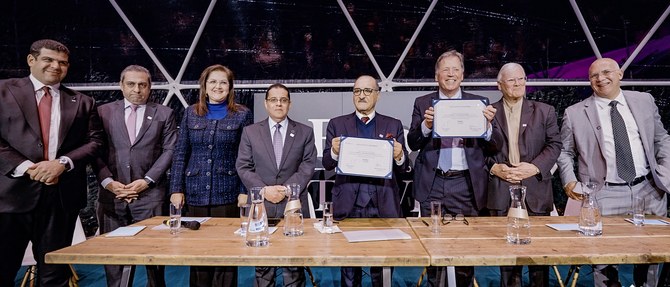
A memorandum of understanding to develop the project was co-signed at the Dome by Abdulaziz Al-Turki, group chairman of Rawabi Holding and chairman of Magnom Properties, and Forbes CEO Mike Federle.
The signing was attended by Othman A. Ibrahim, CEO of Rawabi Holding, vice chairman of its board of directors and vice chairman of Magnom Properties; Maged Marie, CEO, Magnom Properties; and architects Adrian Smith and Gordon Gill.
The partnership agreement comes as a global study has stressed the importance of real estate in the Middle East as a core driver of economic growth and investment of choice buoyed by strong demand fundamentals, high gross domestic product growth, and diversification strategies in the non-oil sector.
“We are excited to partner with Magnom Properties to work with the world-renowned architect, Adrian Smith, and build the first sustainable international tower under the Forbes name,” said Federle.
“Forbes continues to create impact around the world, whether it be our trusted brand of journalism, summits to promote women’s rights or the power of entrepreneurial capitalism, to endeavoring to build a cutting-edge and responsible tower where businesses can thrive in the heart of one of the most iconic cities in the world,” he added.
Commenting on the new partnership, Al-Turki said: “Cities play a critical role in our race to reach net zero and buildings, which are responsible for up to a third of greenhouse gas emissions globally, are a great opportunity to improve urban efficiency and build inclusive, resilient, and sustainable communities.
“A key pillar of Egypt’s ambitious Vision 2030 is urban development, and the launch of the Forbes International Tower, primed to achieve a Platinum LEED certification, reflects our vision of setting new standards in sustainability.”
Ibrahim said: “The launch of the project comes at a time when overall macroeconomic outlook in Egypt remains favorable and investments in (the Middle East and North Africa) are at an eight-year high, with studies projecting a 6.5 percent (compound annual growth rate) in real estate from 2022-2030 for the region, which is higher than the global market average.”
Marie added: “We are happy to announce the signing of our agreement with Forbes at WEF 2023, where constructive dialogues on issues of global importance are inspiring action to shape a better future for all.
“We are partnering with some of the best brands in the world to harness advanced technologies and deliver a carbon-neutral development that represents the best in architectural design, green building standards, and sustainable engineering and specification.”
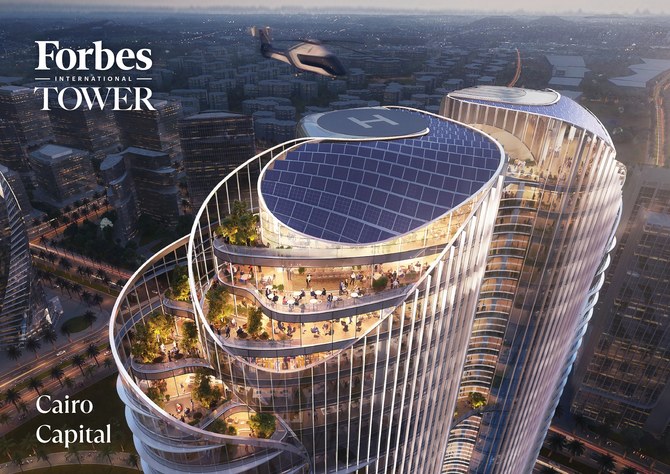
Architect Smith explained that the “futuristic Forbes International Tower has a contextually responsive soaring glass, steel, and photovoltaic-laced design.
“The tower features captivating curves of glass and steel that launch skyward to form 55 floors of flexible office space and two stories of high-end retail experiences.”
Located in the northern Central Business District of Cairo’s New Administrative Capital, the new tower harnesses the surrounding natural resources and improves energy performance standards with a solar panel rooftop, fully automated heating, ventilation and air conditioning field devices, and modern intelligent building technology. The biophilic designs assist in air circulation, bring nature indoors, and aim to enhance employee well-being.
Gill added: “Marked by a conscious commitment to exploring low carbon pathways, the Forbes International Tower adheres to the highest standards of green building principles and will utilize several advanced technologies in partnership with leading global partners to drive energy efficiency and reduce emissions. More details will be released in due course.”
Peter Hung, president, licensing and branded ventures, Forbes, said: “Having launched Forbes Global Properties, our first real estate brokerage business, three years ago, we are taking an important step forward in our real estate plans with the development of Forbes International Tower, the first commercial building in the world with the Forbes brand.”


