

Saudi’s Ministry and WEF innovation platform UpLink team up to address food insecurity

It is the first of two challenges related to food systems, the second of which, focusing on climate-smart agriculture, will be launched later this year. (Supplied/File)
Short Url
Updated 19 January 2023
Follow

Saudi’s Ministry and WEF innovation platform UpLink team up to address food insecurity

  • The Food Ecosystems and Arid Climates Challenge calls on entrepreneurs to help solve food issues in regions with arid climates
  • The winners will receive $109,000 to help scale up and implement their ventures, and benefit from a profile boost and increased networking opportunities

LONDON: Saudi Arabia’s Ministry of Economy and Planning has launched an innovation challenge focusing on global food security issues.

The Food Ecosystems and Arid Climates Challenge has been organized in partnership with UpLink, the World Economic Forum’s innovation platform, which aims to connect entrepreneurs with investors and other collaborators.

Organizers said the challenge invites industry players to tackle problems through collaboration and cooperation, with the aim of crowdsourcing transformative solutions designed to enhance food security in countries affected by low rainfall, drought and desertification.

“Our world faces a wide range of major socioeconomic challenges and food security is at the top of the list,” said Faisal F. Alibrahim, the Saudi minister of economy and planning.

“The Kingdom of Saudi Arabia is fully committed to being a major innovation accelerator, and dedicating resources to empower and support entrepreneurs who are determined to tackle the challenge of food security, in this case in regions with arid climates.”

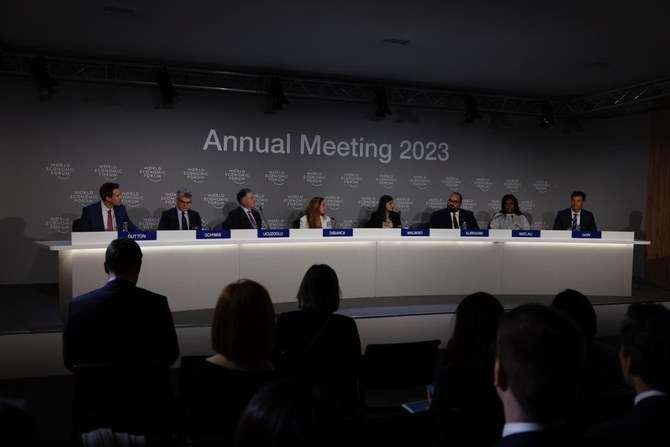
The initiative was unveiled on Thursday during the WEF’s annual meeting in Davos, Switzerland, with a call for food industry entrepreneurs, start-ups, social ventures, and small and medium-sized enterprises to submit their proposals.

The winners of the challenge will receive 100,000 Swiss francs ($109,000) to invest in scaling up and implementing their ventures in arid regions, and also benefit from increased visibility and access to networking opportunities.

According to UN’s World Food Program, 828 million people worldwide face hunger, 2.3 billion are considered food insecure, and 3.1 billion cannot afford a healthy diet. It is estimated that by 2030, water scarcity and droughts will have displaced 700 million people.

The collaboration between the Saudi ministry and UpLink aims to enhance food security and improve the supply of healthy and nutritious foods in regions that need them most, organizers said, to help achieve the UN Sustainable Development Goal of zero hunger by 2030.

It is the first of two challenges related to food systems, the second of which, focusing on climate-smart agriculture, will be launched later this year.


KAIA records busiest week with new operational records

Updated 7 sec ago
Follow

KAIA records busiest week with new operational records

JEDDAH: King Abdulaziz International Airport started 2026 on a strong note, handling 5.45 million passengers in January, a 7.3 percent increase over the same month last year.

Flight movements reached 29,200, up 11 percent, while total baggage throughput rose 8 percent to 6.6 million items.

The airport recorded its busiest operational week from Jan. 11 to 17, serving 1.28 million travelers.

Passenger numbers peaked on Jan. 17, marking the airport’s busiest day ever with 195,300 travelers and 1,089 flights, underscoring the efficiency of its operations and the capacity of its infrastructure to accommodate growing travel demand.

These results reflect Jeddah Airports Co.’s ongoing efforts to enhance the passenger experience, expand travel options, and manage rising air traffic in line with the National Aviation Program and Saudi Vision 2030.

Since its establishment in 2022, the company, known as JEDCO, has overseen the management and operations of KAIA, driving the implementation of the Aviation Program under the National Transport and Logistics Strategy.

In 2025, the airport reached a historic milestone, welcoming 53.4 million passengers, the highest annual total ever recorded at a Saudi airport, placing it among the world’s mega airports in terms of traffic.

The airport handled a total of 310,000 flights and 60.4 million bags, representing a 12 percent increase compared to 2024. It also handled 9.57 million Zamzam water containers and 2,968 cargo flights.

This achievement reflects the airport’s qualitative transformation and its position as a regional hub and national gateway connecting the Kingdom to the world. It also highlights its role in facilitating the movement of visitors and pilgrims, promoting tourism in line with the goals of Vision 2030, diversifying the economy, and providing a distinguished travel experience.

The January milestone at KAIA is part of a broader success story for Saudi airports, with 2025 statistics showing unprecedented growth in the Kingdom’s air traffic, surpassing regional averages and cementing Saudi Arabia’s status as one of the world’s fastest-growing and most advanced aviation markets.

Passenger numbers rose 9.6 percent, fueled by tourism, international events, and expanding global connectivity.

This growth reflected both increased capacity and enhanced connectivity, with Saudi airports handling approximately 140.9 million passengers, 76 million international and 65 million domestic passengers. Flight movements rose 8.3 percent to around 980,400, highlighting the sector’s sustained recovery.

KAIA accounted for 38 percent of total passenger traffic, averaging 146,000 passengers daily and operating at 107 percent of capacity. King Khalid International Airport handled 29 percent of passengers, with a daily average of 112,000. Madinah and Dammam airports also recorded historic surges, operating at 137 percent and 112 percent of capacity, respectively.