

Power returns to cities in Pakistan day after massive outage

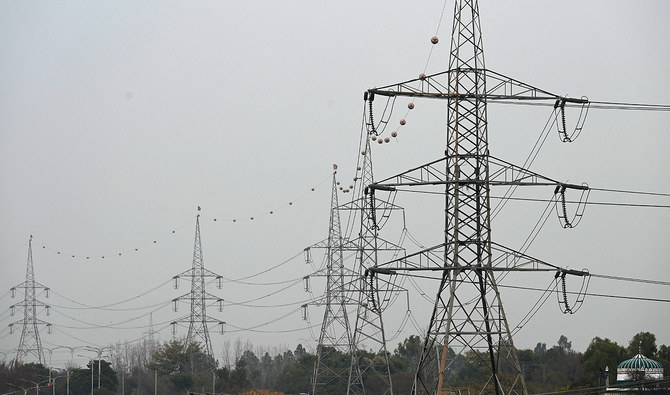
A general view of the high voltage lines during a nationwide power outage in Rawalpindi on January 23, 2023. (Photo courtesy: AFP)
Short Url
Updated 24 January 2023
Follow

Power returns to cities in Pakistan day after massive outage

  • The outage started around 7:30am on Monday, a failure linked to a cost-cutting measure
  • Power largely returned to mega cities overnight, with localized and brief falls in connection

ISLAMABAD: Power had returned to most cities across Pakistan on Tuesday, a day after a nationwide breakdown left the country of 220 million people without electricity.

The outage started around 7:30 am (0230 GMT) on Monday, a failure linked to a cost-cutting measure as Pakistan grapples with an economic crisis.

Energy Minister Khurram Dastgir Khan said on Monday evening that power was being gradually restored.

Electricity largely returned to mega cities Karachi and Lahore overnight, but with localized and brief falls in connection continuing.

The capital Islamabad and other cities, including Rawalpindi, Quetta, Peshawar and Gujranwala, also reported that the lights were back on.

However, some rural areas were still waiting to be reconnected.

The country’s power system is a complex and delicate web, where problems can quickly cascade.

Khan said a variation in frequency on the national grid caused the cut, as power generation units were turned on early Monday morning.

The units are temporarily switched off on winter nights to save fuel, he had told reporters earlier.

Localized power cuts are common in Pakistan, and hospitals, factories and government institutions are often kept running by private generators. But the machines are beyond the means of most citizens and small businesses.

In parts of northern Pakistan, temperatures were due to drop below freezing overnight with supplies of natural gas — the most common heating method — also unreliable due to load-shedding.

The economy is already hobbled by rampant inflation, a falling rupee and severely low foreign exchange reserves, with the power cut piling extra pressure on small businesses.

In the garrison city of Rawalpindi, homeware trader Muhammad Iftikhar Sheikh, 71, said he was unable to demonstrate electronic products to browsing patrons.

“The customers never buy without testing first,” he said. “All of us are sitting idle.”

Schools mostly continued either in the dark or using battery-powered lighting.

A shop owner in the southern port city Karachi, where temperatures were higher, told AFP he feared his entire dairy stock would spoil without refrigeration.

Printer Khurrum Khan, 39, said orders were piling up because of the blackout.

Unreliable power is “a permanent curse which our governments have failed to overcome,” he said.

Mobile phone services were also disrupted as a result of the outage, the Pakistan Telecommunication Authority tweeted.

A similar breakdown in January 2021 affected the entire country, after a fault occurred in southern Pakistan, tripping the national transmission system.


Over 200 security forces personnel killed in Balochistan militant attacks in 2025— chief minister

Updated 7 sec ago
Follow

Over 200 security forces personnel killed in Balochistan militant attacks in 2025— chief minister

  • Pakistani security forces launched thousands of operations, killed 760 militants, says Sarfraz Bugti
  • Pakistan’s military media wing says 12 “Indian-sponsored militants” killed in Balochistan’s Kalat district

ISLAMABAD: Over 200 security forces personnel were killed in several militant attacks in Pakistan’s southwestern Balochistan province this year, Chief Minister Sarfraz Bugti said on Sunday. 

Balochistan, Pakistan’s largest province by since yet its most backward by almost all social and economic indicators, has suffered from a bloody separatist insurgency for decades launched by ethnic Baloch militant groups. The most prominent among them is the Balochistan Liberation Army.

These militant outfits accuse the military and federal government of denying the local Baloch population a share in the province’s mineral wealth, charges Islamabad denies. 

“We have lost [in one year] 205 security forces personnel, including paramilitary, uniformed, police, levies, and along with that, there are six officers,” Bugti told reporters during a press conference. 

The chief minister said Balochistan had witnessed 900 militant attacks throughout the year, adding that the number of civilian casualties was recorded at 280. 

Bugti said security forces had also launched thousands of intelligence-based operations in 2025 against militants. 

“Out of those, the terrorists who have been killed so far, that is 760,” he said. 

TWELVE MILITANTS KILLED IN KALAT 

Separately, the Pakistani military’s media wing said on Sunday that security forces had killed 12 “Indian-sponsored militants” in Balochistan’s Kalat district on Dec. 6. 

It said the militants belonged to Indian proxy “Fitna al Hindustan,” a term the military uses frequently to describe ethnic Baloch militant groups who demand independence from Pakistan. Islamabad accuses New Delhi of arming and funding these separatist groups, charges India has always denied.

“Weapons, ammunition and explosives were also recovered from the terrorists, who remained actively involved in numerous terrorist activities in the area,” the ISPR said. 

Balochistan, which borders Afghanistan, has seen a surge in militant attacks in recent months. Pakistan’s military said on Saturday that security forces had killed five militants in the Dera Bugti area of the province.