

Britain imposes new Iranian sanctions over ‘brutal repression’

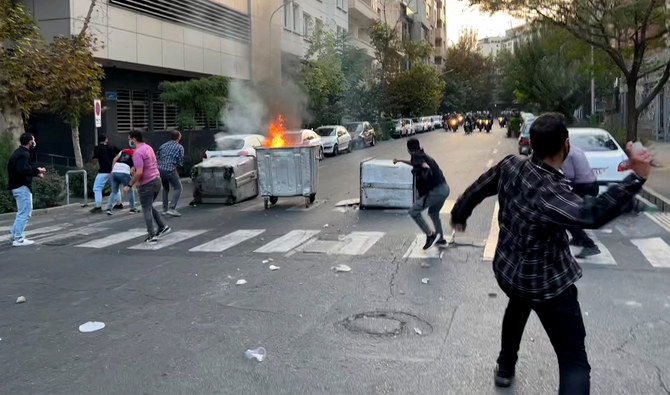
A file picture obtained by AFP outside Iran shows a bin burning in the middle of an intersection during a protest for Mahsa Amini, a woman who reportedly died after being arrested by the Islamic republic's "morality police", in Tehran on September 20, 2022. (AFP/File)
Short Url
Updated 23 January 2023
Follow

Britain imposes new Iranian sanctions over ‘brutal repression’

  • EU introduces new sanctions against Iran for “brutal and disproportionate use of force” against protesters
  • Britain has imposed 50 new sanctions against Iran since death of Mahsa Amini which sparked protests

LONDON: Britain sanctioned more Iranian individuals and entities on Monday over the country’s “brutal repression” of its people, including a crackdown on anti-government protests and the recent execution of British-Iranian dual national Alireza Akbari.

The sanctions included an asset freeze on Iranian deputy prosecutor general Ahmad Fazelian, who the British foreign office said was responsible for an unfair judicial system that used the death penalty for political purposes.

“Those sanctioned today, from the judicial figures using the death penalty for political ends to the thugs beating protesters on the streets, are at the heart of the regime’s brutal repression of the Iranian people,” British foreign minister James Cleverly said in a statement.

“The UK and our partners have sent a clear message through these sanctions that there will be no hiding place for those guilty of the worst human rights violations.”

The European Union also introduced new sanctions against Iran on Monday for a “brutal and disproportionate use of force” against protesters.

Widespread anti-government demonstrations erupted in Iran in September after the death in custody of Kurdish Iranian woman Mahsa Amini, who had been detained by morality police enforcing the Islamic Republic’s mandatory dress code for women.

Others sanctioned by Britain on Monday include Kiyumars Heidari, commander in chief of Iran’s ground forces; Hossein Nejat, deputy commander of the Islamic Revolutionary Guard Corps (IRGC); and the Basij Resistance Force and its deputy commander, Salar Abnoush.

The IRGC has an estimated 125,000-strong military with army, navy and air units, and commands the Basij religious militia often used in crackdowns.

The Basij Cooperative Foundation, linked to the Basij militia, and Qasem Rezaei, deputy commander of Iran’s law enforcement forces, were also sanctioned.

Britain has now imposed 50 new sanctions against Iran since Amini’s death, the foreign office said.


Morocco flood evacuees still shaken, waiting to return home

Updated 4 sec ago
Follow

Morocco flood evacuees still shaken, waiting to return home

  • More than 150,000 people have been evacuated over the past week as heavy rainfall battered provinces in Morocco’s north
  • Authorities have set up a vast camp of small blue tents sheltering nearly 40,000 people 50km north of Rabat
KENITRA, Morocco: It was through a call from her local mosque’s loudspeakers that Kasia El Selami learnt it was time to flee as floodwaters rose in her Moroccan village of Ouled Ameur.
Selami is among more than 150,000 people to have been evacuated over the past week as heavy rainfall battered provinces in Morocco’s north.
“We felt immense fear... especially for our children,” said the 67-year-old while hanging a blanket by the tent in which she now lives.
Some residents, including children and elderly people, were seen stranded on rooftops before being rescued, at times with small boats.
Others were rescued by helicopter as floodwaters inundated roads and farmland in several areas.
Near Kenitra, some 50 kilometers north of Rabat, authorities have set up a vast camp of small blue tents sheltering nearly 40,000 people, including Selami and her children.
At the camp, evacuees make do with little while waiting to be able to return home.
One woman scrubbed laundry in a small basin just a few meters away from an enclosure where evacuated cows, horses, chickens and sheep were penned.
Nearby, sick or lightly injured men and women queued outside a mobile clinic.

‘Terrified’

Despite the relative quiet, Ali Al Aouni said these were “very difficult days.”
The 60-year-old complained about the cold and anxiety, adding that his children were still “terrified” after what had happened.
“The water level got about a meter and a half high” in his village, he recalled. “We’re afraid to go home if the flood comes back.”
Aouni said his eldest son stayed behind to watch over their property, updating him over the phone that the water kept rising.
Not far away, the civil defense was handing out mattresses, warm clothing and food to the rescued families.
These came “in addition to health care and veterinary check-ups for livestock,” Adil Al-Khatabi, an official, told AFP.
Selami is already thinking about going home.
“We’re waiting for this ordeal to end as soon as possible, so we can return to our homes,” she said.
Last December 37 people were killed in sudden floods in Safi, in Morocco’s deadliest weather-related disaster in the past decade.
In recent weeks, severe weather and flooding in neighboring Algeria killed two people, including a child.
In Tunisia, at least five people died, while others were still missing after the country experienced its heaviest rainfall in over 70 years last month.
And further north, Portugal and Spain have also endured storms and torrential rains in recent days.