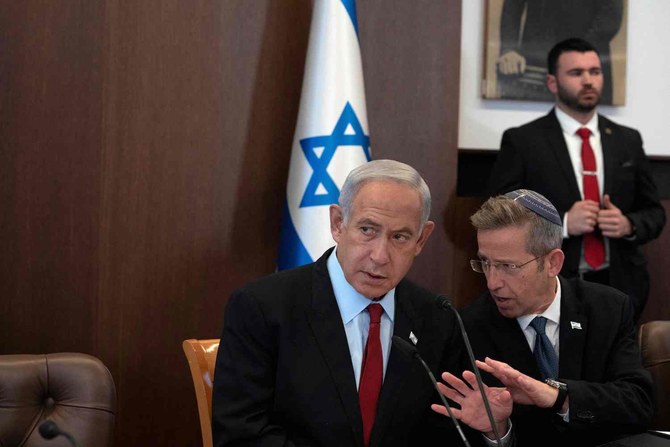
JERUSALEM: Israeli Prime Minister Benjamin Netanyahu dismissed a senior cabinet member with a criminal record on Sunday, complying with a Supreme Court ruling even as he pursues contested judicial reforms that would curb its powers.
Pledging to find “every legal means” of keeping Aryeh Deri in public office in future, Netanyahu told him during a weekly cabinet session he was being removed from the interior and health ministries, according to an official transcript.
A Deri confidant, Barak Seri, told Army Radio earlier on Sunday that the portfolios would be kept by other members of the ultra-Orthodox Jewish party Shas as it remains in the coalition.
The Supreme Court last week ordered Netanyahu to dismiss Deri, citing his 2022 plea-bargain conviction for tax fraud.
That ruling stoked a stormy debate in Israel — accompanied by nationwide protests — over reform proposals that Netanyahu says will restore balance between the branches of government but that critics say will undermine judicial independence.
A poll in Israel Hayom newspaper found 35 percent support for Netanyahu’s bid to shake up the system for bench appointments, with 45 percent of respondents opposed. There was just 26 percent support for his government’s bid to enable parliament, with a one-vote majority, to override some Supreme Court decisions.
In his cabinet statement, Netanyahu described the Deri ruling as “regrettable” and “indifferent to the public will.”
Settler outpost
The less than month-old religious-nationalist coalition creaked elsewhere as a far-right partner boycotted the cabinet session in protest at the demolition on Friday of a small settler outpost that had been erected in the occupied West Bank.
Israeli Defense Minister Yoav Galant, a member of Netanyahu’s conservative Likud party, ordered the outpost to be razed as it had no building permit — over the objections of the Religious Zionist party, which had sought to delay the decision.
The incident pitted Galant against Religious Zionism leader Bezalel Smotrich, who wields some cabinet responsibilities for West Bank settlements under a coalition deal with Netanyahu.
A group of settlers tried on Sunday to rebuild the outpost but they were blocked by Israeli security forces. Seven people were detained, said a border police spokesman.
“This (settlements) is a capstone issue for our participation in the government,” National Missions Minister Orit Strock of Religious Zionism told Israel’s Kan radio. She declined to elaborate on what steps the party might take next.
In solidarity with Religious Zionism, fellow far-right coalition party Jewish Power said it would demand that Israel implement a long-delayed evacuation of Khan Al-Ahmar, a Bedouin Palestinian encampment in a key West Bank area near Jerusalem.
World powers have urged Israel not to demolish Khan Al-Ahmar, worrying about another potential blow to efforts to negotiate the creation of Palestinian state alongside Israel. Most countries deem Israel’s West Bank settlements illegal.


![]()

Israel PM Netanyahu fires minister in compliance with Supreme Court order
Short Url
https://arab.news/bn4q9
Israel PM Netanyahu fires minister in compliance with Supreme Court order
- The Supreme Court last week ordered Netanyahu to dismiss Deri, citing his 2022 plea-bargain conviction for tax fraud
- World powers have urged Israel not to demolish Khan Al-Ahmar, worrying about another potential blow to efforts to negotiate the creation of Palestinian state alongside Israel


Latest updates


© 2026 SAUDI RESEARCH & PUBLISHING COMPANY, All Rights Reserved And subject to Terms of Use Agreement.