

Sahara celebrates desert cultures at Chad festival

1 / 4
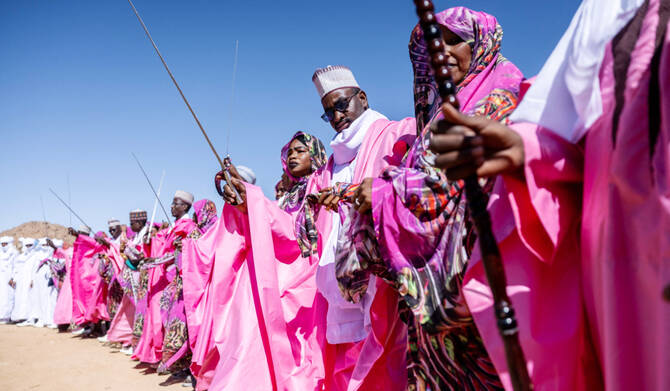
Chadian dancers perform at the International Festival of Saharan Cultures in Amdjarass, Ennedi-Est, Chad, on February 7, 2026. (AFP)
2 / 4
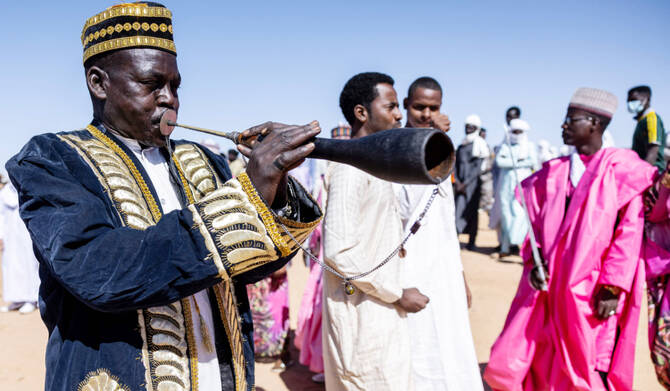
A chadian musician performs at the International Festival of Saharan Cultures in Amdjarass, Ennedi-Est, Chad, on February 7, 2026. (AFP)
3 / 4
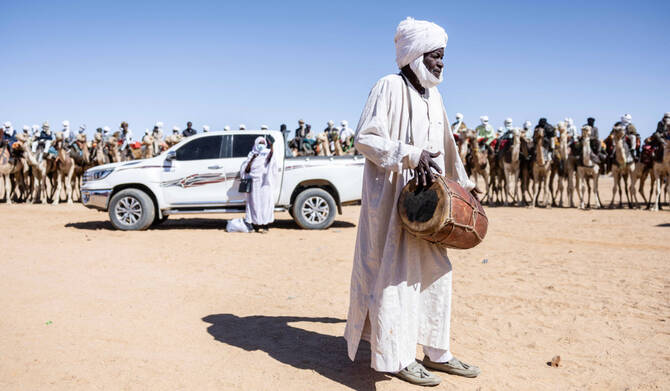
A chadian musician performs at the International Festival of Saharan Cultures in Amdjarass, Ennedi-Est, Chad, on February 7, 2026. (AFP)
4 / 4
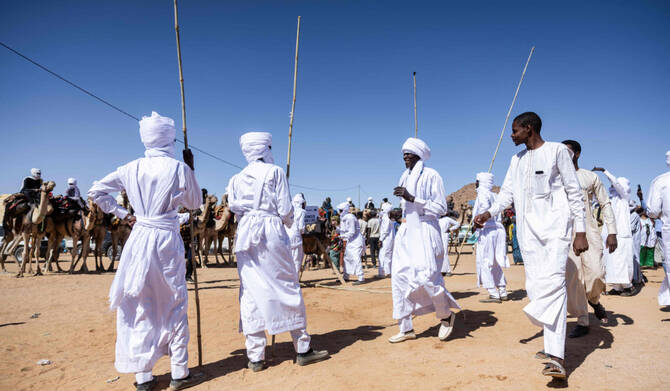
Chadian dancers perform at the International Festival of Saharan Cultures in Amdjarass, Ennedi-Est, Chad, on February 7, 2026. (AFP)
Short Url
Updated 10 February 2026
Follow

Sahara celebrates desert cultures at Chad festival

  • Amdjarass, which is home to several nomadic peoples, is located in far northeast of Chad, a vast, sparsely populated region renowned for its dramatic rock formations and desert landscapes

AMDJARASS, Chad: In the heart of the Sahara, where the routes to Sudan and Libya cross, the Chadian city of Amdjarass has been transformed this week into an open-air celebration of desert culture.
Until Friday, Amdjarass hosts dance troupes, musicians, traditional storytellers, craftspeople, cooks and nomadic camel drivers from across the vast region.
Niger, the guest of honor at the sixth Amdjarass International Festival of Saharan Cultures (FICSA), hailed the event as a way to foster peace in a region beset by conflict and climate change.
“In a world rife with tensions, crises and misunderstandings, culture remains a space for encounter and dialogue, enabling us to understand and respect each other and build together,” Niger’s crafts and tourism minister Aghaichata Guichene Atta told the opening ceremony on Saturday.
“Our countries have everything to gain by joining forces to make culture a tool for peace, development and employment,” she said, to cheers from the crowd.
Atta highlighted the role of Saharan women in keeping desert cultures alive down the centuries.
In a shapeshifting region where traditions are seldom archived on paper, the women “carry the living memory of Saharan societies through their songs, their stories, their hands that weave, shape, cook and educate.”
Amdjarass, which is home to several nomadic peoples, is located in far northeast of Chad, a vast, sparsely populated region renowned for its dramatic rock formations and desert landscapes.
The once dusty village, now a grid-shaped city, derives its name from “djarass,” the Arabic word for bell, in reference to a strange white rock that rings in the wind and was once used to warn locals of raids by rival tribes.

- Spark interest in the desert -

Local Issak Bassam, 27, said he was delighted the festival had returned to his hometown after a break of seven years due to the covid pandemic, the change of president in 2021 and organizational problems.
“I haven’t got the money to travel so this festival is a way for me to meet people from different horizons and celebrate Saharan culture in all its diversity,” he told AFP.
Amdjarass was the stronghold of late president Idriss Deby Itno, who hailed from the area and ruled Chad for 30 years until he was killed during clashes with rebels and his son was handed the reins of power.
For current Prime Minister Allah Maye Halina and festival founder Issouf Elli Moussami, FICSA is not just an excuse for a week-long outdoor party.
It is also a lever for encouraging tourism into an area far off the beaten track.
Guitarist Omar “Bombino” Moctar from Niger, who played his blend of Tuareg blues-rock to a crowd gathered under the desert stars, said he hoped the festival would spark the world’s interest in a region about which it knows little.
“Through my music, I want to share happiness with all the peoples of the desert, bring them together and explain to the whole world the dangers we face,” he said.


Egyptian woman faces death threats for filming alleged harasser

Updated 13 February 2026
Follow

Egyptian woman faces death threats for filming alleged harasser

  • Case revives longstanding national debate in Egypt over harassment and violence against women
  • A 2013 UN study found that 99.3 percent of Egyptian women reported experiencing harassment

CAIRO: A young Egyptian woman is facing death threats after posting a video showing the face of a man she says repeatedly harassed her, reviving debate over how victims are treated in the country.
Mariam Shawky, an actress in her twenties, filmed the man aboard a crowded Cairo bus earlier this week, accusing him of stalking and harassing her near her workplace on multiple occasions.
“This time, he followed me on the bus,” Shawky, who has been dubbed “the bus girl” by local media, said in a clip posted on TikTok.
“He kept harassing me,” added the woman, who did not respond to an AFP request for comment.
Hoping other passengers would intervene, Shawky instead found herself isolated. The video shows several men at the back of the bus staring at her coldly as she confronts her alleged harasser.
The man mocks her appearance, calls her “trash,” questions her clothing and moves toward her in what appears to be a threatening manner.
No one steps in to help. One male passenger, holding prayer beads, orders her to sit down and be quiet, while another gently restrains the man but does not defend Shawky.
Death threats
As the video spread across social media, the woman received a brief flurry of support, but it was quickly overwhelmed by a torrent of abuse.
Some high-profile public figures fueled the backlash.
Singer Hassan Shakosh suggested she had provoked the situation by wearing a piercing, saying it was “obvious what she was looking for.”
Online, the comments were more extreme. “I’ll be the first to kill you,” one user wrote. “If you were killed, no one would mourn you,” said another.
The case has revived a longstanding national debate in Egypt over harassment and violence against women.
A 2013 UN study found that 99.3 percent of Egyptian women reported experiencing harassment, with more than 80 percent saying they faced it regularly on public transport.
That same year, widespread protests against sexual violence rocked the Egyptian capital.
In 2014, a law criminalizing street harassment was passed. However, progress since then has been limited. Enforcement remains inconsistent and authorities have never released figures on the number of convictions.
Public concern spiked after previous high-profile incidents, including the 2022 killing of university student Nayera Ashraf, stabbed to death by a man whose advances she had rejected.
The perpetrator was executed, yet at the time “some asked for his release,” said prominent Egyptian feminist activist Nadeen Ashraf, whose social-media campaigning helped spark Egypt’s MeToo movement in 2020.
Denials
In the latest case, the authorities moved to act even though the bus company denied any incident had taken place in a statement later reissued by the Ministry of Transport.
The Interior Ministry said that the man seen in the video had been “identified and arrested” the day after the clip went viral.
Confronted with the footage, he denied both the harassment and ever having met the woman before, according to the ministry.
Local media reported he was later released on bail of 1,000 Egyptian pounds (around $20), before being detained again over a pre-existing loan case.
His lawyer has called for a psychiatric evaluation of Shawky, accusing her of damaging Egypt’s reputation.
These images tell “the whole world that there are harassers in Egypt and that Egyptian men encourage harassment, defend it and remain silent,” said lawyer Ali Fayez on Facebook.
Ashraf told AFP that the case revealed above all “a systemic and structural problem.”
She said such incidents were “never taken seriously” and that blame was almost always shifted onto women’s appearance.
“If the woman is veiled, they’ll say her clothes are tight. And if her hair is uncovered, they’ll look at her hair. And even if she wears a niqab, they’ll say she’s wearing makeup.”
“There will always be something.”