

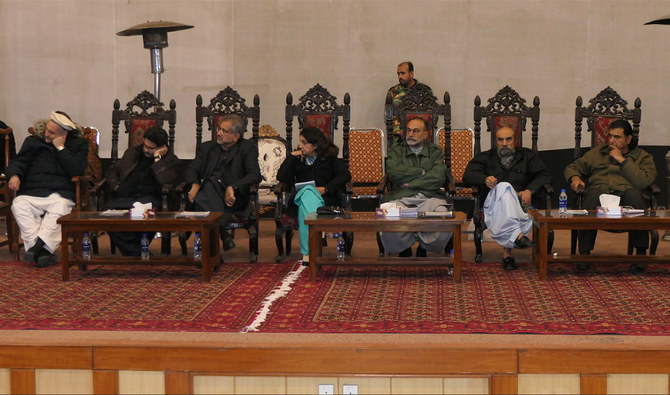

QUETTA: A group of dissident politicians belonging to the country’s ruling coalition kicked off a nationwide debate called “Reimagining Pakistan” on Saturday, taking up a wide range of issues for discussion while expressing regret they were not adequately addressed since independence.
The seminar series was announced on Twitter by Mustafa Nawaz Khokhar, who resigned his Senate seat last November after securing it as a candidate of the Pakistan Peoples Party. Khokhar invited lawyers, labor leaders, journalists and civil society representatives to become part of the dialogue while maintaining that the nation had to choose between “rotten thinking and piles of problems” and “the attempt to reimagine Pakistan and awaken hope” for its destiny.
His message was also reinforced by the country’s former finance minister Miftah Ismail who took tough decisions for the resumption of an International Monetary Fund (IMF) bailout program but was subsequently forced to step down by the government in September which replaced him with Ishaq Dar. Ismail also noted in a short social media video that people had been complaining about Pakistan’s problems and it was time to find solutions to them.
The first seminar in the series was held in the capital of the country’s impoverished Balochistan province which was also addressed by former prime minister Shahid Khaqan Abbasi and was billed as an effort to develop national consensus on issues related to education, health, law and economy.
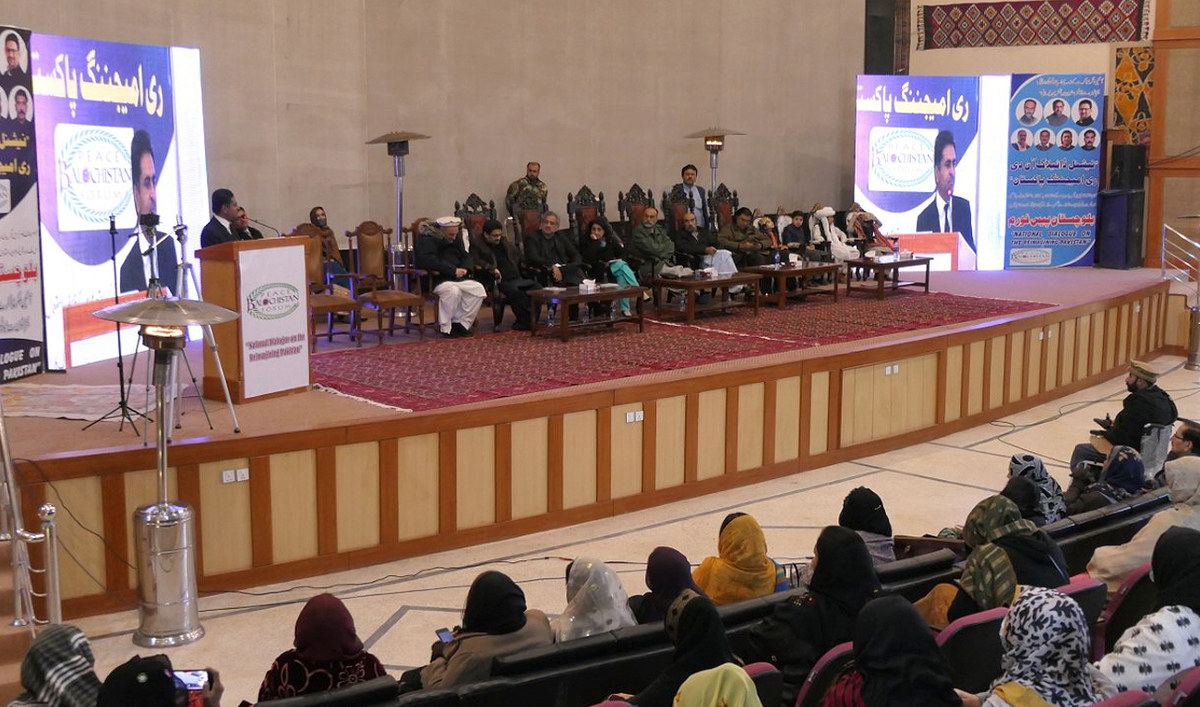
A senior lawyer is addressing a seminar, “Reimagining Pakistan,” in Quetta, Pakistan, on January 21, 2023. (AN Photo)
“I am very disappointed with the country’s political system which has failed to address public problems in the last seven decades,” Abbasi, a prominent member of the ruling Pakistan Muslim League-Nawaz (PML-N) party, told the gathering. “Under this forum, we will utilize our efforts to find solutions to various issues.”
He maintained that the ongoing politics in the country was not focusing on public issues but revolved around power struggle.
Asked about his differences with the top leadership of his political faction over the appointment of Maryam Nawaz Sharif as the PML-N vice president, Abbasi said it was the party’s decision and he was not planning to part ways from it.
At one point, he noted the country’s military had announced it was not going to interfere in politics any further while adding that the issue still remained a big cause of Pakistan’s current weaknesses and crises.
The initiative to launch the national debate over the country’s outstanding problems by the dissident politicians also led to media speculation that a new political party was about to be launched ahead of the general elections which are scheduled later this year.
Ismail, however, denied any such plan was in the offing while pointing out that he was still part of the PML-N party.
“I am not a family politician but a businessman and I don’t have to be part of the country’s electoral politics,” he told Arab News on the sidelines of the event. “I can do better for my country if I develop a national consensus … that Pakistan is not working for an overwhelming majority of people.”
“We don’t say that we have a roadmap and we know all the solutions,” he continued. “We are saying, let’s talk to ordinary Pakistanis and hear their issues because we understand their problems. We have started from Quetta and we will go all over the country and will bring all the Pakistanis together to find some solutions.”
Speaking to Arab News, Khokhar described the initiative to start the seminars as a “nonpartisan effort” to serve the country while saying he was planning to contest the next elections as an independent candidate from Islamabad and was not willing to join any political party at this stage.
“We have been doing nonpartisan efforts and people from other nationalist, religious and mainstream political parties have come around this forum and are beginning to talk about public issues which need to be resolved,” he said.
Expressing fears of an “imminent political breakdown,” he noted the country lacked political stability which was also required to deal with its ongoing ecomonic woes.
“We need long-term plans and major reforms, but sadly none of the political parties is talking about those reforms to save our economy,” he added.
Other participants of the gathering, mostly based in Quetta, discussed issues facing Balochistan, including Gwadar protests, enforced disappearances and decades-long insurgency waged by separatist groups against the state.


